

Immune checkpoint blockade (ICB) therapies represent a groundbreaking approach in oncology, offering the potential to harness the immune system to effectively target and eliminate cancer cells. While the clinical success of ICB therapies is evident, their efficacy varies significantly across different patients and cancer types, prompting a need for a deeper understanding of the underlying cellular mechanisms.
Deciphering Cell-Specific Responses with Single-Cell RNA-Sequencing
Single-cell RNA sequencing (scRNA-seq) has emerged as a pivotal technique for investigating cell-specific responses to ICB treatments. This method provides a high-resolution view of gene expression at the single-cell level, enabling researchers to dissect the heterogeneity within tumor microenvironments and identify specific cellular interactions that influence ICB efficacy. However, individual scRNA-seq studies often suffer from limited sample sizes and require advanced bioinformatics skills, hindering broader accessibility and comprehensive analysis.
A Comprehensive ScRNA-Seq Resource
In an effort to address these limitations, researchers at the University of Michigan, Ann Arbor have compiled a substantial dataset encompassing eight scRNA-seq studies from nine distinct cancer types. This dataset includes 223 patients, 90,270 cancer cells, and 265,671 other cell types, offering a broad spectrum of information on cellular responses to ICB. The compilation was meticulously curated, quality-checked, and pre-processed to ensure data integrity and usability.
Workflow for developing a dedicated resource centered on cancer cells in ICB studies using single-cell data
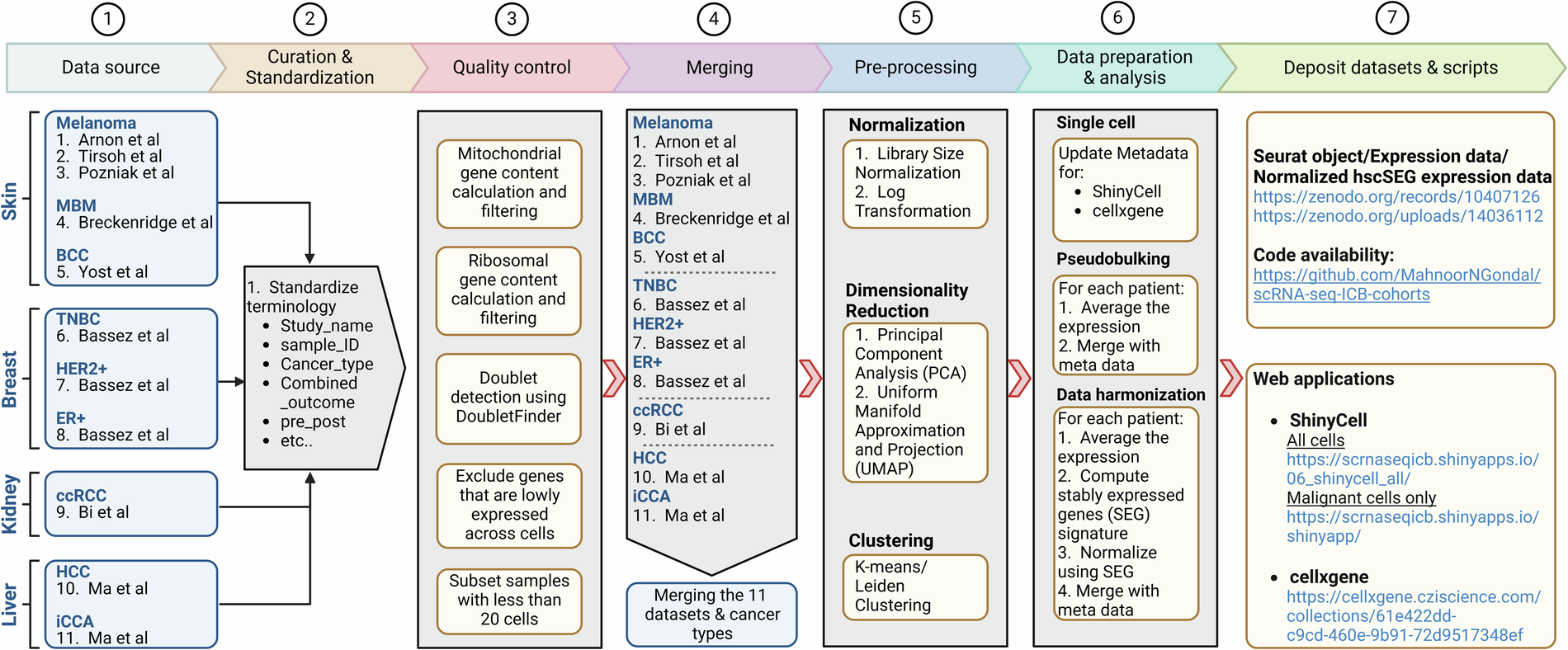
The steps include conducting a comprehensive literature review of scRNA-seq studies, standardizing dataset terminologies, implementing rigorous quality control and pre-processing measures, merging datasets for subsequent analysis, and depositing resultant datasets alongside associated R scripts to ensure easy accessibility.
User-Friendly Interface for Data Exploration
To facilitate seamless exploration of this extensive dataset, the researchers developed a user-friendly interface. This platform allows users to navigate and analyze the scRNA-seq data without the need for extensive coding expertise. By sharing both the code and data, the research team aims to democratize access to this valuable resource, enabling a wider range of scientists to investigate ICB responses across diverse cancer types.
Implications for Cancer Research and Treatment
The availability of this comprehensive scRNA-seq resource marks a significant advancement in the study of ICB therapies. Researchers can leverage this dataset to uncover critical insights into the mechanisms driving differential responses to ICB, ultimately contributing to the development of more personalized and effective cancer treatments. By providing a robust framework for analyzing cellular responses, this resource paves the way for future discoveries that could enhance the therapeutic potential of ICB therapies.
In summary, this extensive compilation of scRNA-seq data is a powerful tool that enhances our understanding of how cancer cells respond to immune checkpoint blockade therapies. It offers new opportunities for scientists to drive forward the field of cancer immunotherapy and improve patient outcomes.
Availability – https://cellxgene.cziscience.com/collections/61e422dd-c9cd-460e-9b91-72d9517348ef
Gondal MN, Cieslik M, Chinnaiyan AM. (2025) Integrated cancer cell-specific single-cell RNA-seq datasets of immune checkpoint blockade-treated patients. Sci Data [Epub ahead of print]. [article]
Related Posts






Immune checkpoint blockade (ICB) therapies represent a groundbreaking approach in oncology, offering the potential to harness the immune system to effectively target and eliminate cancer cells. While the clinical success of ICB therapies is evident, their efficacy varies significantly across different patients and cancer types, prompting a need for a deeper understanding of the underlying cellular mechanisms.
Deciphering Cell-Specific Responses with Single-Cell RNA-Sequencing
Single-cell RNA sequencing (scRNA-seq) has emerged as a pivotal technique for investigating cell-specific responses to ICB treatments. This method provides a high-resolution view of gene expression at the single-cell level, enabling researchers to dissect the heterogeneity within tumor microenvironments and identify specific cellular interactions that influence ICB efficacy. However, individual scRNA-seq studies often suffer from limited sample sizes and require advanced bioinformatics skills, hindering broader accessibility and comprehensive analysis.
A Comprehensive ScRNA-Seq Resource
In an effort to address these limitations, researchers at the University of Michigan, Ann Arbor have compiled a substantial dataset encompassing eight scRNA-seq studies from nine distinct cancer types. This dataset includes 223 patients, 90,270 cancer cells, and 265,671 other cell types, offering a broad spectrum of information on cellular responses to ICB. The compilation was meticulously curated, quality-checked, and pre-processed to ensure data integrity and usability.
Workflow for developing a dedicated resource centered on cancer cells in ICB studies using single-cell data
The steps include conducting a comprehensive literature review of scRNA-seq studies, standardizing dataset terminologies, implementing rigorous quality control and pre-processing measures, merging datasets for subsequent analysis, and depositing resultant datasets alongside associated R scripts to ensure easy accessibility.
User-Friendly Interface for Data Exploration
To facilitate seamless exploration of this extensive dataset, the researchers developed a user-friendly interface. This platform allows users to navigate and analyze the scRNA-seq data without the need for extensive coding expertise. By sharing both the code and data, the research team aims to democratize access to this valuable resource, enabling a wider range of scientists to investigate ICB responses across diverse cancer types.
Implications for Cancer Research and Treatment
The availability of this comprehensive scRNA-seq resource marks a significant advancement in the study of ICB therapies. Researchers can leverage this dataset to uncover critical insights into the mechanisms driving differential responses to ICB, ultimately contributing to the development of more personalized and effective cancer treatments. By providing a robust framework for analyzing cellular responses, this resource paves the way for future discoveries that could enhance the therapeutic potential of ICB therapies.
In summary, this extensive compilation of scRNA-seq data is a powerful tool that enhances our understanding of how cancer cells respond to immune checkpoint blockade therapies. It offers new opportunities for scientists to drive forward the field of cancer immunotherapy and improve patient outcomes.
Availability – https://cellxgene.cziscience.com/collections/61e422dd-c9cd-460e-9b91-72d9517348ef
Gondal MN, Cieslik M, Chinnaiyan AM. (2025) Integrated cancer cell-specific single-cell RNA-seq datasets of immune checkpoint blockade-treated patients. Sci Data [Epub ahead of print]. [article]
Related Posts
Recent Posts
 RNAmel simplifies RNA sequencing data analysis with a reproducible, integrated platform
 Heart failure reshapes bone marrow to create inflammation-related immune memory
 Overlooked DNA regions surrounding ‘microexons’ hold missing pieces of autism’s genetic puzzle
 RiboBA improves detection of hidden protein-coding regions using ribosome profiling
 An anti-senescence gene may fight spinal disc deterioration
 Bulk RNA-seq Analysis: A Complete Beginner’s Guide
RNA-Seq Products & Services


Stay Connected