
Researchers conducted a genome-wide analysis study to find novel genes and rare variants contributing to SSc risk.
Systemic sclerosis (SSc) is a severe autoimmune disease with complex genetic causes. Some genetic contributors have been identified, but others remain unknown, which has impeded development of targeted treatments. In a new study published in Annals of the Rheumatic Diseases, researchers at Baylor College of Medicine and collaborating institutions used complementary approaches that integrate exome sequencing and evolutionary action machine learning to identify protein changes and their associated mechanisms in SSc.
Previous genome-wide association studies (GWAS) that analyzed the frequency of common genetic variants show the strongest genetic contributors located in the human leucocyte antigen (HLA) region on chromosome six. In this study, researchers led by first author Dr. Shamika Ketkar performed GWAS using exome sequencing data from 2,559 SSc patient cases and 893 healthy control cases in the Scleroderma Family Registry and DNA Repository at the University of Texas Health Science Center at Houston. They aimed to find novel genes and rare variants contributing to SSc risk.
“What truly surprised and excited us was the discovery and replication of MICB, a gene located within the HLA region but acting independently of the classical HLA genes. MICB had not previously been implicated in systemic sclerosis, and its identification represents a novel genetic contributor and a potential therapeutic target,” said Ketkar, assistant professor of molecular and human genetics at Baylor.
Integrated WES/RNA-seq assay from the same tissue
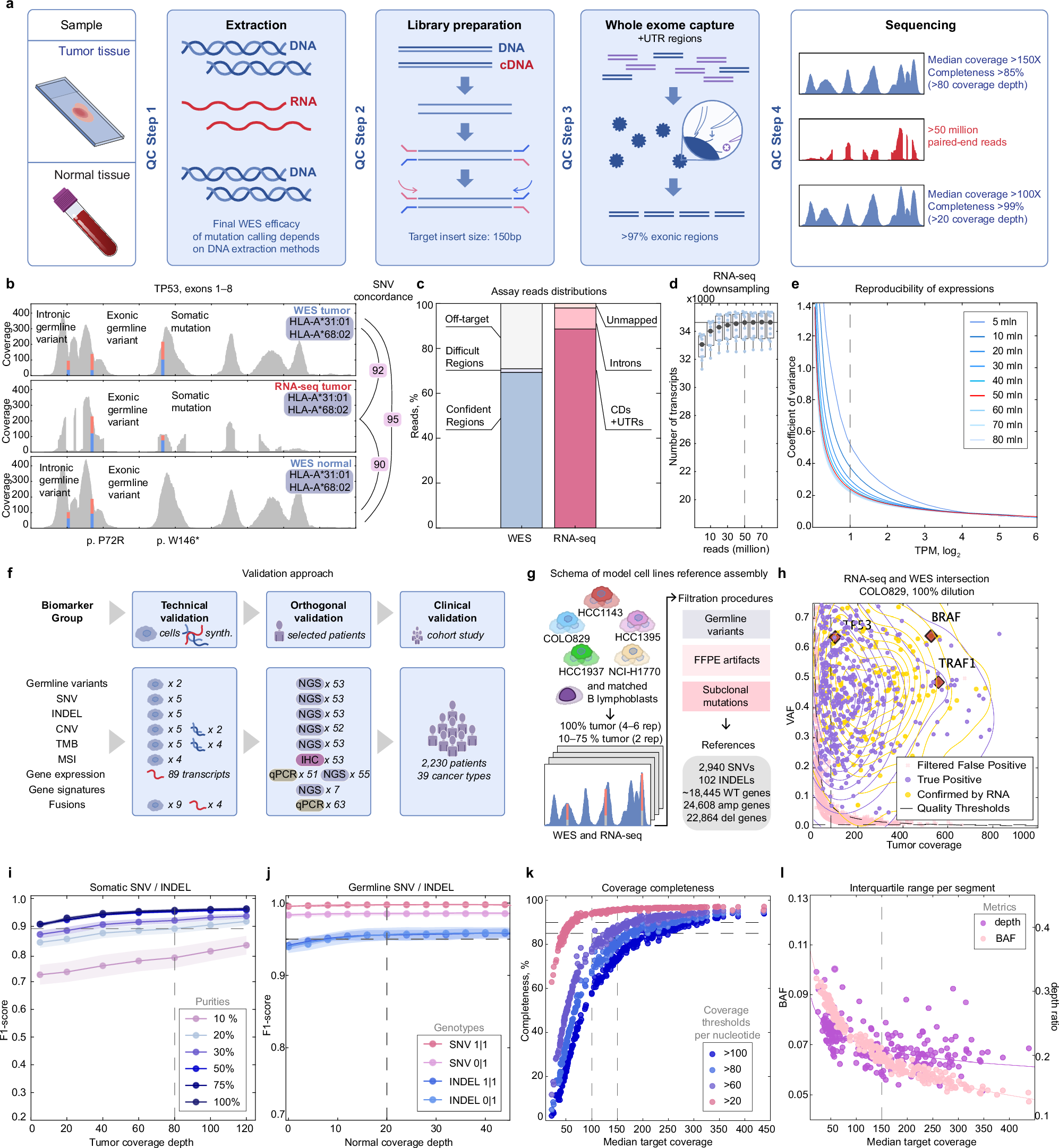
a Tissue sample processing workflow. b Tumor/normal variant calling and RNA confirmation in TP53 exons; reference (blue) and mutant (red) alleles shown. Sample integrity confirmed via SNV concordance and HLA genotype. c Proportion of read types in optimized DNA and RNA sequencing. d Dependence of variability of detected transcripts on total read numbers per sample (n = 10). Box plots show the interquartile range. e Dependence of coefficient of variance (CV) of single gene expression (log2TPM) on the expression level. f Schema showing the three-step validation approach for different biomarker groups. g Schema of experiment to develop comprehensive somatic references for COLO829, HCC1143, HCC1395, HCC1937, and NCI-H1770 cell lines. h Scatter plot of VAF and coverage for all variants (n = 500) in COLO829 (100% purity); true positives (purple), RNA-confirmed (yellow), and filtered false positives (pink). Dashed line marks filtering threshold. Somatic (i) and germline (j) variant calling F1-scores by coverage and tumor purity (i) or genotypes (j); shading shows s.e.m. from 10 samples per dilution (n = 60). Dependence of coverage completeness (k), BAF variance (pink dots, left y-axis), and tumor/normal depth ratio variance (purple dots, right y-axis) (l) on median sample coverage (n = 250).
Collaborators in Spain replicated the findings using previously published European GWAS data comprising nearly 10,000 cases, further strengthening the significance of the findings. At Baylor, Dr. Olivier Lichtarge’s lab used its evolutionary action-machine learning (EAML) framework to analyze the exome sequencing data and prioritize genes with high-impact variants predictive of SSc. The results once again pointed to MICB, as well as other genes on chromosome six like NOTCH4 and rare missense variants in genes enriched in interferon signaling (a key pathway in the immune system), including IFI44L and IFIT5.
“With our machine learning framework, we are not only identifying whether a variant occurs frequently, but also, using evolutionary data across all species, we are weighing the likelihood the variant is functionally disruptive to the protein and eventually to the patient,” said Lichtarge, Cullen Chair and professor of molecular and human genetics, biochemistry and molecular biology and pharmacology. “We previously used this method in diseases with much larger genome data sets, like Alzheimer’s disease and heart disease, and in this study, we show that it can be effective in complex diseases with a smaller patient data set.”
To understand the functional impact of the genetic variants identified in the study, researchers integrated publicly available single-cell RNA sequencing data from SSc skin biopsies to resolve cell type-specific expression patterns of risk genes. They also performed expression quantitative trait locus (eQTL) analysis using whole blood datasets to establish regulatory links between disease-associated variants and transcriptomic changes. MICB and NOTCH4 were found to be expressed in fibroblasts and endothelial cells, two cell types that play central roles in fibrosis and vasculopathy, key clinical features of SSc. These complementary analyses confirmed functional regulatory effects of identified risk genes.
“To solve complex diseases like SSc, we need to combine different approaches and machine learning to the analysis of large DNA, RNA and protein data sets to discover otherwise hidden targets for treatment,” said corresponding author Dr. Brendan Lee, professor, chair and Robert and Janice McNair Endowed Chair of molecular and human genetics at Baylor.
Source – Baylor College of Medicine


Researchers conducted a genome-wide analysis study to find novel genes and rare variants contributing to SSc risk.
Systemic sclerosis (SSc) is a severe autoimmune disease with complex genetic causes. Some genetic contributors have been identified, but others remain unknown, which has impeded development of targeted treatments. In a new study published in Annals of the Rheumatic Diseases, researchers at Baylor College of Medicine and collaborating institutions used complementary approaches that integrate exome sequencing and evolutionary action machine learning to identify protein changes and their associated mechanisms in SSc.
Previous genome-wide association studies (GWAS) that analyzed the frequency of common genetic variants show the strongest genetic contributors located in the human leucocyte antigen (HLA) region on chromosome six. In this study, researchers led by first author Dr. Shamika Ketkar performed GWAS using exome sequencing data from 2,559 SSc patient cases and 893 healthy control cases in the Scleroderma Family Registry and DNA Repository at the University of Texas Health Science Center at Houston. They aimed to find novel genes and rare variants contributing to SSc risk.
Integrated WES/RNA-seq assay from the same tissue
a Tissue sample processing workflow. b Tumor/normal variant calling and RNA confirmation in TP53 exons; reference (blue) and mutant (red) alleles shown. Sample integrity confirmed via SNV concordance and HLA genotype. c Proportion of read types in optimized DNA and RNA sequencing. d Dependence of variability of detected transcripts on total read numbers per sample (n = 10). Box plots show the interquartile range. e Dependence of coefficient of variance (CV) of single gene expression (log2TPM) on the expression level. f Schema showing the three-step validation approach for different biomarker groups. g Schema of experiment to develop comprehensive somatic references for COLO829, HCC1143, HCC1395, HCC1937, and NCI-H1770 cell lines. h Scatter plot of VAF and coverage for all variants (n = 500) in COLO829 (100% purity); true positives (purple), RNA-confirmed (yellow), and filtered false positives (pink). Dashed line marks filtering threshold. Somatic (i) and germline (j) variant calling F1-scores by coverage and tumor purity (i) or genotypes (j); shading shows s.e.m. from 10 samples per dilution (n = 60). Dependence of coverage completeness (k), BAF variance (pink dots, left y-axis), and tumor/normal depth ratio variance (purple dots, right y-axis) (l) on median sample coverage (n = 250).
Collaborators in Spain replicated the findings using previously published European GWAS data comprising nearly 10,000 cases, further strengthening the significance of the findings. At Baylor, Dr. Olivier Lichtarge’s lab used its evolutionary action-machine learning (EAML) framework to analyze the exome sequencing data and prioritize genes with high-impact variants predictive of SSc. The results once again pointed to MICB, as well as other genes on chromosome six like NOTCH4 and rare missense variants in genes enriched in interferon signaling (a key pathway in the immune system), including IFI44L and IFIT5.
To understand the functional impact of the genetic variants identified in the study, researchers integrated publicly available single-cell RNA sequencing data from SSc skin biopsies to resolve cell type-specific expression patterns of risk genes. They also performed expression quantitative trait locus (eQTL) analysis using whole blood datasets to establish regulatory links between disease-associated variants and transcriptomic changes. MICB and NOTCH4 were found to be expressed in fibroblasts and endothelial cells, two cell types that play central roles in fibrosis and vasculopathy, key clinical features of SSc. These complementary analyses confirmed functional regulatory effects of identified risk genes.
Source – Baylor College of Medicine
Yudina A, Tazearslan C, Baisangurov A, Nuzhdina E, Lauziere K, Segodin V, Podsvirova S, Starikov S, Chasse M, Shaposhnikov K, Kaneunyenye L, Klimchuk O, Kuzkina N, English N, Khegai G, Sookiasian D, Shafranskaya D, Fernandez D, Lozinsky Y, Sobolev A, Abdou M, Turova P, Chernyshov K, Efremov A, Andrewes S, Feinberg A, McKenna B, Brown JH, Love A, Curran J, Lennerz J, Bagaev A. (2025) Clinical and analytical validation of a combined RNA and DNA exome assay across a large tumor cohort. Communications Medicine 5(1):236. [article]
Related Posts
Novel biosensor uses DNA ‘barcodes’ to uncover disease signals in cells
CellART extracts single-cell information from high-resolution spatial transcriptomics
Cell2space restores spatial context to single-cell RNA sequencing data
Urine test may improve bladder cancer diagnosis and guide treatment decisions
DeCoRE – a computational method to resolve RNA structural heterogeneity from RNA structure probing data by direct RNA sequencing
Tracing 700 million years of cell evolution
How should biological replicates be handled in long-read RNA sequencing?
RNA-Seq reveals a new way the developing heart controls its growth
The Human RNome Project Consortium seeks to publish first-ever complete sequence of the body’s RNA
scFlowReport brings multiple single-cell RNA sequencing analyses into one workflow
Long-read RNA sequencing reveals how neurons choose alternative RNA endings
DeOPUS improves cell-type estimates from bulk RNA sequencing
ResolVI improves accuracy in spatial transcriptomics analysis
RNA sequencing reveals transcriptional allele differences in prostate cancer stem cells
Unmasking “zombie cells” in aging tissue with an AI-powered barcode
Single-cell TimeLapse-seq reveals MTA is an essential retrotransposon
RNA variant imaging for cancer diagnosis
Autism-risk mutations reveal two opposing patterns of brain gene activity
A real-data approach to evaluating RNA transcript analysis methods
Detection and sequencing of Ap2N-capped RNAs in human cells
Stay Connected
Submit a Post to the Blog
Recent Posts
Subscribe to the RNA-Seq Blog
RNA-Seq Products & Services