

Cells with the same DNA can behave very differently, and understanding why requires looking at more than one molecular layer at a time. Traditional single-cell methods often measure either gene expression or chromatin accessibility, but not both together, which can limit insight into how genes are regulated.
Researchers at Guangzhou Medical University describe a new experimental approach called ISSAAC-seq that allows scientists to measure chromatin accessibility and gene expression from the same single nucleus. Chromatin accessibility tells researchers which parts of the genome are open and potentially active, while gene expression shows which genes are actually being used by the cell. Combining these readouts in the same nucleus provides a clearer picture of how regulatory DNA elements influence gene activity.
The ISSAAC-seq workflow begins by tagging open chromatin regions and RNA-derived cDNA at the same time using a transposase-based strategy. After this initial step, individual nuclei can be isolated using different methods, including plates or droplet-based systems, depending on the experiment. This flexibility makes the protocol compatible with a wide range of existing single-nucleus platforms and allows studies to scale from hundreds to tens of thousands of nuclei.
A schematic view of the workflow
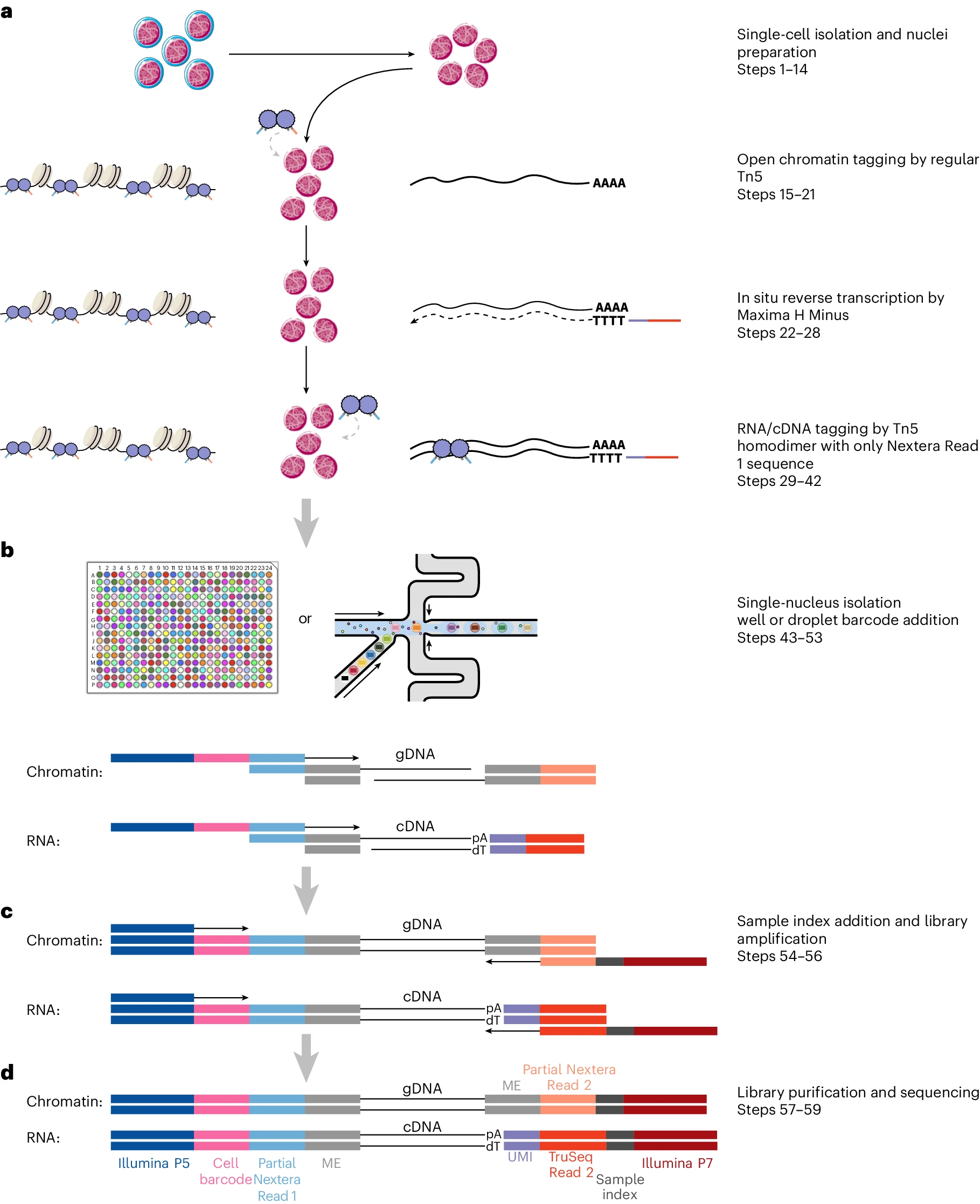
a, All the steps in the in situ reaction module for open chromatin and RNA/cDNA tagmentation. b, Both plate and droplet methods can be used for single-nucleus isolation and barcoding. c, Library preparation by PCR. d, The final library structure.
Importantly, the method is designed to be fast and practical. The full workflow can be completed in one or two days and produces high-quality data for both chromatin accessibility and gene expression. By enabling coordinated analysis of these two layers, ISSAAC-seq gives researchers a powerful way to explore cell-type-specific regulatory mechanisms and better understand cellular heterogeneity.
Xu W, Hu Y, Zhang Y, Schnepp P M, Lo L M, Zhang Q, Cheng S M, Chen X. (2026) Single-nucleus chromatin accessibility and gene expression co-profiling by ISSAAC-seq. Nature Protocols [Epub ahead of print]. [article]
Related Posts






Cells with the same DNA can behave very differently, and understanding why requires looking at more than one molecular layer at a time. Traditional single-cell methods often measure either gene expression or chromatin accessibility, but not both together, which can limit insight into how genes are regulated.
Researchers at Guangzhou Medical University describe a new experimental approach called ISSAAC-seq that allows scientists to measure chromatin accessibility and gene expression from the same single nucleus. Chromatin accessibility tells researchers which parts of the genome are open and potentially active, while gene expression shows which genes are actually being used by the cell. Combining these readouts in the same nucleus provides a clearer picture of how regulatory DNA elements influence gene activity.
The ISSAAC-seq workflow begins by tagging open chromatin regions and RNA-derived cDNA at the same time using a transposase-based strategy. After this initial step, individual nuclei can be isolated using different methods, including plates or droplet-based systems, depending on the experiment. This flexibility makes the protocol compatible with a wide range of existing single-nucleus platforms and allows studies to scale from hundreds to tens of thousands of nuclei.
A schematic view of the workflow
a, All the steps in the in situ reaction module for open chromatin and RNA/cDNA tagmentation. b, Both plate and droplet methods can be used for single-nucleus isolation and barcoding. c, Library preparation by PCR. d, The final library structure.
Importantly, the method is designed to be fast and practical. The full workflow can be completed in one or two days and produces high-quality data for both chromatin accessibility and gene expression. By enabling coordinated analysis of these two layers, ISSAAC-seq gives researchers a powerful way to explore cell-type-specific regulatory mechanisms and better understand cellular heterogeneity.
Xu W, Hu Y, Zhang Y, Schnepp P M, Lo L M, Zhang Q, Cheng S M, Chen X. (2026) Single-nucleus chromatin accessibility and gene expression co-profiling by ISSAAC-seq. Nature Protocols [Epub ahead of print]. [article]
Related Posts
Recent Posts
 Scientists identify the neuroblastoma cells that signal poor outcomes
 GARAGE improves rare cell detection in single-cell RNA sequencing analysis using AI
 Machine learning reveals how RNA splicing is regulated in individual cell types
 Illumina releases SpliceAI2 to help advance rare disease research
 Postdoctoral Fellow – Long-Read RNA Methods Development for Neurodegeneration
 Novel biosensor uses DNA ‘barcodes’ to uncover disease signals in cells
RNA-Seq Products & Services



Stay Connected