Why do some people remain healthy through childhood yet become more vulnerable to brain disorders such as dementia later in life? A KAIST (President Kwang Hyung Lee) -led team has uncovered a key part of the answer: a developmental ‘switch’ in astrocytes—the brain’s most abundant support cells that shapes how strongly the brain’s immune system reacts in adulthood. The study identifies a gene, NR3C1 (encoding the glucocorticoid receptor), as a master regulator of this switch and shows how early-life epigenetic ‘memory’ can predispose the adult brain to excessive inflammation.
The work was carried out by a joint team led by Professor Inkyung Jung (Department of Biological Sciences, KAIST) and Associate Director Won-Suk Chung (Center for Vascular Research, Institute for Basic Science; Professor, KAIST Biological Sciences). Using mouse models, the researchers mapped gene-regulatory programs across multiple stages of astrocyte development and found that NR3C1 acts during a brief early-postnatal window to enforce long-term immune restraint.
To build this map, the team combined state-of-the-art 3D epigenome profiling with RNA sequencing and chromatin accessibility analyses, capturing how DNA folds and which regulatory elements contact target genes. They identified 55 stage-specific transcription factors that guide astrocyte maturation; among them, NR3C1 emerged as the critical ‘switch’ in early life. Notably, deleting NR3C1 in astrocytes did not disrupt normal development. However, when the adult mice were challenged with an autoimmune model of multiple sclerosis, animals lacking astrocytic NR3C1 mounted exaggerated inflammatory responses and developed more severe disease.
Landscapes of transcriptome, epigenome, and long-range chromatin interactions during astrocyte development
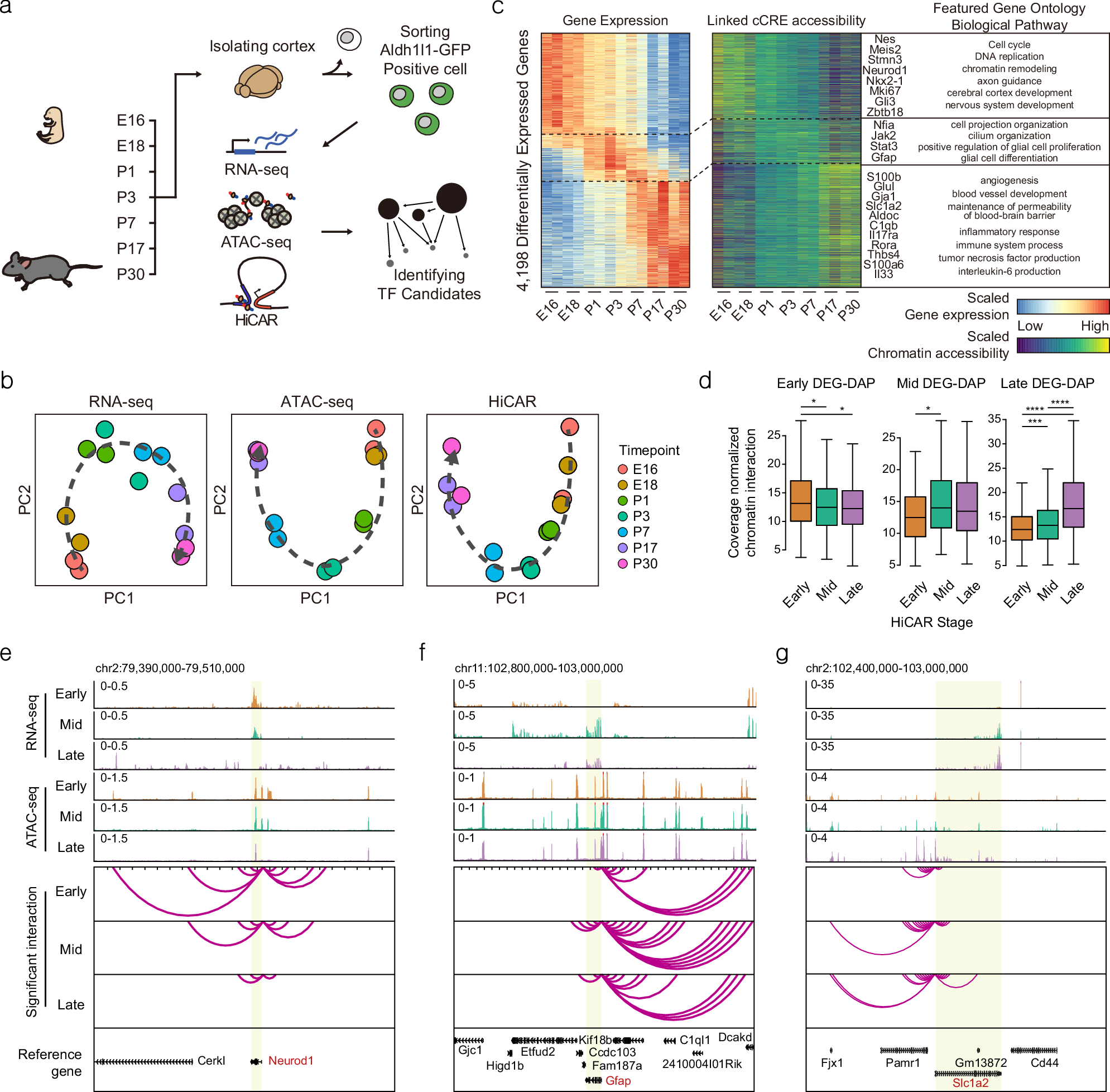
a Schematic of the multi-omics analyses of astrocyte development. Astrocytes were isolated from E16, E18, P1, P3, P7, P17, and P30 mouse cortices with two biological replicates. b Principal component analyses based on RNA-seq (left), ATAC-seq (middle), and HiCAR (right) representing astrocyte developmental trajectory throughout each dataset. The color indicates the time point of each developmental stage. c Heatmap showing the expression patterns of developmental DEGs (left) and accessibility patterns of their linked cCREs (right). Representative genes and ontologies are displayed to the right of the heatmap. d Boxplots representing significant long-range chromatin interaction scores between DEGs and Differentially Accessible Peaks (DAPs). The box indicates the interquartile range (IQR), and the whiskers represent the highest and lowest points within 1.5 × IQR. P values of differences of interaction between early DEG and DAP (n = 438) were P = 0.029 for Early vs Mid, P = 0.016 for Early vs Late, P = 0.332 for Mid vs Late; between mid DEG and DAP (n = 106) were P = 0.014 for Early vs Mid, P = 0.239 for Early vs Late, P = 0.505 for Mid vs Late; between late DEG and DAP (n = 572) were P = 1.24 × 10⁻³ for Early vs Mid, P < 2.20 × 10⁻¹⁶ for Early vs Late, P < 2.20 × 10⁻¹⁶ for Mid vs Late (two-sided Kolmogorov–Smirnov test). Early, E16 and E18; Mid, P1, P3, and P7; Late, P17 and P30. e–g Genome browser snapshots of representative DEGs, including Neurod1 (e), Gfap (f), and Slc1a2 (g) with gene expression, chromatin accessibility, and significant long-range chromatin interactions.
Mechanistically, the study shows that early loss of NR3C1 epigenetically primes immune genes – keeping their regulatory elements open and ready – so that later in life these genes respond too strongly to inflammatory cues. In effect, NR3C1 serves as an early ‘brake’ that prevents over-activation of astrocyte immune programs in adulthood.
“This is the first demonstration that astrocyte immune functions are governed by epigenetic memory,” said Professor Won-Suk Chung. “Our findings offer new clues to the origins of degenerative brain disorders, including Alzheimer’s disease.”
“We reveal a temporal regulatory window in astrocyte development that can set the stage for disease vulnerability in adulthood,” added Professor Inkyung Jung. “Understanding the 3D genome logic behind these programs could open paths to therapies for immune-related brain disorders such as multiple sclerosis.”
Source – KAIST


Why do some people remain healthy through childhood yet become more vulnerable to brain disorders such as dementia later in life? A KAIST (President Kwang Hyung Lee) -led team has uncovered a key part of the answer: a developmental ‘switch’ in astrocytes—the brain’s most abundant support cells that shapes how strongly the brain’s immune system reacts in adulthood. The study identifies a gene, NR3C1 (encoding the glucocorticoid receptor), as a master regulator of this switch and shows how early-life epigenetic ‘memory’ can predispose the adult brain to excessive inflammation.
The work was carried out by a joint team led by Professor Inkyung Jung (Department of Biological Sciences, KAIST) and Associate Director Won-Suk Chung (Center for Vascular Research, Institute for Basic Science; Professor, KAIST Biological Sciences). Using mouse models, the researchers mapped gene-regulatory programs across multiple stages of astrocyte development and found that NR3C1 acts during a brief early-postnatal window to enforce long-term immune restraint.
To build this map, the team combined state-of-the-art 3D epigenome profiling with RNA sequencing and chromatin accessibility analyses, capturing how DNA folds and which regulatory elements contact target genes. They identified 55 stage-specific transcription factors that guide astrocyte maturation; among them, NR3C1 emerged as the critical ‘switch’ in early life. Notably, deleting NR3C1 in astrocytes did not disrupt normal development. However, when the adult mice were challenged with an autoimmune model of multiple sclerosis, animals lacking astrocytic NR3C1 mounted exaggerated inflammatory responses and developed more severe disease.
Landscapes of transcriptome, epigenome, and long-range chromatin interactions during astrocyte development
a Schematic of the multi-omics analyses of astrocyte development. Astrocytes were isolated from E16, E18, P1, P3, P7, P17, and P30 mouse cortices with two biological replicates. b Principal component analyses based on RNA-seq (left), ATAC-seq (middle), and HiCAR (right) representing astrocyte developmental trajectory throughout each dataset. The color indicates the time point of each developmental stage. c Heatmap showing the expression patterns of developmental DEGs (left) and accessibility patterns of their linked cCREs (right). Representative genes and ontologies are displayed to the right of the heatmap. d Boxplots representing significant long-range chromatin interaction scores between DEGs and Differentially Accessible Peaks (DAPs). The box indicates the interquartile range (IQR), and the whiskers represent the highest and lowest points within 1.5 × IQR. P values of differences of interaction between early DEG and DAP (n = 438) were P = 0.029 for Early vs Mid, P = 0.016 for Early vs Late, P = 0.332 for Mid vs Late; between mid DEG and DAP (n = 106) were P = 0.014 for Early vs Mid, P = 0.239 for Early vs Late, P = 0.505 for Mid vs Late; between late DEG and DAP (n = 572) were P = 1.24 × 10⁻³ for Early vs Mid, P < 2.20 × 10⁻¹⁶ for Early vs Late, P < 2.20 × 10⁻¹⁶ for Mid vs Late (two-sided Kolmogorov–Smirnov test). Early, E16 and E18; Mid, P1, P3, and P7; Late, P17 and P30. e–g Genome browser snapshots of representative DEGs, including Neurod1 (e), Gfap (f), and Slc1a2 (g) with gene expression, chromatin accessibility, and significant long-range chromatin interactions.
Mechanistically, the study shows that early loss of NR3C1 epigenetically primes immune genes – keeping their regulatory elements open and ready – so that later in life these genes respond too strongly to inflammatory cues. In effect, NR3C1 serves as an early ‘brake’ that prevents over-activation of astrocyte immune programs in adulthood.
Source – KAIST
Park S, Park H, Byun YG, Wei X, Eom J, Joo J, Lee AJ, Diao Y, Chung WS, Jung I. (2025) NR3C1-mediated epigenetic regulation suppresses astrocytic immune responses in mice. Nat Commun 16(1):8330. [article]
Related Posts
Novel biosensor uses DNA ‘barcodes’ to uncover disease signals in cells
CellART extracts single-cell information from high-resolution spatial transcriptomics
Cell2space restores spatial context to single-cell RNA sequencing data
Urine test may improve bladder cancer diagnosis and guide treatment decisions
DeCoRE – a computational method to resolve RNA structural heterogeneity from RNA structure probing data by direct RNA sequencing
Tracing 700 million years of cell evolution
How should biological replicates be handled in long-read RNA sequencing?
RNA-Seq reveals a new way the developing heart controls its growth
The Human RNome Project Consortium seeks to publish first-ever complete sequence of the body’s RNA
scFlowReport brings multiple single-cell RNA sequencing analyses into one workflow
Long-read RNA sequencing reveals how neurons choose alternative RNA endings
DeOPUS improves cell-type estimates from bulk RNA sequencing
ResolVI improves accuracy in spatial transcriptomics analysis
RNA sequencing reveals transcriptional allele differences in prostate cancer stem cells
Unmasking “zombie cells” in aging tissue with an AI-powered barcode
RNA variant imaging for cancer diagnosis
Autism-risk mutations reveal two opposing patterns of brain gene activity
A real-data approach to evaluating RNA transcript analysis methods
Detection and sequencing of Ap2N-capped RNAs in human cells
Single-cell RNA sequencing provides a closer look at the Aedes aegypti midgut
Stay Connected
Submit a Post to the Blog
Recent Posts
Subscribe to the RNA-Seq Blog
RNA-Seq Products & Services