Meningiomas are the most common primary brain tumors, accounting for nearly one-third of all central nervous system (CNS) tumors. While most are benign and manageable, 20–30% progress to high-grade forms that behave aggressively, recur frequently, and resist standard treatments. Recurrence remains a major clinical challenge, as these tumors often return stronger, leaving patients with limited therapeutic options. Despite advances in understanding their genetic and molecular profiles, how meningiomas evolve from primary to recurrent states has remained unclear.
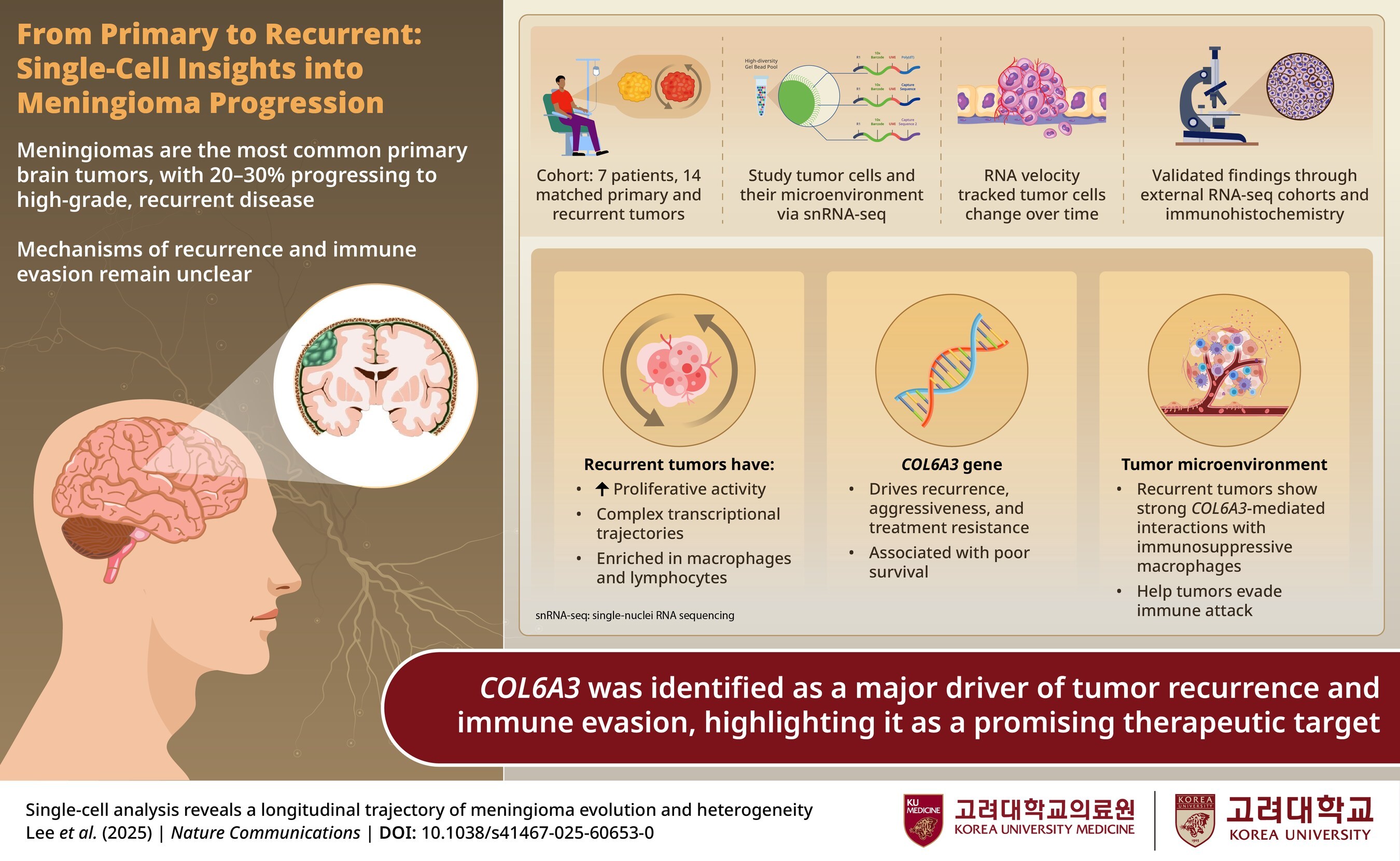
New study uses single-cell transcriptomics to map how meningiomas evolve from primary to recurrent states
To address this gap, researchers from Korea University set out to map the evolutionary trajectory of meningiomas at single-cell resolution. Their goal was to investigate how tumor cells and their microenvironment evolve between primary and recurrent disease, and to identify the molecular drivers of recurrence.
Lead author Associate Professor Jason K. Sa explains: “Our study generated the first longitudinal single-cell atlas of matched primary and recurrent meningiomas. This resource enabled us to reconstruct tumor evolutionary trajectories and cellular hierarchies over time, revealing profound shifts in proliferative programs and tumor–immune interactions at recurrence.”
Their findings were published in Nature Communications on July 1, 2025.
The team analyzed matched patient samples using single-nuclei RNA sequencing (snRNA-seq), which allowed profiling of both tumor cells and their surrounding microenvironment. To capture the dynamic progression of tumor cells, they applied RNA velocity and latent time analysis, tracking transcriptional changes as tumors transitioned to recurrence. Findings were further validated using external RNA-seq datasets and immunohistochemistry (IHC), strengthening the robustness of the results.
The study uncovered several key insights. Recurrent meningiomas exhibited markedly higher proliferative activity compared to their primary counterparts, which were enriched in cell cycle–related processes. Rather than progressing linearly, recurrent tumors diverged into multiple aggressive transcriptional trajectories. Most notably, the researchers identified COL6A3 as a central player driving these transitions.
“We identified COL6A3 as a key driver of meningioma recurrence, associated with relapse risk and treatment resistance. Further analysis of tumor cell–macrophage interactions revealed that the COL6A3–CD44 signaling cascade mediates extracellular matrix remodeling and promotes an immunosuppressive tumor microenvironment at recurrence,” Ms. Ji Yoon Lee, the study’s first author, notes.
This dual role in both tumor cell behavior and immune modulation makes COL6A3 an especially compelling therapeutic target.
Dr. Sa adds, “By identifying COL6A3 as a driver of malignancy in recurrent meningiomas, we found its dual potential. First, as a prognostic biomarker to better stratify high-risk patients and guide treatment decisions, and second, as a novel therapeutic target for drug discovery. This opens the door to precision strategies that combine early diagnosis with targeted therapies to improve patient outcomes.”
This work significantly advances our understanding of how meningiomas progress from primary to recurrent states. It emphasizes the need to address both tumor cell evolution and tumor–immune interactions when designing therapies.
Looking ahead, Ms. Lee shares: “Over the next 5 to 10 years, we anticipate this work can impact patient care by enabling predictive tools for radiotherapy response and recurrence risk assessment.”
Ultimately, targeting COL6A3 may provide a promising strategy to prevent recurrence and improve outcomes for patients with high-grade meningiomas.
Source – PR Newswire


Meningiomas are the most common primary brain tumors, accounting for nearly one-third of all central nervous system (CNS) tumors. While most are benign and manageable, 20–30% progress to high-grade forms that behave aggressively, recur frequently, and resist standard treatments. Recurrence remains a major clinical challenge, as these tumors often return stronger, leaving patients with limited therapeutic options. Despite advances in understanding their genetic and molecular profiles, how meningiomas evolve from primary to recurrent states has remained unclear.
New study uses single-cell transcriptomics to map how meningiomas evolve from primary to recurrent states
To address this gap, researchers from Korea University set out to map the evolutionary trajectory of meningiomas at single-cell resolution. Their goal was to investigate how tumor cells and their microenvironment evolve between primary and recurrent disease, and to identify the molecular drivers of recurrence.
Their findings were published in Nature Communications on July 1, 2025.
The team analyzed matched patient samples using single-nuclei RNA sequencing (snRNA-seq), which allowed profiling of both tumor cells and their surrounding microenvironment. To capture the dynamic progression of tumor cells, they applied RNA velocity and latent time analysis, tracking transcriptional changes as tumors transitioned to recurrence. Findings were further validated using external RNA-seq datasets and immunohistochemistry (IHC), strengthening the robustness of the results.
The study uncovered several key insights. Recurrent meningiomas exhibited markedly higher proliferative activity compared to their primary counterparts, which were enriched in cell cycle–related processes. Rather than progressing linearly, recurrent tumors diverged into multiple aggressive transcriptional trajectories. Most notably, the researchers identified COL6A3 as a central player driving these transitions.
This dual role in both tumor cell behavior and immune modulation makes COL6A3 an especially compelling therapeutic target.
This work significantly advances our understanding of how meningiomas progress from primary to recurrent states. It emphasizes the need to address both tumor cell evolution and tumor–immune interactions when designing therapies.
Ultimately, targeting COL6A3 may provide a promising strategy to prevent recurrence and improve outcomes for patients with high-grade meningiomas.
Source – PR Newswire
Lee JY, Lee EJ, Seo BY, Kim J, Song Y, Lee D, Moon N, Koo H, Park CK, Kim MS, Park SI, Nam DH, Kong DS, Sa JK. (2025) Single-cell analysis reveals a longitudinal trajectory of meningioma evolution and heterogeneity. Nature Communications 16(1): 5481. [article]
Related Posts
Novel biosensor uses DNA ‘barcodes’ to uncover disease signals in cells
CellART extracts single-cell information from high-resolution spatial transcriptomics
Cell2space restores spatial context to single-cell RNA sequencing data
Urine test may improve bladder cancer diagnosis and guide treatment decisions
DeCoRE – a computational method to resolve RNA structural heterogeneity from RNA structure probing data by direct RNA sequencing
Tracing 700 million years of cell evolution
How should biological replicates be handled in long-read RNA sequencing?
RNA-Seq reveals a new way the developing heart controls its growth
The Human RNome Project Consortium seeks to publish first-ever complete sequence of the body’s RNA
scFlowReport brings multiple single-cell RNA sequencing analyses into one workflow
Long-read RNA sequencing reveals how neurons choose alternative RNA endings
DeOPUS improves cell-type estimates from bulk RNA sequencing
ResolVI improves accuracy in spatial transcriptomics analysis
RNA sequencing reveals transcriptional allele differences in prostate cancer stem cells
Unmasking “zombie cells” in aging tissue with an AI-powered barcode
RNA variant imaging for cancer diagnosis
Autism-risk mutations reveal two opposing patterns of brain gene activity
A real-data approach to evaluating RNA transcript analysis methods
Detection and sequencing of Ap2N-capped RNAs in human cells
Single-cell RNA sequencing provides a closer look at the Aedes aegypti midgut
Stay Connected
Submit a Post to the Blog
Recent Posts
Subscribe to the RNA-Seq Blog
RNA-Seq Products & Services