New AI-based tool allows to predict activity of DNA sequences

Deep learning approaches have transformed how scientists predict activity and function of DNA sequences in the genome. A new AI tool called Corgi (Context-aware Regulatory Genomics Inference), developed by Martin Vingron’s bioinformatics group at the Max Planck Institute for Molecular Genetics (Berlin, Germany) allows researchers to predict how the genome behaves across different cell types. The findings could help improve efforts to mimic the activity of cells virtually, with potential applications in basic research and medicine. The study was published in Nature Communications.
Although different cells in our body may appear similar, each person has a unique genetic makeup due to small genetic variations. These variants can alter gene expression in cells. Researchers are increasingly interested in these variants because they may be involved in disease mechanisms and could inform personalized medical interventions. However, only a few variants are functionally relevant. In recent years, AI-based tools have been developed that predict the effects of these variants from sequence data and prioritize the most important ones.
Many of these tools have fundamental limitations. Some cannot extrapolate beyond their training data because they fail to consider the cellular context that determines how genes are switched on or off.
“With Corgi, we have created a model that overcomes many of these limitations. It can correctly predict measurements related to genome activity, including gene expression, chromatin accessibility, and histone modifications,” says Ekin Deniz Aksu, the study’s first author.
Earlier models typically disregarded this cellular context, relying solely on sequence. These models were trained using large datasets that linked DNA sequences to outputs, such as RNA activity or chromatin accessibility. However, the problem is that DNA does not act alone but with a plethora of regulatory molecules. The same DNA sequence may behave differently in a neuron than in a liver cell, for example, because each cell contains a different mix of regulatory molecules.
Corgi’s architecture mimics cellular gene regulation
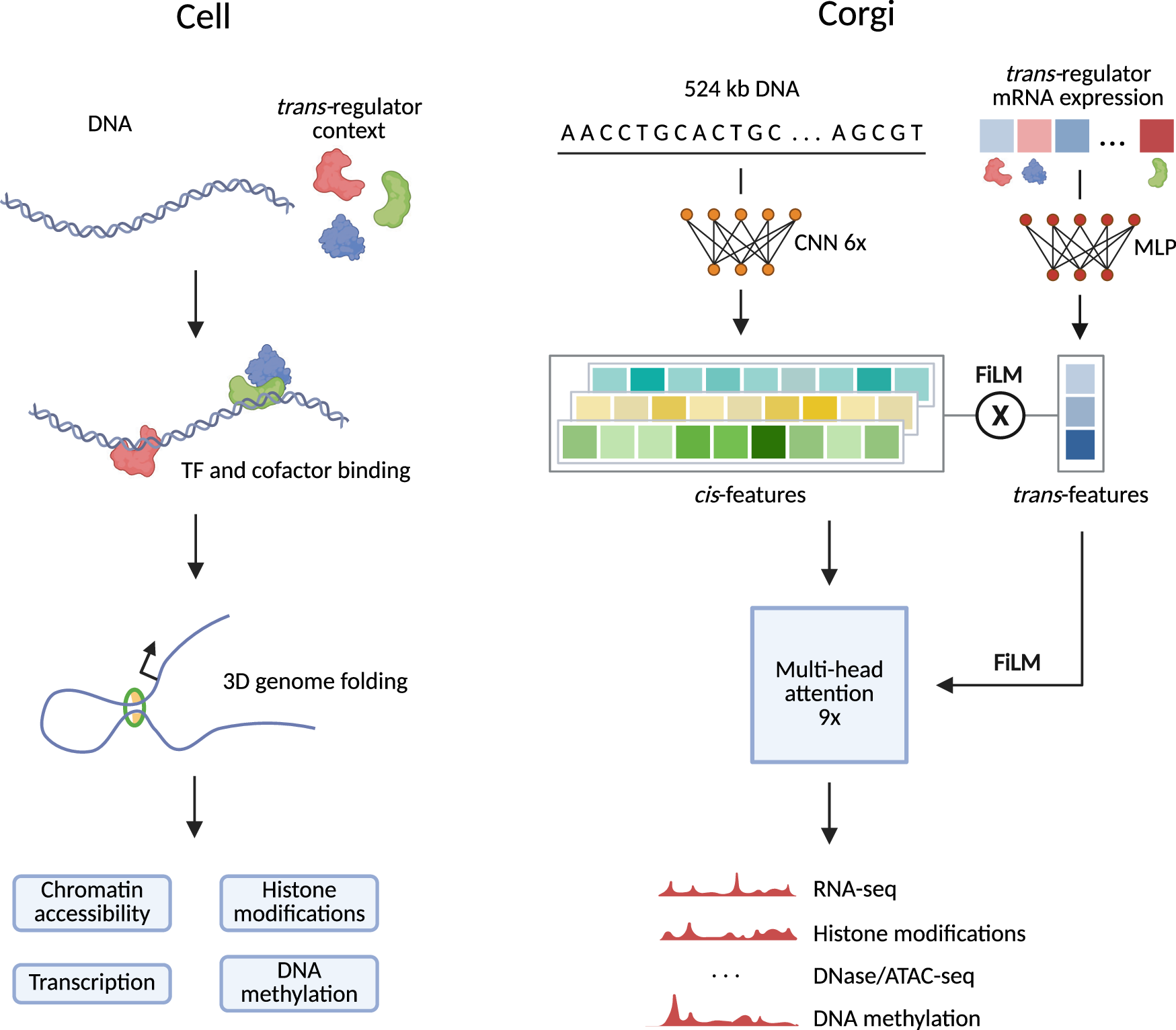
The researchers designed an architecture that strives to imitate how cells read the regulatory genome using trans factors. The model first extracts cis-regulatory features via convolutional layers and trans-regulatory features via an MLP operating on trans-regulator expression. These are integrated using FiLM layers, which apply feature-wise affine transformations akin to biophysical “affinity × concentration” models. Instead of single TFs, these features are combinations of trans-regulators learned by the model. Afterwards, transformer blocks with FiLM layers capture long-range genomic interactions in a cell type-specific manner.
“To train our model, we now created an architecture that more closely resembles actual biological reality in a cell by integrating expression data from a large set of regulatory genes,” says Ekin Deniz Aksu.
An improved version of the tool, called Corgi+, can infer epigenetic information from RNA sequencing data. With further adjustments, researchers could use the tool in the future to fill major gaps in datasets without conducting every experiment directly, particularly with regard to rare cell types, embryos, and limited patient tissue.
The scientists hope their approach will also improve virtual cell models. These systems aim to mimic the effects of gene perturbations on a cellular level, but they do not incorporate information about DNA activity.
“We believe that our model could help merge sequence-to-function models with virtual cells in the future,” says Ekin Deniz Aksu.
In the long run, such systems could help scientists screen for drug candidates virtually and understand how certain mutations alter cellular processes and cause complex disease phenotypes.
Source – Max Planck Institute for Molecular Genetics


New AI-based tool allows to predict activity of DNA sequences
Deep learning approaches have transformed how scientists predict activity and function of DNA sequences in the genome. A new AI tool called Corgi (Context-aware Regulatory Genomics Inference), developed by Martin Vingron’s bioinformatics group at the Max Planck Institute for Molecular Genetics (Berlin, Germany) allows researchers to predict how the genome behaves across different cell types. The findings could help improve efforts to mimic the activity of cells virtually, with potential applications in basic research and medicine. The study was published in Nature Communications.
Although different cells in our body may appear similar, each person has a unique genetic makeup due to small genetic variations. These variants can alter gene expression in cells. Researchers are increasingly interested in these variants because they may be involved in disease mechanisms and could inform personalized medical interventions. However, only a few variants are functionally relevant. In recent years, AI-based tools have been developed that predict the effects of these variants from sequence data and prioritize the most important ones.
Many of these tools have fundamental limitations. Some cannot extrapolate beyond their training data because they fail to consider the cellular context that determines how genes are switched on or off.
Earlier models typically disregarded this cellular context, relying solely on sequence. These models were trained using large datasets that linked DNA sequences to outputs, such as RNA activity or chromatin accessibility. However, the problem is that DNA does not act alone but with a plethora of regulatory molecules. The same DNA sequence may behave differently in a neuron than in a liver cell, for example, because each cell contains a different mix of regulatory molecules.
Corgi’s architecture mimics cellular gene regulation
The researchers designed an architecture that strives to imitate how cells read the regulatory genome using trans factors. The model first extracts cis-regulatory features via convolutional layers and trans-regulatory features via an MLP operating on trans-regulator expression. These are integrated using FiLM layers, which apply feature-wise affine transformations akin to biophysical “affinity × concentration” models. Instead of single TFs, these features are combinations of trans-regulators learned by the model. Afterwards, transformer blocks with FiLM layers capture long-range genomic interactions in a cell type-specific manner.
An improved version of the tool, called Corgi+, can infer epigenetic information from RNA sequencing data. With further adjustments, researchers could use the tool in the future to fill major gaps in datasets without conducting every experiment directly, particularly with regard to rare cell types, embryos, and limited patient tissue.
The scientists hope their approach will also improve virtual cell models. These systems aim to mimic the effects of gene perturbations on a cellular level, but they do not incorporate information about DNA activity.
In the long run, such systems could help scientists screen for drug candidates virtually and understand how certain mutations alter cellular processes and cause complex disease phenotypes.
Source – Max Planck Institute for Molecular Genetics
Aksu ED, Vingron M. (2026) Context-aware sequence-to-function model of human gene regulation. Nature Communications 17(1):6200. [article]
Related Posts
UMIche – a UMI-centric analysis platform for enhancing molecular quantification accuracy in bulk and single-cell sequencing
New RNA sequencing tool reveals how stem cells develop into heart cells
Estimating the completeness of large-scale single-cell sequencing projects
New RNA sequencing tool improves transcriptome reconstruction using machine learning
DeMixNB: deconvolution of sparse-count RNA sequencing data for tumor cells
New RNA sequencing method improves tRNA analysis using deep learning
Researchers create first whole-body single-cell atlas of an adult vertebrate
UAlbany Joins $10 Million Effort to Map RNA Modifications in the Human Body
SpliceCOV improves RNA sequencing analysis by filtering transcriptional noise
Overlooked ‘off switch’ in lung tumors may explain why immunotherapy doesn’t work for everyone
Squids Edit RNA for Novel Protein Functions
New marker panel and web tool help define early human cell fates
RNA sequencing reveals molecular changes driving right ventricular heart failure
Researchers Develop AI Tool to Map MicroRNA Binding Sites on Circular RNAs
Single-cell RNA sequencing reveals the diversity of human neutrophils across health and disease
Yale researchers improve RNA extraction from precision-cut lung slices
RNA sequencing reveals how genes combine to regulate inflammation and immune responses
RNAffinityDB – a curated database of experimental RNA–protein binding affinities
“Raman Genome” for SARS-CoV-2: new Raman technology distinguishes viral variants by their molecular RNA architecture
Advanced paternal age has sex-specific effects on fetal brain gene expression
Stay Connected
Submit a Post to the Blog
Recent Posts
Subscribe to the RNA-Seq Blog
RNA-Seq Products & Services