

Cells are constantly communicating with each other by releasing proteins and other biomolecules into their surroundings. This process, called secretion, is crucial for many biological functions—whether it’s sending signals to other cells, fighting off infections, or even delivering therapeutic drugs. However, scientists still don’t fully understand the gene activity that drives different secretion patterns in individual cells.
Researchers from the David Geffen School of Medicine at the University of California Los Angeles have developed an innovative technique called SEC-seq to bridge this knowledge gap. This method allows scientists to analyze both the secretions of a single cell and the genes that control them—at the same time.
A summary of the SEC-seq workflow
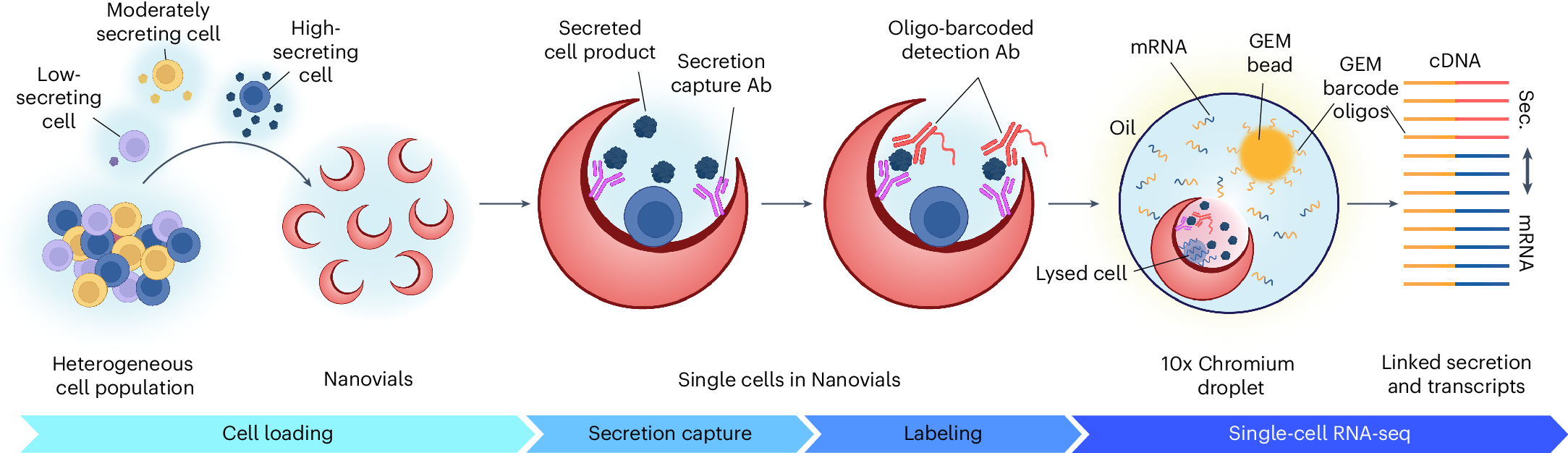
Cells are loaded into Nanovials, and their secretions are captured by attached antibodies. The secretion levels are quantified by using an oligo-barcoded secretion-detection antibody at a single-cell level and are linked to the transcriptomes of each cell through emulsification of the cell-loaded Nanovials into droplets by using standard single-cell sequencing workflows, forming single-cell GEMs (gel beads in emulsions). Ab, antibody; Sec., secretion.
How SEC-seq Works
SEC-seq uses tiny hydrogel beads, called Nanovials, to trap cells along with the molecules they release. Here’s a simplified breakdown of the process:
- Capturing Secretions – Cells are placed onto Nanovials, where secreted proteins are tagged with special molecular barcodes.
- Sorting Cells – Using flow cytometry, cells are separated based on how much of a particular protein they secrete.
- RNA Sequencing – The sorted cells are analyzed with single-cell RNA sequencing (scRNA-seq) to link their gene activity to their secretory behavior.
Why this is Important
SEC-seq provides a powerful tool for studying how cells regulate secretion, which is critical for fields like immunology and regenerative medicine. The research team demonstrated its potential by:
- Tracking T cell receptor sequences alongside cytokine secretion to study immune responses.
- Identifying a highly secreting population of mesenchymal stromal cells with regenerative potential.
- Mapping plasma cell transcriptomes to immunoglobulin secretion levels.
This breakthrough could pave the way for engineering cells with enhanced therapeutic properties, leading to more effective cell-based therapies in the future.
Langerman J, Baghdasarian S, Cheng RYH, et al. (2025) Linking single-cell transcriptomes with secretion using SEC-seq. Nat Protoc. [Epub ahead of print]. [article]
Related Posts






Cells are constantly communicating with each other by releasing proteins and other biomolecules into their surroundings. This process, called secretion, is crucial for many biological functions—whether it’s sending signals to other cells, fighting off infections, or even delivering therapeutic drugs. However, scientists still don’t fully understand the gene activity that drives different secretion patterns in individual cells.
Researchers from the David Geffen School of Medicine at the University of California Los Angeles have developed an innovative technique called SEC-seq to bridge this knowledge gap. This method allows scientists to analyze both the secretions of a single cell and the genes that control them—at the same time.
A summary of the SEC-seq workflow
Cells are loaded into Nanovials, and their secretions are captured by attached antibodies. The secretion levels are quantified by using an oligo-barcoded secretion-detection antibody at a single-cell level and are linked to the transcriptomes of each cell through emulsification of the cell-loaded Nanovials into droplets by using standard single-cell sequencing workflows, forming single-cell GEMs (gel beads in emulsions). Ab, antibody; Sec., secretion.
How SEC-seq Works
SEC-seq uses tiny hydrogel beads, called Nanovials, to trap cells along with the molecules they release. Here’s a simplified breakdown of the process:
- Capturing Secretions – Cells are placed onto Nanovials, where secreted proteins are tagged with special molecular barcodes.
- Sorting Cells – Using flow cytometry, cells are separated based on how much of a particular protein they secrete.
- RNA Sequencing – The sorted cells are analyzed with single-cell RNA sequencing (scRNA-seq) to link their gene activity to their secretory behavior.
Why this is Important
SEC-seq provides a powerful tool for studying how cells regulate secretion, which is critical for fields like immunology and regenerative medicine. The research team demonstrated its potential by:
- Tracking T cell receptor sequences alongside cytokine secretion to study immune responses.
- Identifying a highly secreting population of mesenchymal stromal cells with regenerative potential.
- Mapping plasma cell transcriptomes to immunoglobulin secretion levels.
This breakthrough could pave the way for engineering cells with enhanced therapeutic properties, leading to more effective cell-based therapies in the future.
Langerman J, Baghdasarian S, Cheng RYH, et al. (2025) Linking single-cell transcriptomes with secretion using SEC-seq. Nat Protoc. [Epub ahead of print]. [article]
Related Posts
Recent Posts
 Scientists identify the neuroblastoma cells that signal poor outcomes
 GARAGE improves rare cell detection in single-cell RNA sequencing analysis using AI
 Machine learning reveals how RNA splicing is regulated in individual cell types
 Illumina releases SpliceAI2 to help advance rare disease research
 Postdoctoral Fellow – Long-Read RNA Methods Development for Neurodegeneration
 Novel biosensor uses DNA ‘barcodes’ to uncover disease signals in cells
RNA-Seq Products & Services


Stay Connected