

Transposable elements (TEs), often called “jumping genes,” are mobile DNA sequences that can relocate within the genome. While they have played a key role in evolution by reshuffling genetic material, their activity can also cause genetic instability, disrupt important genes, and contribute to various diseases, including cancer and neurological disorders. However, studying TEs has been notoriously difficult due to their repetitive nature, making it challenging to determine exactly where they are active in the genome.
Now, a research team led by researchers at University of Hong Kong has developed LocusMasterTE, a novel computational method designed to improve the accuracy of TE expression quantification. Unlike standard approaches that rely on short-read RNA sequencing (RNA-seq), LocusMasterTE leverages the power of long-read sequencing to provide more precise measurements of TE activity.
Why Is TE Quantification So Challenging?
Traditional short-read RNA sequencing is great for analyzing gene expression, but it struggles with highly repetitive sequences like TEs. When a short-read RNA-seq method encounters a TE, it often cannot determine its exact location in the genome. As a result, these sequences are “multi-mapped,” meaning they could belong to multiple places, leading to inaccurate quantification of TE expression.
Long-read sequencing, on the other hand, provides much more detailed information about full-length transcripts, which can help distinguish between different TE copies. However, long-read sequencing is still expensive and not as widely used as short-read methods. LocusMasterTE bridges this gap by integrating both technologies, making TE expression analysis more accurate and practical.
How Does LocusMasterTE Work?
LocusMasterTE combines long-read RNA-seq data with an expectation-maximization algorithm, a statistical technique that reassigns ambiguous reads based on their most likely location. This improves the resolution of TE quantification by:
- Incorporating fractional transcript per million (TPM) values from long-read sequencing, which helps assign multi-mapped reads to their correct locations.
- Refining short-read RNA-seq data to provide a more accurate estimate of TE activity in specific genomic regions.
- Enhancing the precision of TE expression quantification in both simulated and real human datasets.
Schematic overview of LocusMasterTE
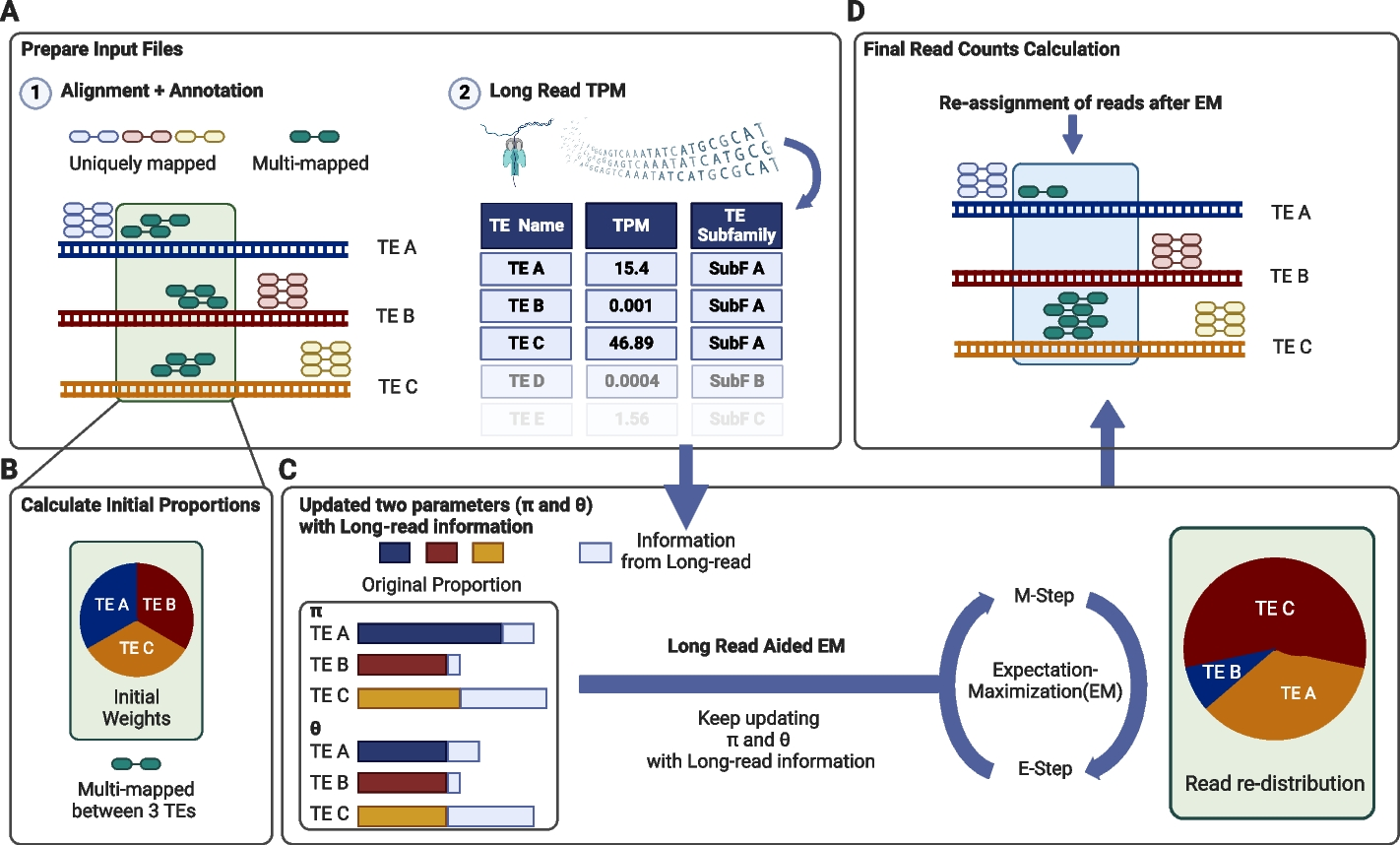
An example illustration for the LocusMasterTE pipeline is presented. A The short-read RNA sequencing data is aligned using the provided annotation file, and reads are classified into uniquely mapped and multi-mapped reads based on the alignment score. Uniquely mapped reads and multi-mapped reads are then aligned to TE A, TE B, and TE C. Long-read RNA sequencing, preferably ONT, is aligned using minimap2, and TEs are quantified using featureCounts with the same annotation file provided for short-read RNA sequencing. TPM counts for long-reads are calculated, and the belonging subfamily is provided for each individual TE. B Initially, equal weights are assigned to all three TEs—TE A, TE B, and TE C (TE A:0.33, TE B: 0.33, TE C: 0.33). C Two critical parameters, pi (π) and theta (θ), represent the proportion of fragments originating from the transcript and the proportion of non-unique fragments to be reassigned, respectively. These parameters are updated with TPM fractional values from long-read RNA sequencing. During the E-step, Maximum Likelihood Estimation (MLE) is calculated for all TEs. In the M-step, MAP estimates are updated. D Finally, after the EM algorithm coverages, best-aligned read counts are determined, leading to the final assignment of TE counts
Implications for Disease Research and Genomic Studies
Accurately quantifying TE expression is critical for understanding their role in diseases. Many studies have linked increased TE activity to conditions such as:
- Cancer – Uncontrolled TE activation can disrupt tumor suppressor genes or trigger genomic instability.
- Neurodegenerative Disorders – TE reactivation has been observed in Alzheimer’s and ALS, potentially contributing to disease progression.
- Autoimmune Diseases – Some TEs can mimic viral sequences, triggering immune responses linked to diseases like lupus.
By improving TE expression analysis, LocusMasterTE has the potential to uncover new disease mechanisms, identify novel biomarkers, and even guide therapeutic strategies targeting TE activity.
Final Thoughts
LocusMasterTE represents a significant step forward in the study of transposable elements, making it easier to quantify their expression accurately. As the field of genomics continues to evolve, tools like this will be essential for unraveling the complex roles of TEs in health and disease. Researchers now have a more precise method to explore how these “jumping genes” contribute to biological processes, potentially leading to new treatments and diagnostic tools.
Lee S, Barbour JA, Tam YM, Yang H, Huang Y, Wong JWH. (2025) LocusMasterTE: integrating long-read RNA sequencing improves locus-specific quantification of transposable element expression. Genome Biology 26(1):72. [article]
Related Posts









Transposable elements (TEs), often called “jumping genes,” are mobile DNA sequences that can relocate within the genome. While they have played a key role in evolution by reshuffling genetic material, their activity can also cause genetic instability, disrupt important genes, and contribute to various diseases, including cancer and neurological disorders. However, studying TEs has been notoriously difficult due to their repetitive nature, making it challenging to determine exactly where they are active in the genome.
Now, a research team led by researchers at University of Hong Kong has developed LocusMasterTE, a novel computational method designed to improve the accuracy of TE expression quantification. Unlike standard approaches that rely on short-read RNA sequencing (RNA-seq), LocusMasterTE leverages the power of long-read sequencing to provide more precise measurements of TE activity.
Why Is TE Quantification So Challenging?
Traditional short-read RNA sequencing is great for analyzing gene expression, but it struggles with highly repetitive sequences like TEs. When a short-read RNA-seq method encounters a TE, it often cannot determine its exact location in the genome. As a result, these sequences are “multi-mapped,” meaning they could belong to multiple places, leading to inaccurate quantification of TE expression.
Long-read sequencing, on the other hand, provides much more detailed information about full-length transcripts, which can help distinguish between different TE copies. However, long-read sequencing is still expensive and not as widely used as short-read methods. LocusMasterTE bridges this gap by integrating both technologies, making TE expression analysis more accurate and practical.
How Does LocusMasterTE Work?
LocusMasterTE combines long-read RNA-seq data with an expectation-maximization algorithm, a statistical technique that reassigns ambiguous reads based on their most likely location. This improves the resolution of TE quantification by:
- Incorporating fractional transcript per million (TPM) values from long-read sequencing, which helps assign multi-mapped reads to their correct locations.
- Refining short-read RNA-seq data to provide a more accurate estimate of TE activity in specific genomic regions.
- Enhancing the precision of TE expression quantification in both simulated and real human datasets.
Schematic overview of LocusMasterTE
An example illustration for the LocusMasterTE pipeline is presented. A The short-read RNA sequencing data is aligned using the provided annotation file, and reads are classified into uniquely mapped and multi-mapped reads based on the alignment score. Uniquely mapped reads and multi-mapped reads are then aligned to TE A, TE B, and TE C. Long-read RNA sequencing, preferably ONT, is aligned using minimap2, and TEs are quantified using featureCounts with the same annotation file provided for short-read RNA sequencing. TPM counts for long-reads are calculated, and the belonging subfamily is provided for each individual TE. B Initially, equal weights are assigned to all three TEs—TE A, TE B, and TE C (TE A:0.33, TE B: 0.33, TE C: 0.33). C Two critical parameters, pi (π) and theta (θ), represent the proportion of fragments originating from the transcript and the proportion of non-unique fragments to be reassigned, respectively. These parameters are updated with TPM fractional values from long-read RNA sequencing. During the E-step, Maximum Likelihood Estimation (MLE) is calculated for all TEs. In the M-step, MAP estimates are updated. D Finally, after the EM algorithm coverages, best-aligned read counts are determined, leading to the final assignment of TE counts
Implications for Disease Research and Genomic Studies
Accurately quantifying TE expression is critical for understanding their role in diseases. Many studies have linked increased TE activity to conditions such as:
- Cancer – Uncontrolled TE activation can disrupt tumor suppressor genes or trigger genomic instability.
- Neurodegenerative Disorders – TE reactivation has been observed in Alzheimer’s and ALS, potentially contributing to disease progression.
- Autoimmune Diseases – Some TEs can mimic viral sequences, triggering immune responses linked to diseases like lupus.
By improving TE expression analysis, LocusMasterTE has the potential to uncover new disease mechanisms, identify novel biomarkers, and even guide therapeutic strategies targeting TE activity.
Final Thoughts
LocusMasterTE represents a significant step forward in the study of transposable elements, making it easier to quantify their expression accurately. As the field of genomics continues to evolve, tools like this will be essential for unraveling the complex roles of TEs in health and disease. Researchers now have a more precise method to explore how these “jumping genes” contribute to biological processes, potentially leading to new treatments and diagnostic tools.
Lee S, Barbour JA, Tam YM, Yang H, Huang Y, Wong JWH. (2025) LocusMasterTE: integrating long-read RNA sequencing improves locus-specific quantification of transposable element expression. Genome Biology 26(1):72. [article]
Related Posts
Recent Posts
 Machine learning reveals how RNA splicing is regulated in individual cell types
 Illumina releases SpliceAI2 to help advance rare disease research
 Postdoctoral Fellow – Long-Read RNA Methods Development for Neurodegeneration
 Novel biosensor uses DNA ‘barcodes’ to uncover disease signals in cells
 GP-DHT uses single-cell RNA sequencing to map gene regulatory networks
 Boehringer taps Envisagenics’ AI to mine RNA splicing for cancer targets
RNA-Seq Products & Services


Stay Connected