Few things are as frightening for a parent as hearing that their child has a brain tumor. Names like medulloblastoma and ependymoma are overwhelming on their own. But for some families, the diagnosis becomes even more daunting if it is followed by three letters: NOS or “not otherwise specified”.
Medulloblastoma and ependymoma are among the most common pediatric brain tumors. But they are not single diseases. Each of these diagnoses encompass multiple subtypes, associated with differences in how a tumor behaves, how it responds to treatment, and how likely a child is to survive. Tumors labelled NOS don’t neatly fit into any established subtypes. For families, this ambiguity can shape treatment decisions and leave them without clear answers about what lies ahead.
Accurately classifying childhood cancers is challenging and brain tumors are particularly prone to misdiagnosis. Pediatric tumors tend to be poorly differentiated. Under a microscope, they lack the distinct features that pathologists rely on when using traditional diagnostic methods. Adding to the challenge, pediatric tumors tend to have more flexible patterns of gene activity than adult cancers. Established subtypes, often defined by a single molecular biomarker, mutation, or cellular feature, can harbor significant diversity beneath the surface.
To characterize tumors more precisely, clinicians and researchers need a deeper understanding of their underlying biology.
RNA sequencing (RNA-seq) is a powerful technique that captures a comprehensive molecular snapshot of a tumor. By measuring which genes are active in a sample and to what extent, researchers can identify disease biomarkers, cancer-driving pathways, and potential therapeutic targets. RNA-seq data can reveal unanticipated biologically significant connections that only emerge when the full molecular landscape is examined.
The most powerful application of RNA-seq in cancer is for molecular classification. Gene expression patterns alone can distinguish diverse tumor types with remarkable accuracy and carry profound prognostic implications. Given their significant molecular diversity and the challenges they present to traditional diagnostic methods, pediatric brain tumors stand to benefit enormously as RNA-seq transitions from a research tool to a clinical standard.
Bulk RNA-seq data with expression profiles for thousands of genes across thousands of brain tumor samples are publicly available. But the challenge lies in making sense of this mountain of information, by integrating, organizing, and visualizing it in ways that can be meaningfully interpreted by researchers and clinicians.
This challenge is at the heart of the work led by researchers from the Holland Lab in the Human Biology Division, who focus on bringing the hidden biology of brain tumors into view.
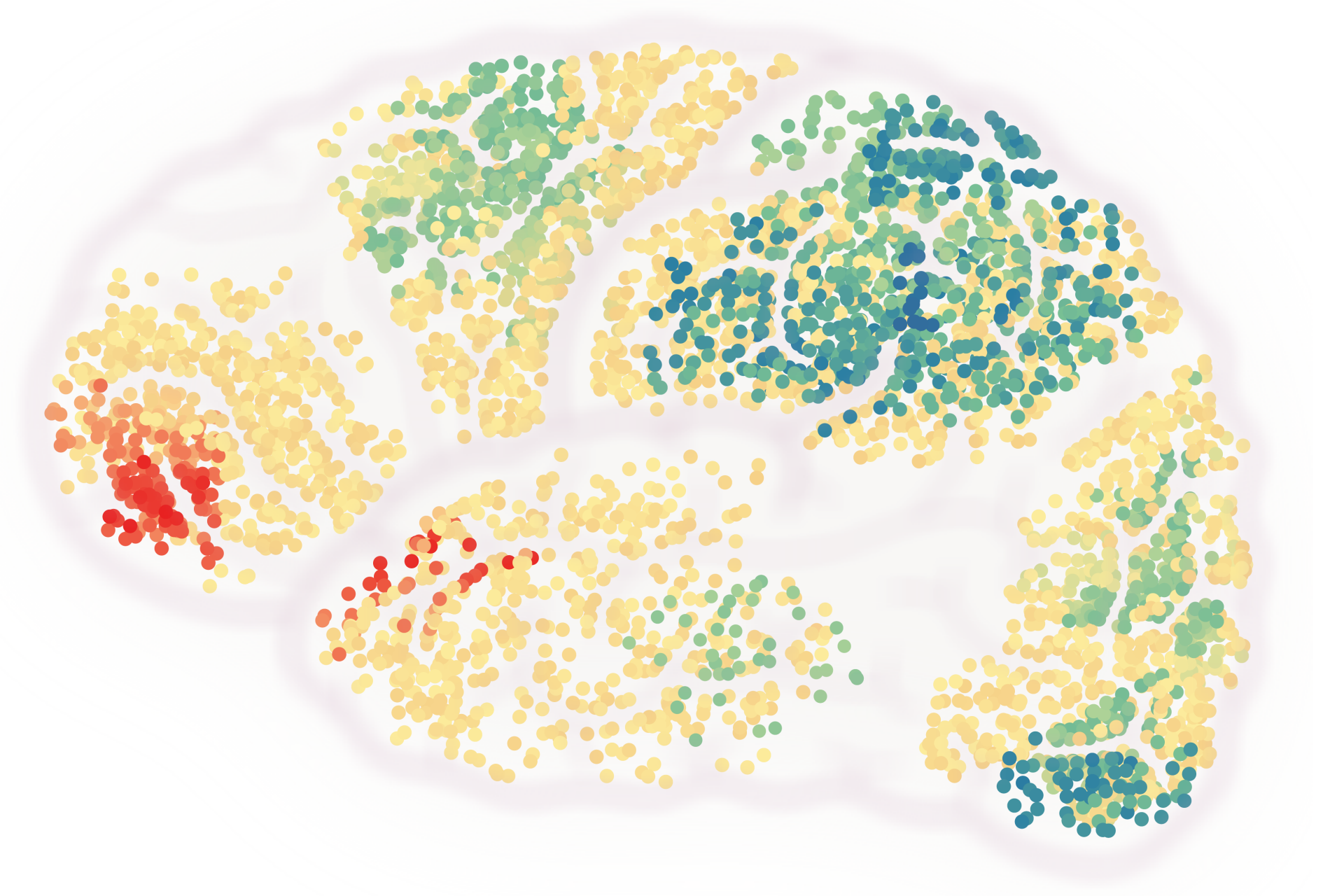
A stylized conceptual example of a reference landscape where each point represents an individual tumor sample. The map can be overlaid with data and colored to indicate differences in gene expression levels, pathway activity, or other biologically relevant information. This visualization is purely illustrative and is not derived from real data. – Image created by Thamiya Vasanthakumar
In a recent study led by computational biologist Dr. Sonali Arora, the team used RNA-seq data from 888 medulloblastomas, 370 ependymomas, and 100 healthy brain samples to create a reference landscape for pediatric brain tumor gene expression. By using computational tools and algorithms to organize, simplify, and visualize this complex dataset, researchers created a map where tumors with similar gene expression “signatures” would cluster together. Crucially, the reference landscape links gene expression patterns to biologically significant pathways, allowing researchers to explore not only which genes are active, but also which processes actually drive tumor behavior. This captures dimensions of tumor biology that can be missed when focusing on individual mutations or chromosomal alterations.
The resulting landscape recapitulated the existing clinically established subtypes for medulloblastoma and ependymoma, that correlated with distinct clinical characteristics and genetic profiles. But it also revealed some unexpected insights. For example, the WNT subtype of medulloblastoma clustered with ependymoma rather than the other medulloblastoma subtypes and alongside healthy fetal brain samples, suggesting that these tumors have biological programs characteristic of early neurodevelopment.
The analysis also uncovered hidden diversity within established subtypes. The group 3 and group 4 subtypes of medulloblastoma, long viewed as single subtypes, clustered into six distinct molecular subgroups. One of these subgroups showed a striking sex-based difference in survival, with males faring worse than females, pointing to biological differences that were previously unrecognized.
Taken together, this work offers a far more nuanced picture of pediatric brain tumors than was previously possible. However, the broader impact comes from this work being shared publicly through Oncoscape, an interactive web-based visualization platform developed at Fred Hutch.
Oncoscape allows researchers and clinicians to explore tumor biology dynamically, navigating molecular landscapes, examining gene expression patterns, and linking them to clinical features such as age, sex, and survival. By focusing on biological pathways rather than single genes, the platform turns complex RNA-seq data into a practical tool for discovery. This resource has already helped other Fred Hutch researchers identify a therapeutic target for aggressive ependymoma subtypes.
As RNA sequencing becomes more integrated into clinical care, tools like Oncoscape bring molecular classification closer to the bedside. New patient tumors can be projected onto these reference maps, helping resolve ambiguous diagnoses and guide treatment decisions. This work moves medulloblastoma and ependymoma diagnosis away from uncertainty and toward a future where every child’s tumor can be understood and treated with greater precision.
Source – Fred Hutchinson Cancer Center


Few things are as frightening for a parent as hearing that their child has a brain tumor. Names like medulloblastoma and ependymoma are overwhelming on their own. But for some families, the diagnosis becomes even more daunting if it is followed by three letters: NOS or “not otherwise specified”.
Medulloblastoma and ependymoma are among the most common pediatric brain tumors. But they are not single diseases. Each of these diagnoses encompass multiple subtypes, associated with differences in how a tumor behaves, how it responds to treatment, and how likely a child is to survive. Tumors labelled NOS don’t neatly fit into any established subtypes. For families, this ambiguity can shape treatment decisions and leave them without clear answers about what lies ahead.
Accurately classifying childhood cancers is challenging and brain tumors are particularly prone to misdiagnosis. Pediatric tumors tend to be poorly differentiated. Under a microscope, they lack the distinct features that pathologists rely on when using traditional diagnostic methods. Adding to the challenge, pediatric tumors tend to have more flexible patterns of gene activity than adult cancers. Established subtypes, often defined by a single molecular biomarker, mutation, or cellular feature, can harbor significant diversity beneath the surface.
To characterize tumors more precisely, clinicians and researchers need a deeper understanding of their underlying biology.
RNA sequencing (RNA-seq) is a powerful technique that captures a comprehensive molecular snapshot of a tumor. By measuring which genes are active in a sample and to what extent, researchers can identify disease biomarkers, cancer-driving pathways, and potential therapeutic targets. RNA-seq data can reveal unanticipated biologically significant connections that only emerge when the full molecular landscape is examined.
The most powerful application of RNA-seq in cancer is for molecular classification. Gene expression patterns alone can distinguish diverse tumor types with remarkable accuracy and carry profound prognostic implications. Given their significant molecular diversity and the challenges they present to traditional diagnostic methods, pediatric brain tumors stand to benefit enormously as RNA-seq transitions from a research tool to a clinical standard.
Bulk RNA-seq data with expression profiles for thousands of genes across thousands of brain tumor samples are publicly available. But the challenge lies in making sense of this mountain of information, by integrating, organizing, and visualizing it in ways that can be meaningfully interpreted by researchers and clinicians.
This challenge is at the heart of the work led by researchers from the Holland Lab in the Human Biology Division, who focus on bringing the hidden biology of brain tumors into view.
A stylized conceptual example of a reference landscape where each point represents an individual tumor sample. The map can be overlaid with data and colored to indicate differences in gene expression levels, pathway activity, or other biologically relevant information. This visualization is purely illustrative and is not derived from real data. – Image created by Thamiya Vasanthakumar
In a recent study led by computational biologist Dr. Sonali Arora, the team used RNA-seq data from 888 medulloblastomas, 370 ependymomas, and 100 healthy brain samples to create a reference landscape for pediatric brain tumor gene expression. By using computational tools and algorithms to organize, simplify, and visualize this complex dataset, researchers created a map where tumors with similar gene expression “signatures” would cluster together. Crucially, the reference landscape links gene expression patterns to biologically significant pathways, allowing researchers to explore not only which genes are active, but also which processes actually drive tumor behavior. This captures dimensions of tumor biology that can be missed when focusing on individual mutations or chromosomal alterations.
The resulting landscape recapitulated the existing clinically established subtypes for medulloblastoma and ependymoma, that correlated with distinct clinical characteristics and genetic profiles. But it also revealed some unexpected insights. For example, the WNT subtype of medulloblastoma clustered with ependymoma rather than the other medulloblastoma subtypes and alongside healthy fetal brain samples, suggesting that these tumors have biological programs characteristic of early neurodevelopment.
The analysis also uncovered hidden diversity within established subtypes. The group 3 and group 4 subtypes of medulloblastoma, long viewed as single subtypes, clustered into six distinct molecular subgroups. One of these subgroups showed a striking sex-based difference in survival, with males faring worse than females, pointing to biological differences that were previously unrecognized.
Taken together, this work offers a far more nuanced picture of pediatric brain tumors than was previously possible. However, the broader impact comes from this work being shared publicly through Oncoscape, an interactive web-based visualization platform developed at Fred Hutch.
Oncoscape allows researchers and clinicians to explore tumor biology dynamically, navigating molecular landscapes, examining gene expression patterns, and linking them to clinical features such as age, sex, and survival. By focusing on biological pathways rather than single genes, the platform turns complex RNA-seq data into a practical tool for discovery. This resource has already helped other Fred Hutch researchers identify a therapeutic target for aggressive ependymoma subtypes.
As RNA sequencing becomes more integrated into clinical care, tools like Oncoscape bring molecular classification closer to the bedside. New patient tumors can be projected onto these reference maps, helping resolve ambiguous diagnoses and guide treatment decisions. This work moves medulloblastoma and ependymoma diagnosis away from uncertainty and toward a future where every child’s tumor can be understood and treated with greater precision.
Source – Fred Hutchinson Cancer Center
Arora S, Nuechterlein N, Jensen M, Glatzer G, Sievers P, Varadharajan S, Korshunov A, Sahm F, Mack SC, Taylor MD, Gujral T, Holland EC. (2025) Integrated transcriptomic landscape of medulloblastoma and ependymoma reveals novel tumor subtype-specific biology. Neuro-Oncology 27(10): noaf251. [article]
Related Posts
RNAmel simplifies RNA sequencing data analysis with a reproducible, integrated platform
Heart failure reshapes bone marrow to create inflammation-related immune memory
Overlooked DNA regions surrounding ‘microexons’ hold missing pieces of autism’s genetic puzzle
RiboBA improves detection of hidden protein-coding regions using ribosome profiling
An anti-senescence gene may fight spinal disc deterioration
Scientists identify the neuroblastoma cells that signal poor outcomes
Novel biosensor uses DNA ‘barcodes’ to uncover disease signals in cells
CellART extracts single-cell information from high-resolution spatial transcriptomics
Cell2space restores spatial context to single-cell RNA sequencing data
Urine test may improve bladder cancer diagnosis and guide treatment decisions
DeCoRE – a computational method to resolve RNA structural heterogeneity from RNA structure probing data by direct RNA sequencing
Tracing 700 million years of cell evolution
How should biological replicates be handled in long-read RNA sequencing?
RNA-Seq reveals a new way the developing heart controls its growth
The Human RNome Project Consortium seeks to publish first-ever complete sequence of the body’s RNA
scFlowReport brings multiple single-cell RNA sequencing analyses into one workflow
Long-read RNA sequencing reveals how neurons choose alternative RNA endings
DeOPUS improves cell-type estimates from bulk RNA sequencing
ResolVI improves accuracy in spatial transcriptomics analysis
RNA sequencing reveals transcriptional allele differences in prostate cancer stem cells
Stay Connected
Submit a Post to the Blog
Recent Posts
Subscribe to the RNA-Seq Blog
RNA-Seq Products & Services