

Researchers from the University of Würzburg have created a high-resolution map of the proteins produced by Campylobacter jejuni, a major foodborne pathogen. Unlike larger, well-studied proteins, small proteins (typically under 100 amino acids) are difficult to detect, yet they play critical roles in bacterial survival and virulence.
To overcome this challenge, the research team used an advanced sequencing technique called Ribo-Seq, which captures the exact regions of bacterial RNA that are actively being translated into proteins. They combined this with two specialized methods: Translation Initiation Site (TIS) profiling to map where protein production begins and Translation Termination Site (TTS) profiling to identify previously unrecognized stop codons in key virulence genes.
Establishing Ribo-seq in C. jejuni with the annotated small proteome
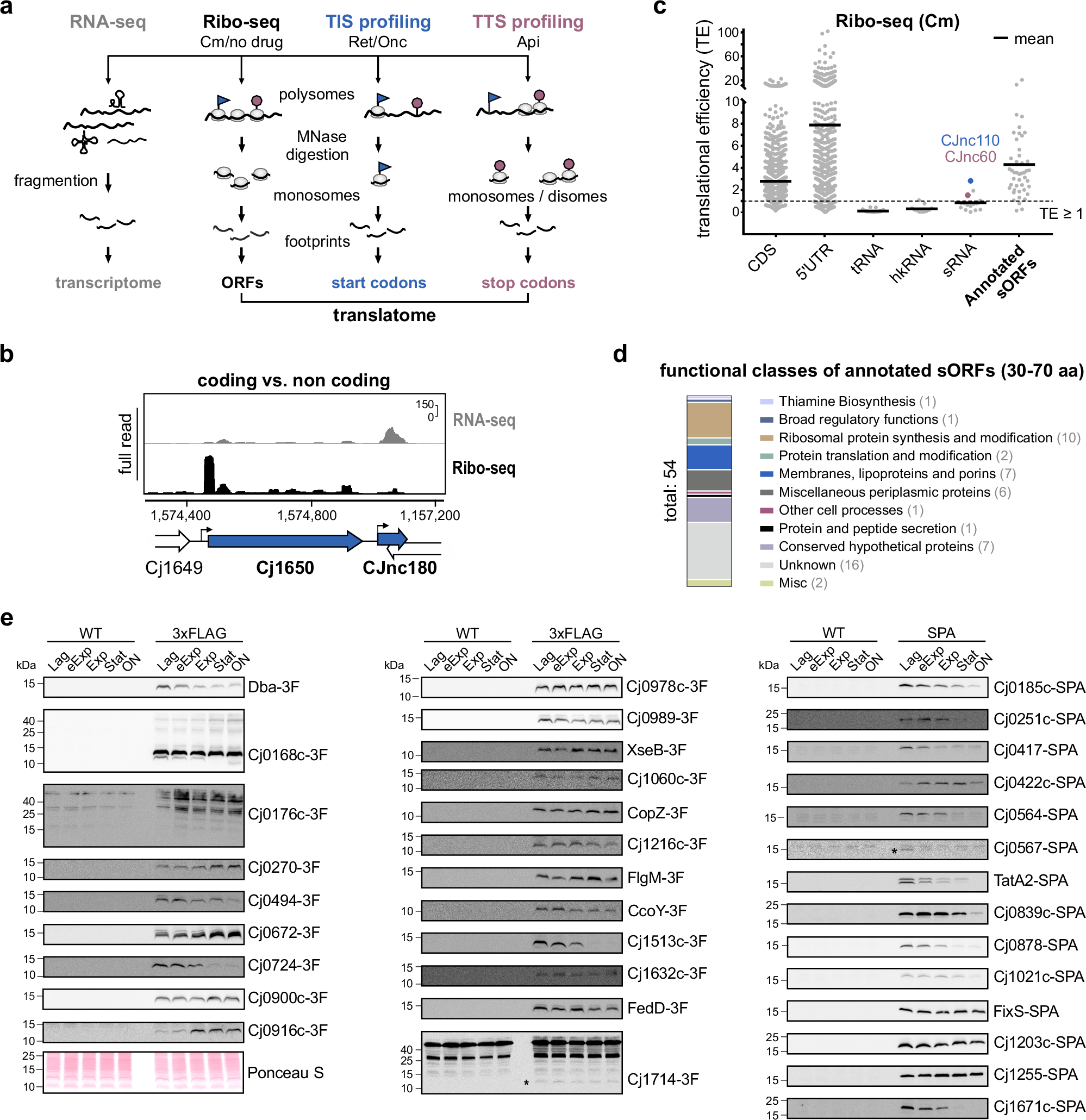
a Overview of Ribo-seq techniques applied/developed in this study. MNase: micrococcal nuclease, Cm: chloramphenicol, Onc: oncocin, Ret: retapamulin, Api: apidaecin. b Ribo-seq and paired RNA-seq distinguish the coding gene Cj1650 from the non-coding sRNA CJnc180. Y-axis: rpm (reads per million). Representative of n = 3 independent experiments. c Translational efficiency (TE: Ribo-seq/RNA-seq) from Cm-treated Ribo-seq for different feature classes in the C. jejuni annotation. A total RNA RPKM of ≥30 was required. CDS: coding sequences/ORFs. hkRNA: housekeeping RNAs. d Functional classes of annotated sORFs. See also Supplementary Data file 1. e Translation validation by western blot for annotated sORFs with C-terminal 3 × FLAG (3F) or SPA epitope tags with an anti-FLAG antibody. Ponceau S staining of membranes was used as loading control. eExp: early exponential. Stat: Stationary. ON: overnight. Untagged WT: antibody (anti-FLAG) control. Representative of n = 2 independent experiments. Asterisks: low abundance FLAG-specific bands. Source data are provided as a Source Data file.
Their findings doubled the number of known small proteins in C. jejuni, including a newly identified 34-amino-acid protein named CioY, which is involved in the bacterium’s oxidase system. This comprehensive dataset, now accessible via an interactive browser, provides an essential resource for understanding how bacterial small proteins contribute to disease and could inform future research on antibiotic targets. The study also demonstrates how integrated Ribo-Seq approaches can be applied to other bacteria to uncover hidden layers of their protein landscapes.
Froschauer K, Svensson SL, Gelhausen R, et al. (2025) Complementary Ribo-seq approaches map the translatome and provide a small protein census in the foodborne pathogen Campylobacter jejuni. Nat Commun 16:3078. [article]
Related Posts




Researchers from the University of Würzburg have created a high-resolution map of the proteins produced by Campylobacter jejuni, a major foodborne pathogen. Unlike larger, well-studied proteins, small proteins (typically under 100 amino acids) are difficult to detect, yet they play critical roles in bacterial survival and virulence.
To overcome this challenge, the research team used an advanced sequencing technique called Ribo-Seq, which captures the exact regions of bacterial RNA that are actively being translated into proteins. They combined this with two specialized methods: Translation Initiation Site (TIS) profiling to map where protein production begins and Translation Termination Site (TTS) profiling to identify previously unrecognized stop codons in key virulence genes.
Establishing Ribo-seq in C. jejuni with the annotated small proteome
a Overview of Ribo-seq techniques applied/developed in this study. MNase: micrococcal nuclease, Cm: chloramphenicol, Onc: oncocin, Ret: retapamulin, Api: apidaecin. b Ribo-seq and paired RNA-seq distinguish the coding gene Cj1650 from the non-coding sRNA CJnc180. Y-axis: rpm (reads per million). Representative of n = 3 independent experiments. c Translational efficiency (TE: Ribo-seq/RNA-seq) from Cm-treated Ribo-seq for different feature classes in the C. jejuni annotation. A total RNA RPKM of ≥30 was required. CDS: coding sequences/ORFs. hkRNA: housekeeping RNAs. d Functional classes of annotated sORFs. See also Supplementary Data file 1. e Translation validation by western blot for annotated sORFs with C-terminal 3 × FLAG (3F) or SPA epitope tags with an anti-FLAG antibody. Ponceau S staining of membranes was used as loading control. eExp: early exponential. Stat: Stationary. ON: overnight. Untagged WT: antibody (anti-FLAG) control. Representative of n = 2 independent experiments. Asterisks: low abundance FLAG-specific bands. Source data are provided as a Source Data file.
Their findings doubled the number of known small proteins in C. jejuni, including a newly identified 34-amino-acid protein named CioY, which is involved in the bacterium’s oxidase system. This comprehensive dataset, now accessible via an interactive browser, provides an essential resource for understanding how bacterial small proteins contribute to disease and could inform future research on antibiotic targets. The study also demonstrates how integrated Ribo-Seq approaches can be applied to other bacteria to uncover hidden layers of their protein landscapes.
Froschauer K, Svensson SL, Gelhausen R, et al. (2025) Complementary Ribo-seq approaches map the translatome and provide a small protein census in the foodborne pathogen Campylobacter jejuni. Nat Commun 16:3078. [article]
Related Posts
Recent Posts
 RNAmel simplifies RNA sequencing data analysis with a reproducible, integrated platform
 Heart failure reshapes bone marrow to create inflammation-related immune memory
 Overlooked DNA regions surrounding ‘microexons’ hold missing pieces of autism’s genetic puzzle
 RiboBA improves detection of hidden protein-coding regions using ribosome profiling
 An anti-senescence gene may fight spinal disc deterioration
 Bulk RNA-seq Analysis: A Complete Beginner’s Guide
RNA-Seq Products & Services


Stay Connected