

Scientists have identified thousands of genes linked to human health and disease, but understanding exactly how these genes influence biological processes remains a major challenge. Simply knowing a gene is associated with a disease doesn’t tell us how it functions, which cells it affects, or how we might target it for treatment. Perturb-seq, a powerful new method developed at Scripps Research helps researchers study gene function in living tissues at the single-cell level.
What Is In Vivo Perturb-seq?
In vivo Perturb-seq is an advanced technique that combines gene editing with single-cell RNA sequencing to analyze how specific genes influence different cell types in a living organism. It relies on adeno-associated virus (AAV) vectors to deliver gene-editing tools, such as CRISPR, directly into tissues. Scientists can then track the effects of these gene changes by analyzing how individual cells respond at the molecular level.
This approach is particularly valuable because it allows researchers to move beyond just identifying risk genes and instead pinpoint their precise roles in diseases like cancer, neurodegenerative disorders, and autoimmune conditions.
How Does the Process Work?
Conducting an in vivo Perturb-seq experiment requires expertise in mouse models, virus production, and single-cell genomics, making it a complex but powerful technique. The process involves several key steps:
- Designing the Perturbation Library – Scientists create a set of guide RNAs (gRNAs) to target specific genes of interest.
- Producing AAV Vectors – These viral carriers are used to deliver the gene-editing tools to tissues in the body.
- Administering AAV in Mice – The modified viruses are injected into mice, allowing gene perturbations to occur in a controlled manner.
- Tissue Collection & Single-Cell Analysis – After a few weeks, researchers collect tissues and perform single-cell RNA sequencing to see how the gene changes affect different cells.
- Data Analysis – Using specialized software, scientists examine how gene perturbations influence cell behavior, identifying key pathways involved in disease.
- The entire process—from designing the experiment to collecting and analyzing data—takes 9 to 15 weeks to complete.
Overview of massively parallel in vivo Perturb-seq screening
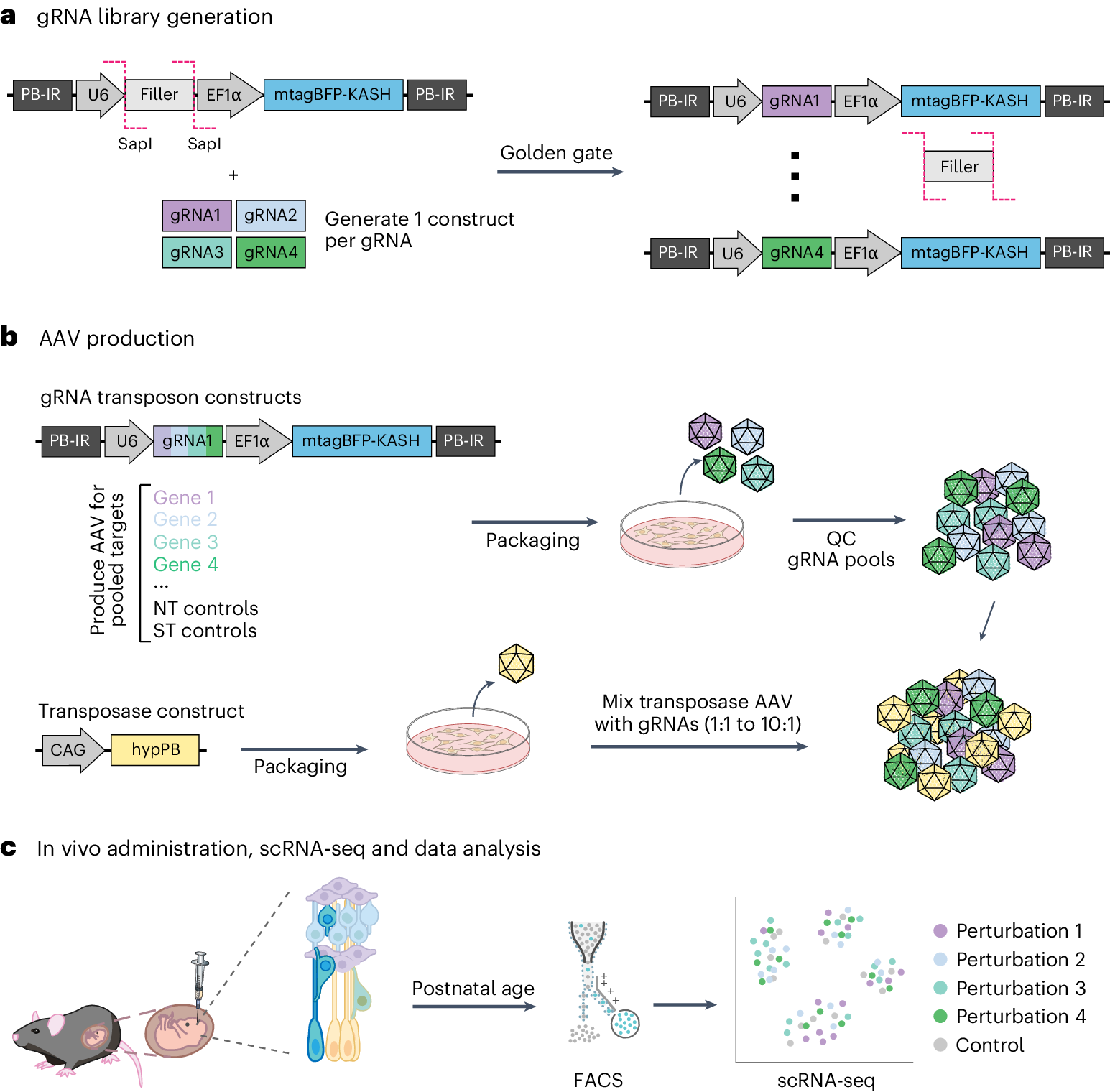
a, A gRNA library is first constructed using Golden Gate cloning to assemble vectors containing the targeting sequence while removing the filler fragment. Each plasmid cloned in arrayed format contains a single gRNA and a sortable reporter; cloned plasmids are then pooled together. IR, inverted repeat. b, The pooled plasmids containing the transposon, gRNA and reporter are packaged into AAV vectors using HEK293FT cells. The transposase (hypPB) is packaged separately. Titers for the gRNA and hypPB AAV vectors are then determined and the gRNA AAV vector is checked for gRNA distribution as a QC metric before pooling at appropriate ratios. ST, safe-targeting; NT, nontargeting. c, For experiments investigating development of the central nervous system, AAV pools are then administered to mice expressing Cas9 through in utero lateral ventricle injection at day E14.5. At P7, cortical tissue is extracted, dissociated for FACS sorting and subjected to scRNA library preparation and sequencing for molecular phenotyping.
Why Is This Important?
By enabling researchers to systematically test how genes function in living systems, in vivo Perturb-seq can accelerate discoveries in functional genomics. This could lead to:
- Better understanding of disease mechanisms – Identifying how risk genes contribute to conditions like cancer and neurodegenerative diseases.
- New drug targets – Discovering which genes and pathways might be effective targets for treatment.
- More precise therapies – Developing personalized medicine approaches based on an individual’s unique genetic makeup.
Final Thoughts
In vivo Perturb-seq represents a major step forward in genomics research. While it requires specialized expertise and resources, it provides unparalleled insights into gene function in real biological contexts. By helping researchers connect genetic risk factors to actual disease mechanisms, this technique has the potential to drive new breakthroughs in medicine.
Zheng X, Thompson PC, White CM, Jin X. (2025) Massively parallel in vivo Perturb-seq screening. Nat Protoc [Epub ahead of print]. [article]
Related Posts




Scientists have identified thousands of genes linked to human health and disease, but understanding exactly how these genes influence biological processes remains a major challenge. Simply knowing a gene is associated with a disease doesn’t tell us how it functions, which cells it affects, or how we might target it for treatment. Perturb-seq, a powerful new method developed at Scripps Research helps researchers study gene function in living tissues at the single-cell level.
What Is In Vivo Perturb-seq?
In vivo Perturb-seq is an advanced technique that combines gene editing with single-cell RNA sequencing to analyze how specific genes influence different cell types in a living organism. It relies on adeno-associated virus (AAV) vectors to deliver gene-editing tools, such as CRISPR, directly into tissues. Scientists can then track the effects of these gene changes by analyzing how individual cells respond at the molecular level.
This approach is particularly valuable because it allows researchers to move beyond just identifying risk genes and instead pinpoint their precise roles in diseases like cancer, neurodegenerative disorders, and autoimmune conditions.
How Does the Process Work?
Conducting an in vivo Perturb-seq experiment requires expertise in mouse models, virus production, and single-cell genomics, making it a complex but powerful technique. The process involves several key steps:
- Designing the Perturbation Library – Scientists create a set of guide RNAs (gRNAs) to target specific genes of interest.
- Producing AAV Vectors – These viral carriers are used to deliver the gene-editing tools to tissues in the body.
- Administering AAV in Mice – The modified viruses are injected into mice, allowing gene perturbations to occur in a controlled manner.
- Tissue Collection & Single-Cell Analysis – After a few weeks, researchers collect tissues and perform single-cell RNA sequencing to see how the gene changes affect different cells.
- Data Analysis – Using specialized software, scientists examine how gene perturbations influence cell behavior, identifying key pathways involved in disease.
- The entire process—from designing the experiment to collecting and analyzing data—takes 9 to 15 weeks to complete.
Overview of massively parallel in vivo Perturb-seq screening
a, A gRNA library is first constructed using Golden Gate cloning to assemble vectors containing the targeting sequence while removing the filler fragment. Each plasmid cloned in arrayed format contains a single gRNA and a sortable reporter; cloned plasmids are then pooled together. IR, inverted repeat. b, The pooled plasmids containing the transposon, gRNA and reporter are packaged into AAV vectors using HEK293FT cells. The transposase (hypPB) is packaged separately. Titers for the gRNA and hypPB AAV vectors are then determined and the gRNA AAV vector is checked for gRNA distribution as a QC metric before pooling at appropriate ratios. ST, safe-targeting; NT, nontargeting. c, For experiments investigating development of the central nervous system, AAV pools are then administered to mice expressing Cas9 through in utero lateral ventricle injection at day E14.5. At P7, cortical tissue is extracted, dissociated for FACS sorting and subjected to scRNA library preparation and sequencing for molecular phenotyping.
Why Is This Important?
By enabling researchers to systematically test how genes function in living systems, in vivo Perturb-seq can accelerate discoveries in functional genomics. This could lead to:
- Better understanding of disease mechanisms – Identifying how risk genes contribute to conditions like cancer and neurodegenerative diseases.
- New drug targets – Discovering which genes and pathways might be effective targets for treatment.
- More precise therapies – Developing personalized medicine approaches based on an individual’s unique genetic makeup.
Final Thoughts
In vivo Perturb-seq represents a major step forward in genomics research. While it requires specialized expertise and resources, it provides unparalleled insights into gene function in real biological contexts. By helping researchers connect genetic risk factors to actual disease mechanisms, this technique has the potential to drive new breakthroughs in medicine.
Zheng X, Thompson PC, White CM, Jin X. (2025) Massively parallel in vivo Perturb-seq screening. Nat Protoc [Epub ahead of print]. [article]
Related Posts
Recent Posts
 Machine learning reveals how RNA splicing is regulated in individual cell types
 Illumina releases SpliceAI2 to help advance rare disease research
 Postdoctoral Fellow – Long-Read RNA Methods Development for Neurodegeneration
 Novel biosensor uses DNA ‘barcodes’ to uncover disease signals in cells
 GP-DHT uses single-cell RNA sequencing to map gene regulatory networks
 Boehringer taps Envisagenics’ AI to mine RNA splicing for cancer targets
RNA-Seq Products & Services


Stay Connected