

The amount of biological sequencing data available in public databases is growing at an astonishing rate. Researchers now have access to millions of DNA and RNA sequences collected from across all forms of life, including viruses, bacteria, plants, animals, and humans. While this wealth of information is incredibly valuable, finding specific sequences within such massive datasets has been a major technical challenge.
A research team from ETH Zurich has developed MetaGraph, a new computational framework that makes it possible to efficiently search through enormous collections of genetic data. Using advanced algorithms and data structures known as annotated de Bruijn graphs, MetaGraph can compress and index petabases of sequencing data, turning previously unmanageable repositories into searchable resources.
Schematic of graph construction and representation
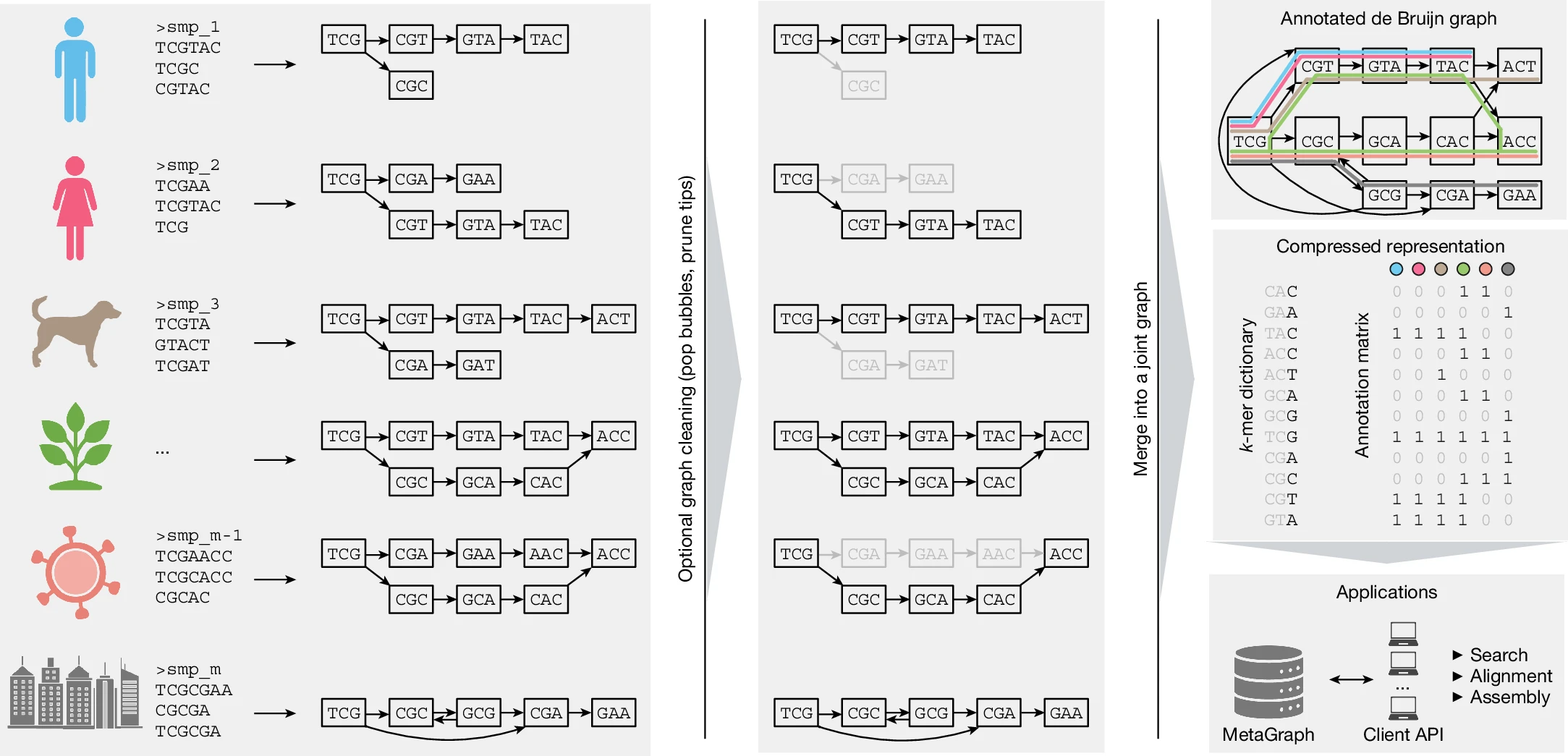
Individual sequencing samples (left) are assembled into graphs (sample graphs), which are then cleaned to remove spurious paths and misassemblies (middle). Next, the sample graphs are merged to form a MetaGraph index (top right), consisting of the compressed k-mer dictionary index and a compressed annotation matrix (middle right; the grey colour indicates parts that can be efficiently compressed and do not have to be stored explicitly). The index is then used as the basis for downstream applications, such as sequence search, assembly and other queries (bottom right).
The team integrated data from seven major public sources, creating a searchable database that includes over 18 million unique DNA and RNA sequence sets and more than 200 billion amino acid residues. Despite this enormous scale, MetaGraph enables full-text searches across all sequences for a fraction of the cost previously required. Researchers can now run complex queries that once seemed impossible, paving the way for faster discoveries in genomics, infectious disease research, and biomedical science.
By making RNA sequencing data searchable and accessible on a global scale, MetaGraph represents a key step toward connecting the world’s genetic information in a cost-effective and practical way.
Availability – The source code of the MetaGraph software is available under a GPLv3 License at GitHub (https://github.com/ratschlab/metagraph)
Karasikov M, Mustafa H, Danciu D, Kulkov O, Zimmermann M, Barber C, Rätsch G, Kahles A. (2025) Efficient and accurate search in petabase-scale sequence repositories. Nature [Epub ahead of print]. [article]
Related Posts




The amount of biological sequencing data available in public databases is growing at an astonishing rate. Researchers now have access to millions of DNA and RNA sequences collected from across all forms of life, including viruses, bacteria, plants, animals, and humans. While this wealth of information is incredibly valuable, finding specific sequences within such massive datasets has been a major technical challenge.
A research team from ETH Zurich has developed MetaGraph, a new computational framework that makes it possible to efficiently search through enormous collections of genetic data. Using advanced algorithms and data structures known as annotated de Bruijn graphs, MetaGraph can compress and index petabases of sequencing data, turning previously unmanageable repositories into searchable resources.
Schematic of graph construction and representation
Individual sequencing samples (left) are assembled into graphs (sample graphs), which are then cleaned to remove spurious paths and misassemblies (middle). Next, the sample graphs are merged to form a MetaGraph index (top right), consisting of the compressed k-mer dictionary index and a compressed annotation matrix (middle right; the grey colour indicates parts that can be efficiently compressed and do not have to be stored explicitly). The index is then used as the basis for downstream applications, such as sequence search, assembly and other queries (bottom right).
The team integrated data from seven major public sources, creating a searchable database that includes over 18 million unique DNA and RNA sequence sets and more than 200 billion amino acid residues. Despite this enormous scale, MetaGraph enables full-text searches across all sequences for a fraction of the cost previously required. Researchers can now run complex queries that once seemed impossible, paving the way for faster discoveries in genomics, infectious disease research, and biomedical science.
By making RNA sequencing data searchable and accessible on a global scale, MetaGraph represents a key step toward connecting the world’s genetic information in a cost-effective and practical way.
Availability – The source code of the MetaGraph software is available under a GPLv3 License at GitHub (https://github.com/ratschlab/metagraph)
Karasikov M, Mustafa H, Danciu D, Kulkov O, Zimmermann M, Barber C, Rätsch G, Kahles A. (2025) Efficient and accurate search in petabase-scale sequence repositories. Nature [Epub ahead of print]. [article]
Related Posts
Recent Posts
 Scientists identify the neuroblastoma cells that signal poor outcomes
 GARAGE improves rare cell detection in single-cell RNA sequencing analysis using AI
 Machine learning reveals how RNA splicing is regulated in individual cell types
 Illumina releases SpliceAI2 to help advance rare disease research
 Postdoctoral Fellow – Long-Read RNA Methods Development for Neurodegeneration
 Novel biosensor uses DNA ‘barcodes’ to uncover disease signals in cells
RNA-Seq Products & Services


Stay Connected