

MicroRNAs (miRNAs) are small molecules that play a key role in regulating gene expression, affecting which proteins and long non-coding RNAs (lncRNAs) are produced in cells. Their activity can vary across different cell types and systems, influencing how cells function in both healthy and disease states. When miRNAs are active, they typically reduce the levels of their target genes by preventing the production of specific proteins and RNA molecules.
In a new study, researchers at Reichman University introduced a method called miTEA-HiRes, which helps to analyze miRNA activity at a high resolution. This technique is designed to work with single-cell transcriptomics (which looks at the gene activity of individual cells), type-specific cell populations, and spatial transcriptomics (which tracks gene activity in different areas of tissue). By comparing miRNA activity in various conditions, researchers can identify how miRNA activity changes in different scenarios.
miTEA-HiRes pipeline
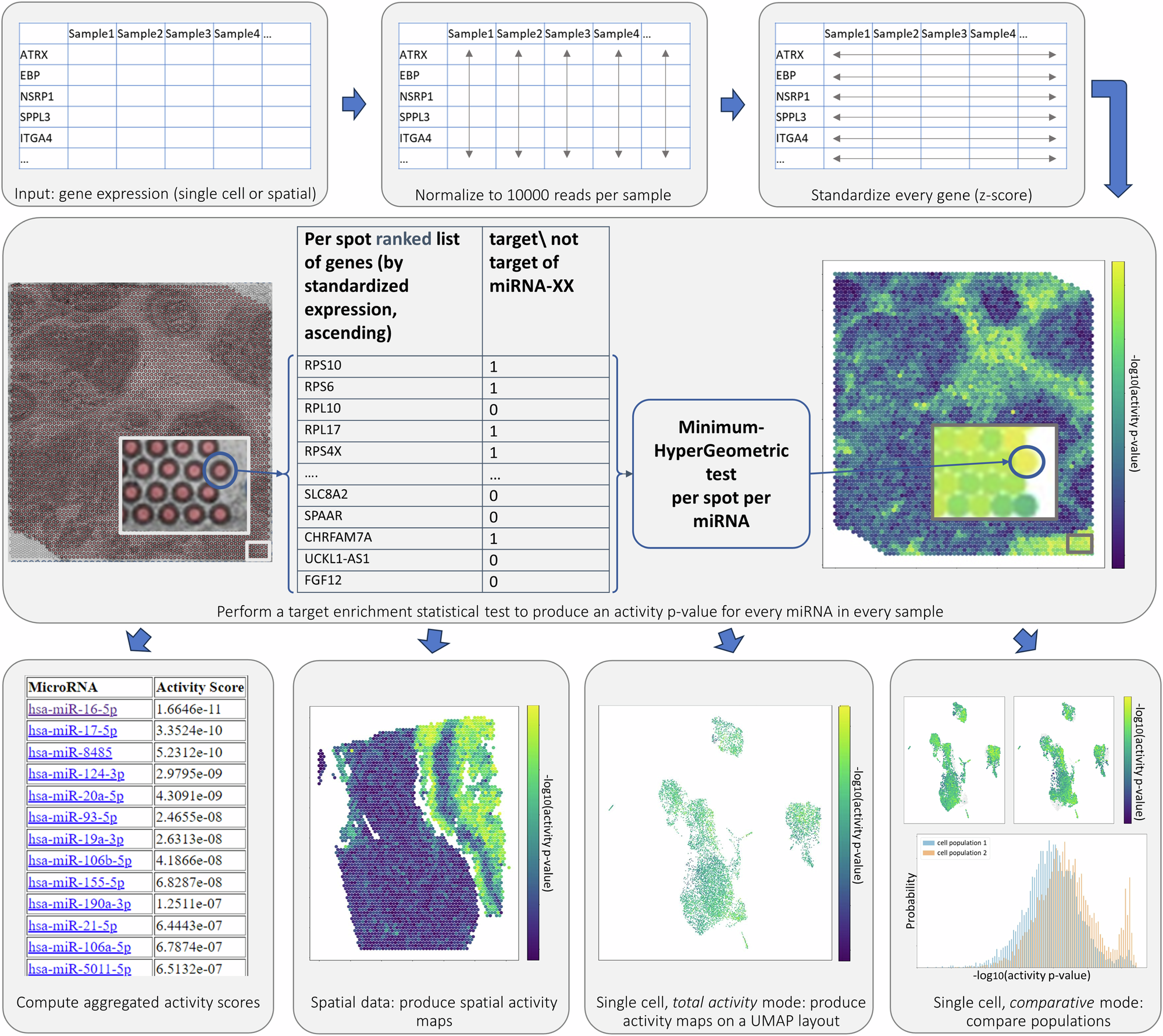
Top row: normalization and standardization. Middle row: computation of activity p-values (shown for spatial data. The same process applies to single-cell data). Bottom row: computation of aggregated activity scores (for all data types); Generation of spatial activity maps for spatial data, or activity maps on a UMAP layout for single-cell data; Statistical comparison between activity p-values of different cell populations for single-cell data in comparative activity mode. See text and Methods for more details.
One of the study’s key findings was the use of miTEA-HiRes to analyze miRNA activity in the blood cells of people with Multiple Sclerosis (MS). The analysis revealed that miR-20a-5p, a specific miRNA, was less active in MS patients, consistent with previous research showing miRNA underexpression in the disease. The study also identified differential activity of miR-519a-3p in specific types of cells, which could offer new insights into how miRNAs contribute to disease.
miTEA-HiRes holds promise for advancing our understanding of miRNA regulation in health and disease. By analyzing miRNA activity at such a detailed level, researchers can gain insights into how miRNAs influence disease development and how they could potentially be targeted for therapeutic purposes.
Herbst E, Mandel-Gutfreund Y, Yakhini Z, Biran H. (2025) Inferring single-cell and spatial microRNA activity from transcriptomics data. Commun Biol [Epub ahead of print]. [article]
Related Posts






MicroRNAs (miRNAs) are small molecules that play a key role in regulating gene expression, affecting which proteins and long non-coding RNAs (lncRNAs) are produced in cells. Their activity can vary across different cell types and systems, influencing how cells function in both healthy and disease states. When miRNAs are active, they typically reduce the levels of their target genes by preventing the production of specific proteins and RNA molecules.
In a new study, researchers at Reichman University introduced a method called miTEA-HiRes, which helps to analyze miRNA activity at a high resolution. This technique is designed to work with single-cell transcriptomics (which looks at the gene activity of individual cells), type-specific cell populations, and spatial transcriptomics (which tracks gene activity in different areas of tissue). By comparing miRNA activity in various conditions, researchers can identify how miRNA activity changes in different scenarios.
miTEA-HiRes pipeline
Top row: normalization and standardization. Middle row: computation of activity p-values (shown for spatial data. The same process applies to single-cell data). Bottom row: computation of aggregated activity scores (for all data types); Generation of spatial activity maps for spatial data, or activity maps on a UMAP layout for single-cell data; Statistical comparison between activity p-values of different cell populations for single-cell data in comparative activity mode. See text and Methods for more details.
One of the study’s key findings was the use of miTEA-HiRes to analyze miRNA activity in the blood cells of people with Multiple Sclerosis (MS). The analysis revealed that miR-20a-5p, a specific miRNA, was less active in MS patients, consistent with previous research showing miRNA underexpression in the disease. The study also identified differential activity of miR-519a-3p in specific types of cells, which could offer new insights into how miRNAs contribute to disease.
miTEA-HiRes holds promise for advancing our understanding of miRNA regulation in health and disease. By analyzing miRNA activity at such a detailed level, researchers can gain insights into how miRNAs influence disease development and how they could potentially be targeted for therapeutic purposes.
Herbst E, Mandel-Gutfreund Y, Yakhini Z, Biran H. (2025) Inferring single-cell and spatial microRNA activity from transcriptomics data. Commun Biol [Epub ahead of print]. [article]
Related Posts
Recent Posts
 Scientists identify the neuroblastoma cells that signal poor outcomes
 GARAGE improves rare cell detection in single-cell RNA sequencing analysis using AI
 Machine learning reveals how RNA splicing is regulated in individual cell types
 Illumina releases SpliceAI2 to help advance rare disease research
 Postdoctoral Fellow – Long-Read RNA Methods Development for Neurodegeneration
 Novel biosensor uses DNA ‘barcodes’ to uncover disease signals in cells
RNA-Seq Products & Services


Stay Connected