

Mitochondria are often called the powerhouses of the cell, and they have their own genetic material known as mitochondrial DNA, or mtDNA. Unlike most DNA in the cell, mtDNA exists in many copies, and mutations may only affect some of those copies, a condition known as heteroplasmy. Researchers at the University of Cambridge explored how the cell controls mtDNA levels and responds to mutations.
To do this, the team used a method called MitoPerturb-Seq, which combines CRISPR gene editing with single-cell RNA sequencing. This approach allows scientists to turn off specific nuclear genes and observe how individual cells respond at the RNA level. By studying thousands of cells at once, they were able to identify how different genes influence mitochondrial function.
MitoPerturb-Seq combines single-cell CRISPR screening with whole-cell multiome in heteroplasmic cells
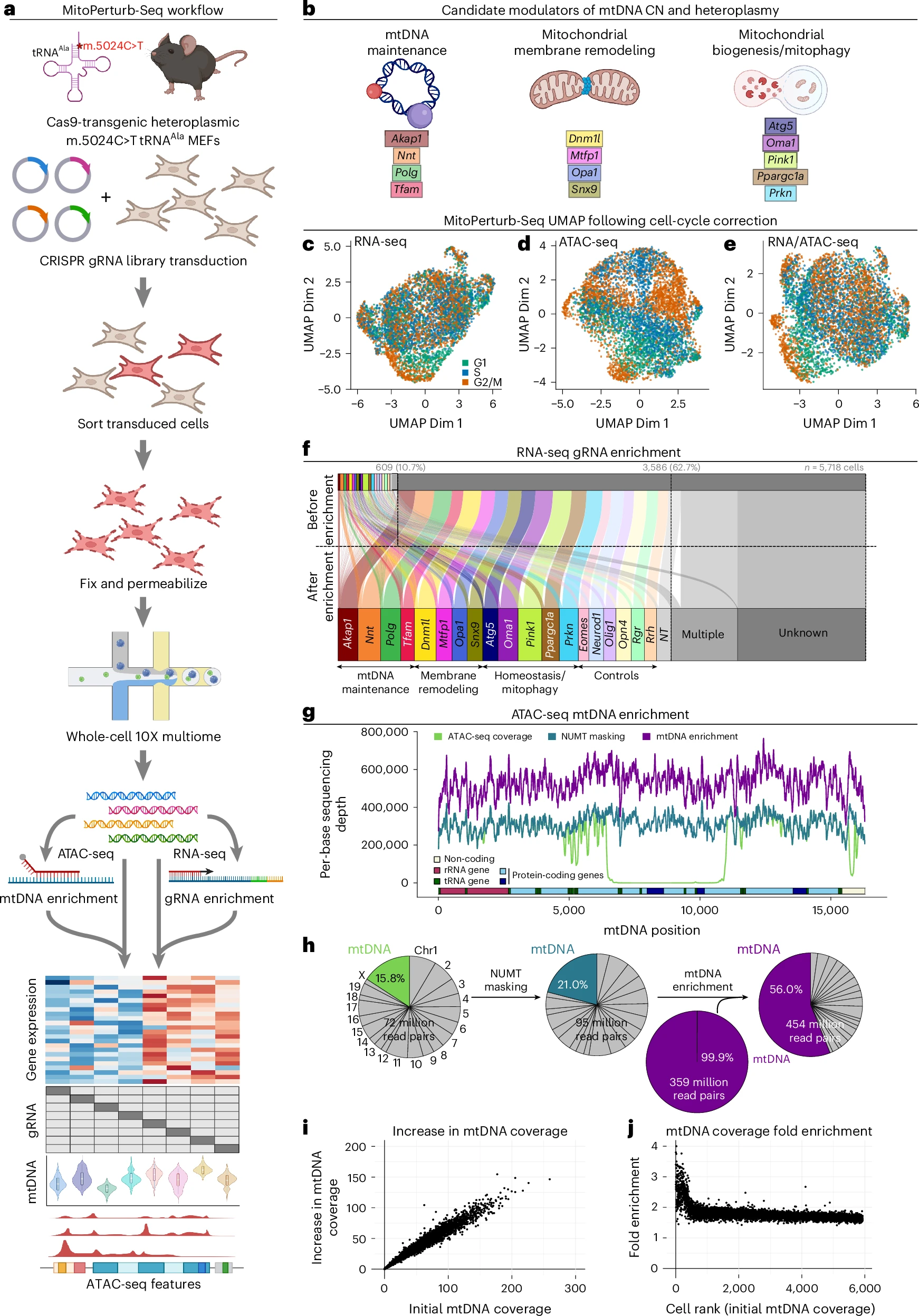
a, Overview of the MitoPerturb-Seq experimental workflow in heteroplasmic MEFs. b, Candidate genes included in the MitoPerturb-Seq pooled gRNA library. c–e, UMAPs showing MitoPerturb-Seq cells, clustered on the basis of overall RNA-seq expression (c), chromatin accessibility (d) and a combined WNN analysis (e), following regression of cell-cycle heterogeneity from the RNA-seq dataset. Cells are colored by cell-cycle phase. f, MitoPerturb-Seq target gene assignments before and after gRNA enrichment. Target genes are colored as in b. The total number of cells and the number of cells with gRNA assignments before and after enrichment are indicated above the plot. g,h, Per-base coverage (g) or percentage of ATAC-seq reads (h) aligning to the mtDNA, following alignment to the standard mm10 genome (light green) or to an NUMT-masked mm10 genome before (dark green) and after (purple) hybridization-capture-based mtDNA enrichment. i,j, Per-cell absolute (i) or fold (j) increase in mtDNA coverage following mtDNA enrichment, compared to initial coverage before enrichment (i) or to cells ordered by initial mtDNA coverage (j).
The researchers focused on genes involved in maintaining mtDNA and tested what happens when these genes are disrupted. They found that certain gene knockouts triggered a cellular stress response, particularly when mtDNA levels dropped. This response affected how cells grow and divide, slowing down proliferation regardless of the stage of the cell cycle.
Interestingly, the stress response was only partly controlled by a well-known pathway involving the ATF4 protein. This suggests that additional mechanisms are involved in how cells sense and adapt to mitochondrial dysfunction. The findings also showed that different genes can trigger distinct responses, highlighting the complexity of mitochondrial regulation.
These insights are important because changes in mtDNA copy number and heteroplasmy are linked to a wide range of diseases, including rare mitochondrial disorders and common neurodegenerative conditions. By using RNA sequencing to map these cellular responses, researchers can better understand how mitochondrial dysfunction develops and identify potential therapeutic targets.
Overall, this work provides a deeper look at how nuclear genes regulate mitochondrial health at the single-cell level. It also demonstrates how combining CRISPR with RNA sequencing can uncover detailed biological processes that are difficult to study using traditional methods.
Burr SP, Auckland K, Glynos A, Dhawanjewar A, Ryall C, Wei W, Hynes-Allen A, Prater M, Sczaniecka-Clift M, Prudent J, Chinnery PF, van den Ameele J. (2026) MitoPerturb-Seq identifies gene-specific single-cell responses to mitochondrial DNA depletion and heteroplasmy. Nature Structural and Molecular Biology [Epub ahead of print]. [article]
Related Posts






Mitochondria are often called the powerhouses of the cell, and they have their own genetic material known as mitochondrial DNA, or mtDNA. Unlike most DNA in the cell, mtDNA exists in many copies, and mutations may only affect some of those copies, a condition known as heteroplasmy. Researchers at the University of Cambridge explored how the cell controls mtDNA levels and responds to mutations.
To do this, the team used a method called MitoPerturb-Seq, which combines CRISPR gene editing with single-cell RNA sequencing. This approach allows scientists to turn off specific nuclear genes and observe how individual cells respond at the RNA level. By studying thousands of cells at once, they were able to identify how different genes influence mitochondrial function.
MitoPerturb-Seq combines single-cell CRISPR screening with whole-cell multiome in heteroplasmic cells
a, Overview of the MitoPerturb-Seq experimental workflow in heteroplasmic MEFs. b, Candidate genes included in the MitoPerturb-Seq pooled gRNA library. c–e, UMAPs showing MitoPerturb-Seq cells, clustered on the basis of overall RNA-seq expression (c), chromatin accessibility (d) and a combined WNN analysis (e), following regression of cell-cycle heterogeneity from the RNA-seq dataset. Cells are colored by cell-cycle phase. f, MitoPerturb-Seq target gene assignments before and after gRNA enrichment. Target genes are colored as in b. The total number of cells and the number of cells with gRNA assignments before and after enrichment are indicated above the plot. g,h, Per-base coverage (g) or percentage of ATAC-seq reads (h) aligning to the mtDNA, following alignment to the standard mm10 genome (light green) or to an NUMT-masked mm10 genome before (dark green) and after (purple) hybridization-capture-based mtDNA enrichment. i,j, Per-cell absolute (i) or fold (j) increase in mtDNA coverage following mtDNA enrichment, compared to initial coverage before enrichment (i) or to cells ordered by initial mtDNA coverage (j).
The researchers focused on genes involved in maintaining mtDNA and tested what happens when these genes are disrupted. They found that certain gene knockouts triggered a cellular stress response, particularly when mtDNA levels dropped. This response affected how cells grow and divide, slowing down proliferation regardless of the stage of the cell cycle.
Interestingly, the stress response was only partly controlled by a well-known pathway involving the ATF4 protein. This suggests that additional mechanisms are involved in how cells sense and adapt to mitochondrial dysfunction. The findings also showed that different genes can trigger distinct responses, highlighting the complexity of mitochondrial regulation.
These insights are important because changes in mtDNA copy number and heteroplasmy are linked to a wide range of diseases, including rare mitochondrial disorders and common neurodegenerative conditions. By using RNA sequencing to map these cellular responses, researchers can better understand how mitochondrial dysfunction develops and identify potential therapeutic targets.
Overall, this work provides a deeper look at how nuclear genes regulate mitochondrial health at the single-cell level. It also demonstrates how combining CRISPR with RNA sequencing can uncover detailed biological processes that are difficult to study using traditional methods.
Burr SP, Auckland K, Glynos A, Dhawanjewar A, Ryall C, Wei W, Hynes-Allen A, Prater M, Sczaniecka-Clift M, Prudent J, Chinnery PF, van den Ameele J. (2026) MitoPerturb-Seq identifies gene-specific single-cell responses to mitochondrial DNA depletion and heteroplasmy. Nature Structural and Molecular Biology [Epub ahead of print]. [article]
Related Posts
Recent Posts
 RNAmel simplifies RNA sequencing data analysis with a reproducible, integrated platform
 Heart failure reshapes bone marrow to create inflammation-related immune memory
 Overlooked DNA regions surrounding ‘microexons’ hold missing pieces of autism’s genetic puzzle
 RiboBA improves detection of hidden protein-coding regions using ribosome profiling
 An anti-senescence gene may fight spinal disc deterioration
 Bulk RNA-seq Analysis: A Complete Beginner’s Guide
RNA-Seq Products & Services



Stay Connected