

Kawasaki disease is a serious condition in children that causes inflammation of blood vessels and is the leading cause of acquired heart disease in pediatric patients. Diagnosing Kawasaki disease can be challenging because children present with different symptoms, making it difficult to classify the severity and type of disease. Researchers at Cornell University used cell-free RNA sequencing to examine blood samples from 98 children with Kawasaki disease, 86 children with other fevers, and 5 healthy children.
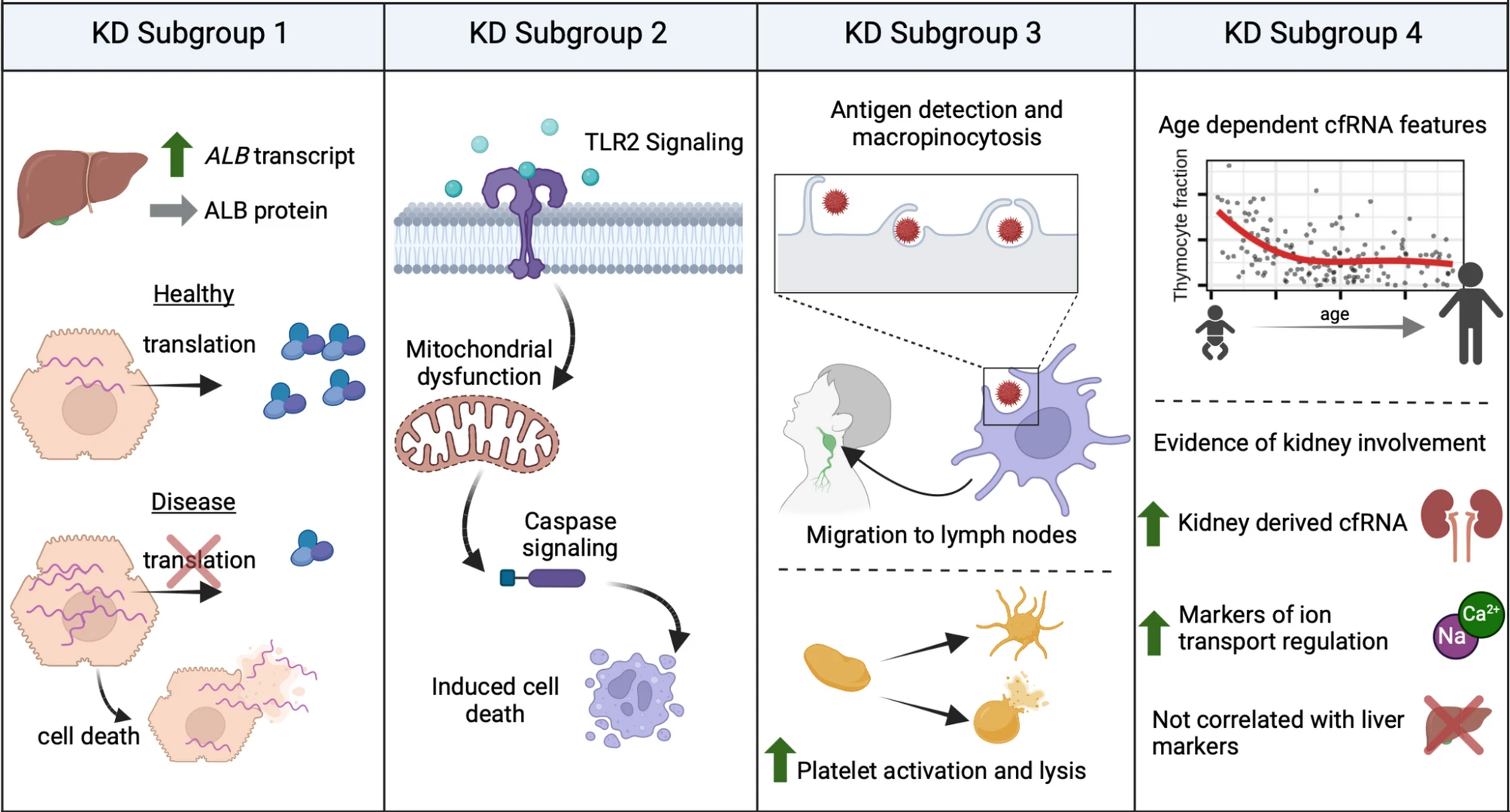
By analyzing cell-free RNA, which is RNA freely circulating in the blood after being released from cells, the team was able to detect differences in gene activity among Kawasaki disease patients. They discovered variations in markers related to liver cell injury, mitochondrial function, platelet activity, and development, which helped distinguish four clinical subgroups of Kawasaki disease. These RNA profiles may act as biomarkers, providing a way to stratify patients more accurately and offering insights into the underlying mechanisms of specific disease types. The findings highlight the power of RNA sequencing to better understand complex diseases and guide improved treatment strategies for children affected by Kawasaki disease.
Loy CJ, Wang H, Kim J, Shimizu C, Lenz J, Belcher E, Tremoulet AH, Burns JC, De Vlaminck I. (2025) Molecular characterization of Kawasaki disease subgroups using cell-free RNA profiling. Sci Rep 15:29799. [article]
Related Posts






Kawasaki disease is a serious condition in children that causes inflammation of blood vessels and is the leading cause of acquired heart disease in pediatric patients. Diagnosing Kawasaki disease can be challenging because children present with different symptoms, making it difficult to classify the severity and type of disease. Researchers at Cornell University used cell-free RNA sequencing to examine blood samples from 98 children with Kawasaki disease, 86 children with other fevers, and 5 healthy children.
By analyzing cell-free RNA, which is RNA freely circulating in the blood after being released from cells, the team was able to detect differences in gene activity among Kawasaki disease patients. They discovered variations in markers related to liver cell injury, mitochondrial function, platelet activity, and development, which helped distinguish four clinical subgroups of Kawasaki disease. These RNA profiles may act as biomarkers, providing a way to stratify patients more accurately and offering insights into the underlying mechanisms of specific disease types. The findings highlight the power of RNA sequencing to better understand complex diseases and guide improved treatment strategies for children affected by Kawasaki disease.
Loy CJ, Wang H, Kim J, Shimizu C, Lenz J, Belcher E, Tremoulet AH, Burns JC, De Vlaminck I. (2025) Molecular characterization of Kawasaki disease subgroups using cell-free RNA profiling. Sci Rep 15:29799. [article]
Related Posts
Recent Posts
 RNAmel simplifies RNA sequencing data analysis with a reproducible, integrated platform
 Heart failure reshapes bone marrow to create inflammation-related immune memory
 Overlooked DNA regions surrounding ‘microexons’ hold missing pieces of autism’s genetic puzzle
 RiboBA improves detection of hidden protein-coding regions using ribosome profiling
 An anti-senescence gene may fight spinal disc deterioration
 Bulk RNA-seq Analysis: A Complete Beginner’s Guide
RNA-Seq Products & Services



Stay Connected