

The world of genomics has rapidly advanced in recent years, with single-cell technologies enabling scientists to study millions of individual cells. These techniques allow us to understand how cells function and interact with one another in various tissues, which is crucial for understanding everything from development to disease. However, there are challenges in capturing the full complexity of these processes. For instance, scientists have struggled to study cells as they change over time (temporal dynamics) and in their natural positions within tissues (spatial context).
To overcome these challenges, researchers at the Helmholtz Center, Munich have developed a new method called multi-omics single-cell optimal transport (moscot). This method combines multiple types of data (multi-omics), like gene expression and chromatin accessibility, with a process called optimal transport, which helps to match up and align complex datasets. By using moscot, researchers can better capture how cells behave in both time and space, making it possible to see the bigger picture of how biological processes unfold.
Moscot enables efficient multimodal OT across single-cell applications
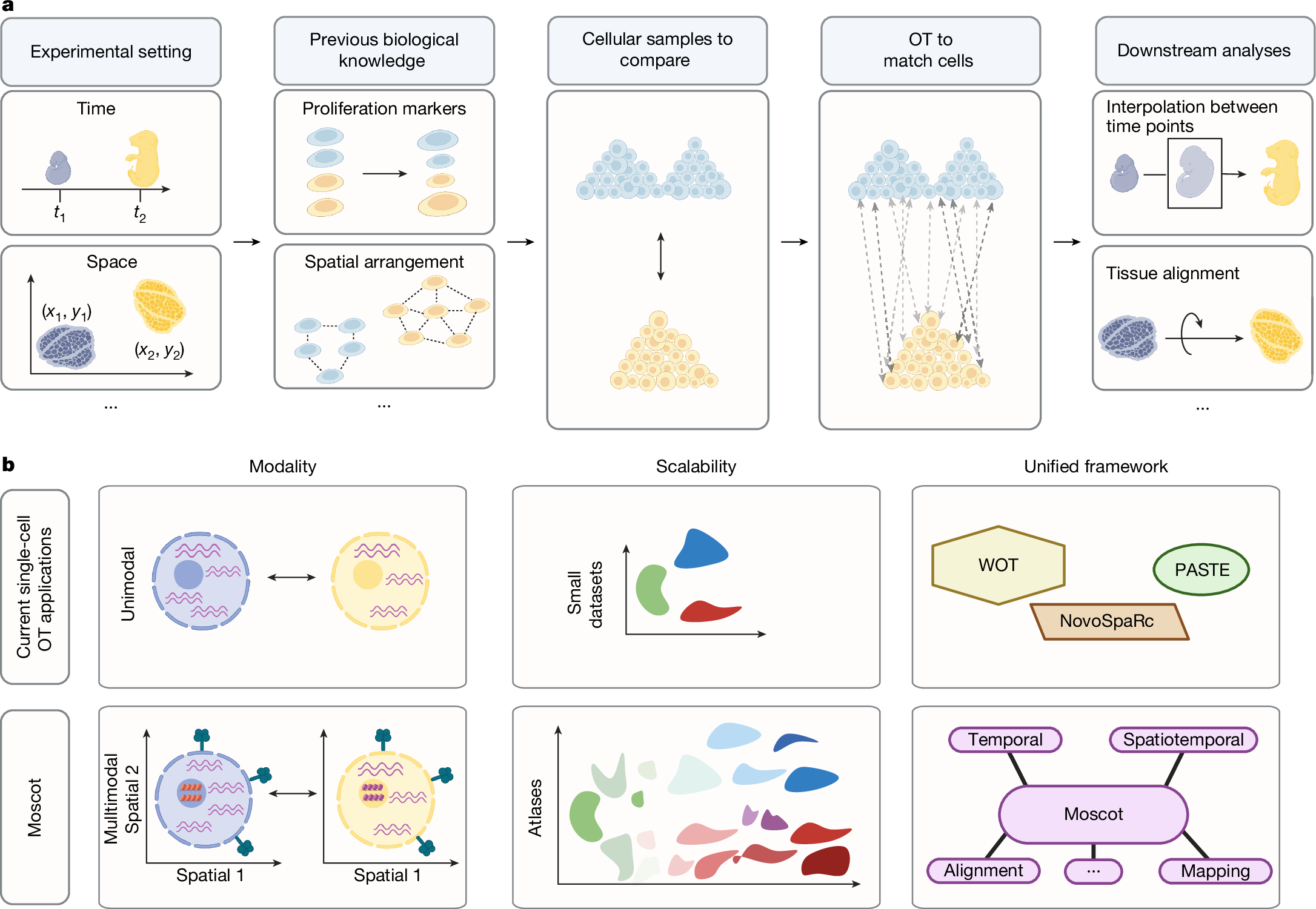
a, Schematic of a generic OT pipeline for single-cell genomic analyses (from left to right): experimental shifts (for example, time points and different spatial slides) lead to disparate cell populations. Previous biological knowledge (for example, proliferation rates and spatial arrangement) is often available and should be used to guide the mapping process. OT aligns cellular distributions by minimizing the displacement cost. The learnt mapping facilitates various downstream analysis opportunities. b, Moscot introduces three key innovations that unlock the full power of OT. First, it supports multimodal data across all models. Second, it overcomes previous scalability limitations to enable atlas-scale applications. Third, moscot is a unified framework with a consistent API across biological problems, which will facilitate usability and enable extensions to new problems in a straightforward manner.
Mapping Developmental Trajectories Across Time
One of the standout capabilities of moscot is its ability to track developmental changes over time. In a recent study, moscot was used to analyze 1.7 million cells from mouse embryos across 20 time points. This allowed scientists to uncover detailed insights into how cells change as embryos develop, providing a clearer understanding of the dynamic process of development. The approach is scalable, meaning it can be used to analyze even larger datasets in the future.
Unlocking the Mystery of Tissue Architecture
Another exciting application of moscot is in studying tissue architecture. Scientists used moscot to map gene expression data from a mouse liver and even align different brain sections. This helped enrich existing spatial transcriptomic datasets, allowing for a more detailed understanding of how cells are organized in space. By combining spatial and temporal data, moscot also helped uncover the spatiotemporal dynamics of embryonic development, providing a clearer picture of how tissues grow and change over time.
Understanding Endocrine Lineages in the Pancreas
In addition to its power in developmental biology, moscot is also helping to study disease processes. For example, researchers used it to analyze how different types of cells in the pancreas develop and relate to each other. By analyzing gene expression and chromatin accessibility data from a pancreas development dataset, moscot helped resolve the relationships between specific cells involved in endocrine functions. This insight was confirmed through experiments showing that NEUROD2 is a key regulator of certain pancreatic cells.
The Power of Open-Source Tools
Perhaps one of the most exciting aspects of moscot is that it is available as open-source software, making it accessible to a wide range of researchers. This gives the scientific community the tools needed to conduct large-scale studies on cell development, tissue organization, and disease, all while advancing our understanding of complex biological systems.
Conclusion
The moscot framework opens up new possibilities in single-cell genomics. By integrating data from multiple biological layers (like gene expression and chromatin structure) and analyzing cells in both temporal and spatial contexts, moscot provides a more complete understanding of biological processes. This technology has the potential to drive major advances in developmental biology, disease research, and personalized medicine, offering insights that could one day lead to more targeted therapies and treatments.
Klein D, Palla G, Lange M, Klein M, Piran Z, Gander M, Meng-Papaxanthos L, Sterr M, Saber L, Jing C, Bastidas-Ponce A, Cota P, Tarquis-Medina M, Parikh S, Gold I, Lickert H, Bakhti M, Nitzan M, Cuturi M, Theis FJ. (2025) Mapping cells through time and space with moscot. Nature [Epub ahead of print]. [article]
Related Posts




The world of genomics has rapidly advanced in recent years, with single-cell technologies enabling scientists to study millions of individual cells. These techniques allow us to understand how cells function and interact with one another in various tissues, which is crucial for understanding everything from development to disease. However, there are challenges in capturing the full complexity of these processes. For instance, scientists have struggled to study cells as they change over time (temporal dynamics) and in their natural positions within tissues (spatial context).
To overcome these challenges, researchers at the Helmholtz Center, Munich have developed a new method called multi-omics single-cell optimal transport (moscot). This method combines multiple types of data (multi-omics), like gene expression and chromatin accessibility, with a process called optimal transport, which helps to match up and align complex datasets. By using moscot, researchers can better capture how cells behave in both time and space, making it possible to see the bigger picture of how biological processes unfold.
Moscot enables efficient multimodal OT across single-cell applications
a, Schematic of a generic OT pipeline for single-cell genomic analyses (from left to right): experimental shifts (for example, time points and different spatial slides) lead to disparate cell populations. Previous biological knowledge (for example, proliferation rates and spatial arrangement) is often available and should be used to guide the mapping process. OT aligns cellular distributions by minimizing the displacement cost. The learnt mapping facilitates various downstream analysis opportunities. b, Moscot introduces three key innovations that unlock the full power of OT. First, it supports multimodal data across all models. Second, it overcomes previous scalability limitations to enable atlas-scale applications. Third, moscot is a unified framework with a consistent API across biological problems, which will facilitate usability and enable extensions to new problems in a straightforward manner.
Mapping Developmental Trajectories Across Time
One of the standout capabilities of moscot is its ability to track developmental changes over time. In a recent study, moscot was used to analyze 1.7 million cells from mouse embryos across 20 time points. This allowed scientists to uncover detailed insights into how cells change as embryos develop, providing a clearer understanding of the dynamic process of development. The approach is scalable, meaning it can be used to analyze even larger datasets in the future.
Unlocking the Mystery of Tissue Architecture
Another exciting application of moscot is in studying tissue architecture. Scientists used moscot to map gene expression data from a mouse liver and even align different brain sections. This helped enrich existing spatial transcriptomic datasets, allowing for a more detailed understanding of how cells are organized in space. By combining spatial and temporal data, moscot also helped uncover the spatiotemporal dynamics of embryonic development, providing a clearer picture of how tissues grow and change over time.
Understanding Endocrine Lineages in the Pancreas
In addition to its power in developmental biology, moscot is also helping to study disease processes. For example, researchers used it to analyze how different types of cells in the pancreas develop and relate to each other. By analyzing gene expression and chromatin accessibility data from a pancreas development dataset, moscot helped resolve the relationships between specific cells involved in endocrine functions. This insight was confirmed through experiments showing that NEUROD2 is a key regulator of certain pancreatic cells.
The Power of Open-Source Tools
Perhaps one of the most exciting aspects of moscot is that it is available as open-source software, making it accessible to a wide range of researchers. This gives the scientific community the tools needed to conduct large-scale studies on cell development, tissue organization, and disease, all while advancing our understanding of complex biological systems.
Conclusion
The moscot framework opens up new possibilities in single-cell genomics. By integrating data from multiple biological layers (like gene expression and chromatin structure) and analyzing cells in both temporal and spatial contexts, moscot provides a more complete understanding of biological processes. This technology has the potential to drive major advances in developmental biology, disease research, and personalized medicine, offering insights that could one day lead to more targeted therapies and treatments.
Klein D, Palla G, Lange M, Klein M, Piran Z, Gander M, Meng-Papaxanthos L, Sterr M, Saber L, Jing C, Bastidas-Ponce A, Cota P, Tarquis-Medina M, Parikh S, Gold I, Lickert H, Bakhti M, Nitzan M, Cuturi M, Theis FJ. (2025) Mapping cells through time and space with moscot. Nature [Epub ahead of print]. [article]
Related Posts
Recent Posts
 Machine learning reveals how RNA splicing is regulated in individual cell types
 Illumina releases SpliceAI2 to help advance rare disease research
 Postdoctoral Fellow – Long-Read RNA Methods Development for Neurodegeneration
 Novel biosensor uses DNA ‘barcodes’ to uncover disease signals in cells
 GP-DHT uses single-cell RNA sequencing to map gene regulatory networks
 Boehringer taps Envisagenics’ AI to mine RNA splicing for cancer targets
RNA-Seq Products & Services


Stay Connected