Insights may apply to combatting arbovirus diseases like fevers from dengue, Zika and chikungunya virus infections in humans

Aedes aegypti, commonly known as the yellow fever mosquito, is a highly adapted, invasive mosquito species recognized as a major global health threat that acts as the primary vector for several severe diseases, most notably dengue fever, as well as yellow fever, chikungunya and Zika virus. Local government agencies conduct routine molecular surveillance of these mosquitoes to detect and track viruses, however, they are primarily limited to using conventional reverse transcription polymerase chain reaction methodologies, which can only detect known pathogens that have already been identified and for which specific genetic primers have been developed.
Recent research efforts applying high-throughput RNA sequencing have led to a large expansion in the mosquito virome (the entire collection of viruses contained within mosquitoes). However, questions remain as to how persistent insect viruses are within mosquito colonies, how insect viruses interact with mosquito immune responses and how frequently insect viruses can be transmitted.
A new study by Boston University Chobanian & Avedisian School of Medicine researchers looked at the mosquitoes’ immune response to discover many more insect viruses and they hope to someday use the mosquitoes’ own immune system to battle some of the most pervasive and antagonistic human viruses.
A mosquito small RNA sequencing approach to discover mosquito-host RNA-interference (RNAi) responses to insect viruses
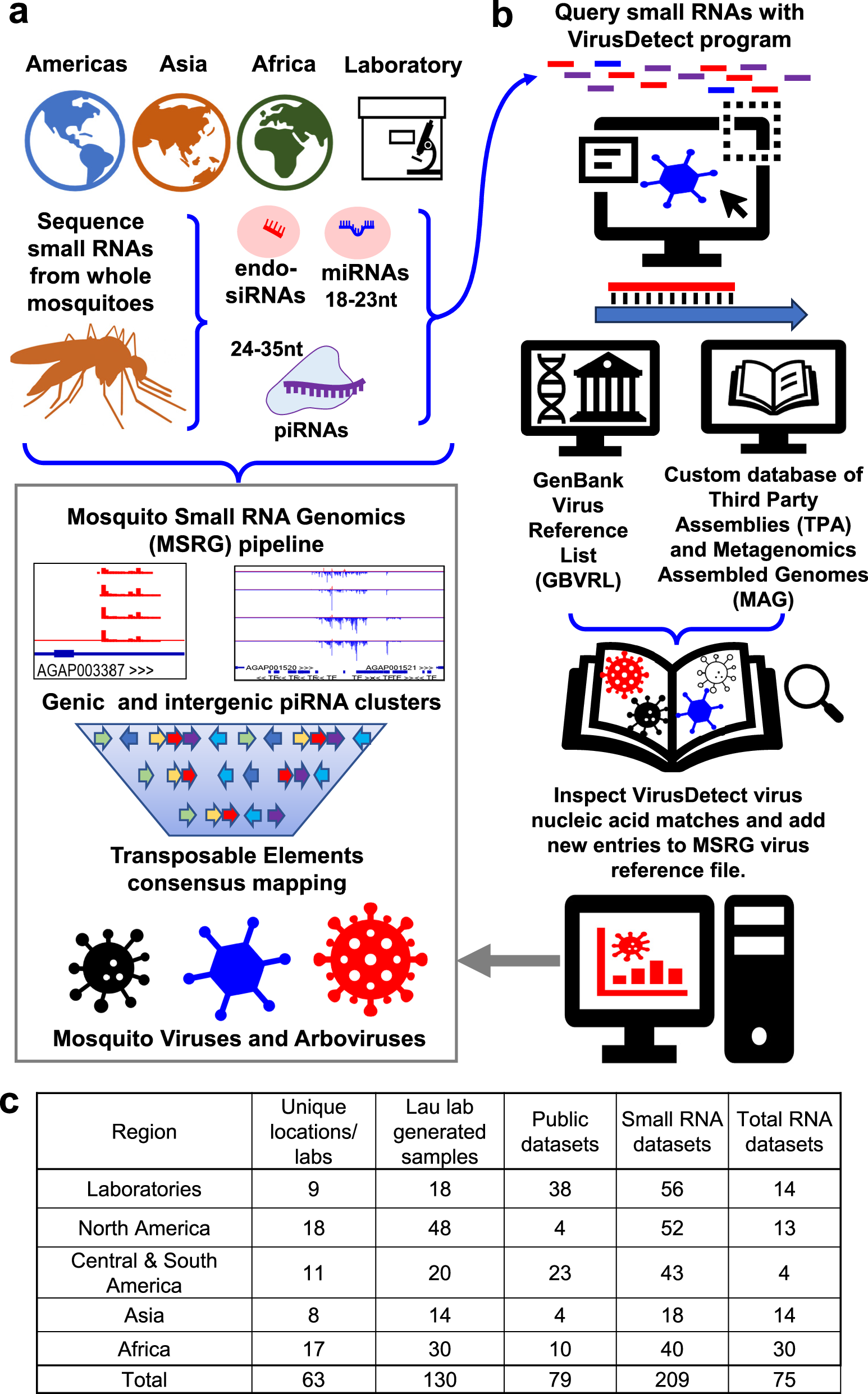
a Overview of the Mosquito Small RNA Genomics (MSRG) pipeline applied to a survey of whole mosquitoes from Americas, Asia, Africa and laboratory strains. b Implementation of the VirusDetect program with updated GBVRL and custom databases for comprehensive mosquito virus detection. c Summary tabulation of the samples and RNA libraries analyzed in this study.
Viruses that replicate in mosquitoes generate double-stranded RNA molecules, and its RNAi pathway allows them to tolerate the replicating virus by inactivating the virus RNA genome into virus small RNA fragments (vsmRNAs). The researchers hypothesized that by tracking vsmRNAs that are triggering the mosquito’s innate immune response of RNA interference (RNAi), we could help municipal insect control groups learn just how many viruse are residing in the Aedes aegypti mosquitoes that swarm cities with warm climates like Miami and Sacramento.
“In our study, we discovered that these mosquitoes are heavily infected with many, viruses, some that are globally distributed while others are unique to one continent like the Formosus virus that is just in mosquito strains originating from Africa. These viruses are constantly battling the mosquito’s immune system, and by studying the viral small RNAs, we can discover new viruses and understand how mosquitoes enable viral disease transmission,” explains corresponding author Nelson Lau, PhD, associate professor of biochemistry and director of the BU Genome Science Institute at the school.
The researchers collected Aedes aegypti mosquitoes from North America, Central America, Africa and Asia to sample and sequence the small RNAs from these samples. By comparing long viral RNAs (the active virus) with viral small RNAs (the immune response), the researchers discovered that some viruses can evade or “hide” from the mosquito’s RNAi pathway—the main defense mechanism mosquitoes use to fight infection. They then developed bioinformatics analysis pipelines to match the small RNAs to databases of potentially new viruses that ecologists and epidemiologists are currently discovering from mosquito field studies all around the world.
“By discovering new mosquito viruses that can generate robust RNAi responses in mosquito cell cultures, we now want to develop these entities as tools to treat non-infected mosquitoes, perhaps inoculate mosquitoes to be more resistant against the pathogenic arboviruses that cause human diseases,” said Lau.
Source – Boston University Chobanian & Avedisian School of Medicine


Insights may apply to combatting arbovirus diseases like fevers from dengue, Zika and chikungunya virus infections in humans
Aedes aegypti, commonly known as the yellow fever mosquito, is a highly adapted, invasive mosquito species recognized as a major global health threat that acts as the primary vector for several severe diseases, most notably dengue fever, as well as yellow fever, chikungunya and Zika virus. Local government agencies conduct routine molecular surveillance of these mosquitoes to detect and track viruses, however, they are primarily limited to using conventional reverse transcription polymerase chain reaction methodologies, which can only detect known pathogens that have already been identified and for which specific genetic primers have been developed.
Recent research efforts applying high-throughput RNA sequencing have led to a large expansion in the mosquito virome (the entire collection of viruses contained within mosquitoes). However, questions remain as to how persistent insect viruses are within mosquito colonies, how insect viruses interact with mosquito immune responses and how frequently insect viruses can be transmitted.
A new study by Boston University Chobanian & Avedisian School of Medicine researchers looked at the mosquitoes’ immune response to discover many more insect viruses and they hope to someday use the mosquitoes’ own immune system to battle some of the most pervasive and antagonistic human viruses.
A mosquito small RNA sequencing approach to discover mosquito-host RNA-interference (RNAi) responses to insect viruses
a Overview of the Mosquito Small RNA Genomics (MSRG) pipeline applied to a survey of whole mosquitoes from Americas, Asia, Africa and laboratory strains. b Implementation of the VirusDetect program with updated GBVRL and custom databases for comprehensive mosquito virus detection. c Summary tabulation of the samples and RNA libraries analyzed in this study.
Viruses that replicate in mosquitoes generate double-stranded RNA molecules, and its RNAi pathway allows them to tolerate the replicating virus by inactivating the virus RNA genome into virus small RNA fragments (vsmRNAs). The researchers hypothesized that by tracking vsmRNAs that are triggering the mosquito’s innate immune response of RNA interference (RNAi), we could help municipal insect control groups learn just how many viruse are residing in the Aedes aegypti mosquitoes that swarm cities with warm climates like Miami and Sacramento.
“In our study, we discovered that these mosquitoes are heavily infected with many, viruses, some that are globally distributed while others are unique to one continent like the Formosus virus that is just in mosquito strains originating from Africa. These viruses are constantly battling the mosquito’s immune system, and by studying the viral small RNAs, we can discover new viruses and understand how mosquitoes enable viral disease transmission,” explains corresponding author Nelson Lau, PhD, associate professor of biochemistry and director of the BU Genome Science Institute at the school.
The researchers collected Aedes aegypti mosquitoes from North America, Central America, Africa and Asia to sample and sequence the small RNAs from these samples. By comparing long viral RNAs (the active virus) with viral small RNAs (the immune response), the researchers discovered that some viruses can evade or “hide” from the mosquito’s RNAi pathway—the main defense mechanism mosquitoes use to fight infection. They then developed bioinformatics analysis pipelines to match the small RNAs to databases of potentially new viruses that ecologists and epidemiologists are currently discovering from mosquito field studies all around the world.
“By discovering new mosquito viruses that can generate robust RNAi responses in mosquito cell cultures, we now want to develop these entities as tools to treat non-infected mosquitoes, perhaps inoculate mosquitoes to be more resistant against the pathogenic arboviruses that cause human diseases,” said Lau.
Source – Boston University Chobanian & Avedisian School of Medicine
Gupta S, Sharma R, Williams A E, Sanchez-Vargas I, Rose N H, Zhang C, Crosbie-Villaseca A, Kyza-Karavioti M, Zhu Z, Dayama G, Gloria-Soria A, Brackney D E, Manning J, Wheeler S S, Caranci A, Reyes T, Sylla M, Badolo A, Akorli J, Aribodor O B, Ayala D, Liu W L, Chen C H, Vasquez C, Acosta C G, Ponlawat A, Magalhaes T, Carter B H, Wesson D M, Surin D, Younger M A, Costa-da-Silva A L, DeGennaro M, Bergman A, Lambrechts L, McBride C S, Olson K E, Calvo E, Lau N C. (2026) Small RNA genomics of Aedes aegypti mosquitoes discovers infectious viruses that trigger an RNA interference response. Nature Communications 17(1): 3658. [article]
Related Posts
RNAmel simplifies RNA sequencing data analysis with a reproducible, integrated platform
Heart failure reshapes bone marrow to create inflammation-related immune memory
Overlooked DNA regions surrounding ‘microexons’ hold missing pieces of autism’s genetic puzzle
RiboBA improves detection of hidden protein-coding regions using ribosome profiling
An anti-senescence gene may fight spinal disc deterioration
Scientists identify the neuroblastoma cells that signal poor outcomes
Novel biosensor uses DNA ‘barcodes’ to uncover disease signals in cells
CellART extracts single-cell information from high-resolution spatial transcriptomics
Cell2space restores spatial context to single-cell RNA sequencing data
Urine test may improve bladder cancer diagnosis and guide treatment decisions
DeCoRE – a computational method to resolve RNA structural heterogeneity from RNA structure probing data by direct RNA sequencing
Tracing 700 million years of cell evolution
How should biological replicates be handled in long-read RNA sequencing?
RNA-Seq reveals a new way the developing heart controls its growth
The Human RNome Project Consortium seeks to publish first-ever complete sequence of the body’s RNA
scFlowReport brings multiple single-cell RNA sequencing analyses into one workflow
Long-read RNA sequencing reveals how neurons choose alternative RNA endings
DeOPUS improves cell-type estimates from bulk RNA sequencing
ResolVI improves accuracy in spatial transcriptomics analysis
RNA sequencing reveals transcriptional allele differences in prostate cancer stem cells
Stay Connected
Submit a Post to the Blog
Recent Posts
Subscribe to the RNA-Seq Blog
RNA-Seq Products & Services