Every cell in the body contains the same DNA, yet different cells behave in very different ways. Some become neurons, others muscle cells, and others form tissues and organs. This diversity is controlled by gene regulatory networks, often called GRNs, which describe how genes interact with one another to control when and how genes are turned on or off.
Over the past decade, new technologies such as RNA sequencing and single cell transcriptomics have allowed scientists to examine gene activity in extraordinary detail. Researchers can now measure the expression of thousands of genes in individual cells. These datasets provide an enormous amount of information about how genes behave during development, disease, and tissue formation.
However, this flood of data has created a new challenge. Many gene regulatory network models are based largely on statistical correlations. In other words, researchers can see that two genes often change activity together, but it is not always clear whether one gene actually controls the other. These large correlation maps often appear as extremely complex networks that are difficult to interpret.
Researchers from the Francis Crick Institute examined why this problem exists and proposed new ways to improve how scientists model gene regulatory networks. According to the authors, many current GRN models have become collections of correlations rather than explanations of the true biological mechanisms that control gene activity.
The researchers suggest that future GRN models should focus more directly on causation. Instead of trying to represent every molecular detail inside a cell, scientists could build models that capture the most important biological rules governing gene regulation.
One promising direction involves methods from machine learning called representation learning. These approaches allow computers to identify meaningful patterns in complex biological data. Rather than manually defining every gene interaction, representation learning models can learn simplified but informative structures that reflect how gene networks operate.
Representational descriptions of GRNs
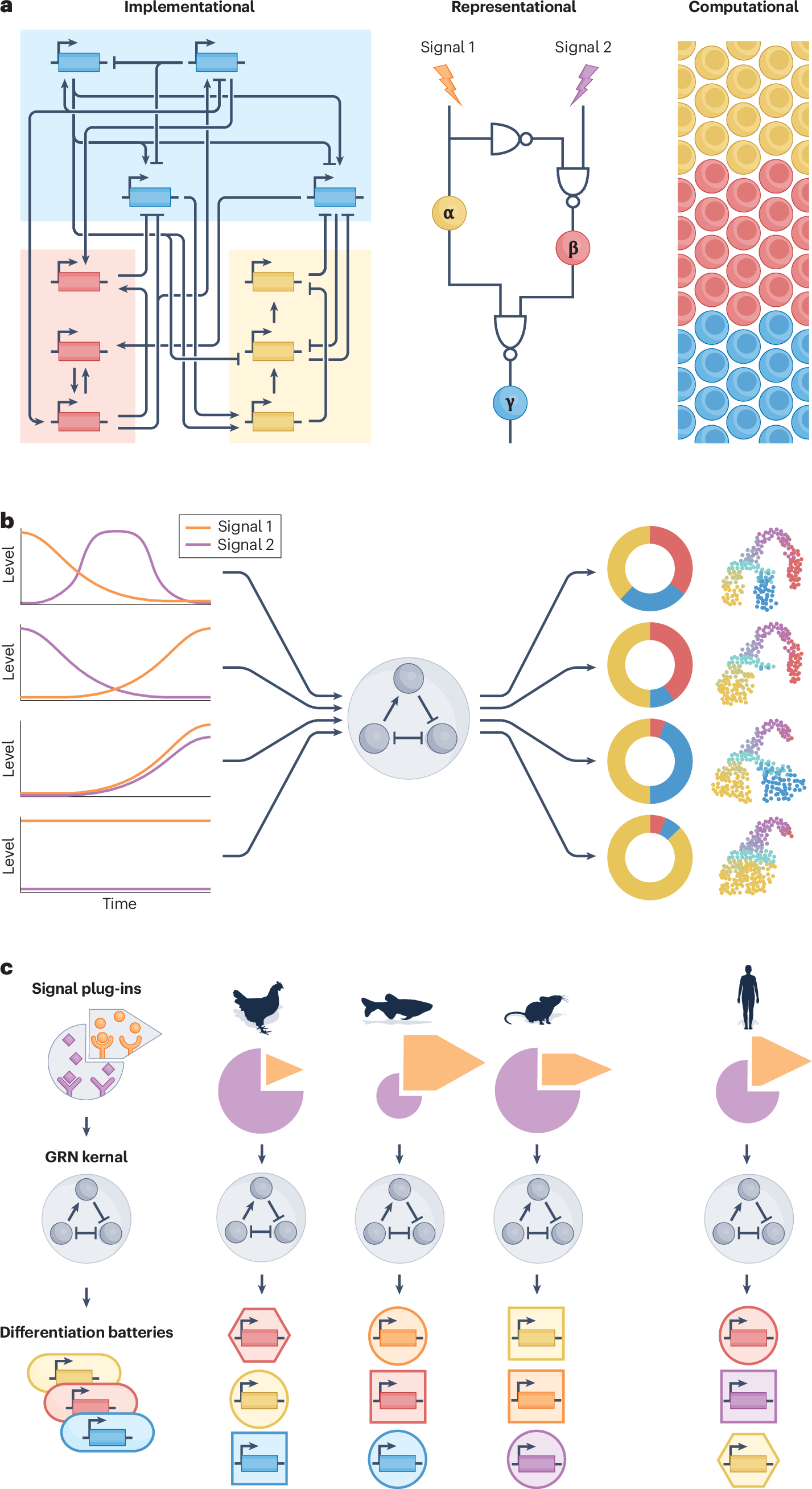
a, Information processing description: Marr’s levels of analysis can be applied to the study of gene regulatory networks (GRNs). An implementational level captures the physical realization of the system, which, in the instance of GRNs, is the explicit description of transcription factors and enhancers that mediate genetic interactions. Above this level, a representational level describes the logic of how this physical realization functions to interpret signals (signal 1 and signal 2) and achieve the goals of the system, which is visualized here as logic gate connecting abstract cell-type factors. Finally, a computational level describes the computational process being performed, in this instance the decoding of input signals to form a striped tissue pattern. b, Cellular signal interpretation descriptions: from a cellular perspective, GRNs can be thought of as processes that take signalling dynamics as input and then output cell-type proportions. Constructing mechanistic models at the level of signal interpretation could describe the cellular function of GRNs without needing to explicitly model the underlying genetic interactions. c, Evolutionary kernel description: GRNs consist of ‘plug-ins’, which are reusable modules, such as signalling pathways that provide inputs; ‘kernels’ that contain the core functional logic of the GRN; and ‘differentiation batteries’ that are responsible for executing the downstream consequences of the GRN. The different functions of these modules are reflected in their evolutionary dynamics: kernels are highly conserved across species owing to being functionally critical to tissue formation (visualized here as the unchanging blue network across species). Plug-ins display higher variability, particularly in the contexts in which they are deployed across tissues in the organism (demonstrated here as the changing size and strength of the different modules). Differentiation batteries display the highest level of variability; they do not feedback into the GRN and so are free to evolve and adapt to provide species-specific outputs. Capturing the evolutionary dynamics of GRN components could, thus, inform the functional role the components perform in the network.
The authors emphasize that future models must remain grounded in biology. Gene regulatory network models should reflect known principles of cell biology and evolution. Incorporating these biological constraints can dramatically reduce the number of possible solutions and help guide computational models toward more realistic explanations.
Another key component will involve better experimental testing. Researchers propose combining computational models with advanced experimental tools that can deliberately perturb gene networks. Techniques such as CRISPR gene editing and synthetic biology allow scientists to change gene activity and observe the resulting cellular behavior.
By systematically altering genes and measuring the resulting responses using technologies like RNA sequencing, researchers can test whether predicted gene regulatory relationships are truly causal. These experiments can help refine computational models and improve our understanding of how cells control gene activity.
The authors also highlight the growing role of synthetic biology. By building artificial regulatory circuits inside cells, scientists can test ideas about how gene networks function. This approach provides a powerful way to evaluate whether proposed network models accurately capture biological reality.
Ultimately, the goal is to move from descriptive maps of gene activity to predictive models that explain how genes control cell behavior. Achieving this will require integrating computational modeling, biological knowledge, and experimental testing.
As large scale RNA sequencing and single cell technologies continue to generate enormous datasets, new modeling strategies will become increasingly important. By combining data driven approaches with mechanistic understanding, researchers hope to develop clearer and more useful models of gene regulation.


Every cell in the body contains the same DNA, yet different cells behave in very different ways. Some become neurons, others muscle cells, and others form tissues and organs. This diversity is controlled by gene regulatory networks, often called GRNs, which describe how genes interact with one another to control when and how genes are turned on or off.
Over the past decade, new technologies such as RNA sequencing and single cell transcriptomics have allowed scientists to examine gene activity in extraordinary detail. Researchers can now measure the expression of thousands of genes in individual cells. These datasets provide an enormous amount of information about how genes behave during development, disease, and tissue formation.
However, this flood of data has created a new challenge. Many gene regulatory network models are based largely on statistical correlations. In other words, researchers can see that two genes often change activity together, but it is not always clear whether one gene actually controls the other. These large correlation maps often appear as extremely complex networks that are difficult to interpret.
Researchers from the Francis Crick Institute examined why this problem exists and proposed new ways to improve how scientists model gene regulatory networks. According to the authors, many current GRN models have become collections of correlations rather than explanations of the true biological mechanisms that control gene activity.
The researchers suggest that future GRN models should focus more directly on causation. Instead of trying to represent every molecular detail inside a cell, scientists could build models that capture the most important biological rules governing gene regulation.
One promising direction involves methods from machine learning called representation learning. These approaches allow computers to identify meaningful patterns in complex biological data. Rather than manually defining every gene interaction, representation learning models can learn simplified but informative structures that reflect how gene networks operate.
Representational descriptions of GRNs
a, Information processing description: Marr’s levels of analysis can be applied to the study of gene regulatory networks (GRNs). An implementational level captures the physical realization of the system, which, in the instance of GRNs, is the explicit description of transcription factors and enhancers that mediate genetic interactions. Above this level, a representational level describes the logic of how this physical realization functions to interpret signals (signal 1 and signal 2) and achieve the goals of the system, which is visualized here as logic gate connecting abstract cell-type factors. Finally, a computational level describes the computational process being performed, in this instance the decoding of input signals to form a striped tissue pattern. b, Cellular signal interpretation descriptions: from a cellular perspective, GRNs can be thought of as processes that take signalling dynamics as input and then output cell-type proportions. Constructing mechanistic models at the level of signal interpretation could describe the cellular function of GRNs without needing to explicitly model the underlying genetic interactions. c, Evolutionary kernel description: GRNs consist of ‘plug-ins’, which are reusable modules, such as signalling pathways that provide inputs; ‘kernels’ that contain the core functional logic of the GRN; and ‘differentiation batteries’ that are responsible for executing the downstream consequences of the GRN. The different functions of these modules are reflected in their evolutionary dynamics: kernels are highly conserved across species owing to being functionally critical to tissue formation (visualized here as the unchanging blue network across species). Plug-ins display higher variability, particularly in the contexts in which they are deployed across tissues in the organism (demonstrated here as the changing size and strength of the different modules). Differentiation batteries display the highest level of variability; they do not feedback into the GRN and so are free to evolve and adapt to provide species-specific outputs. Capturing the evolutionary dynamics of GRN components could, thus, inform the functional role the components perform in the network.
Another key component will involve better experimental testing. Researchers propose combining computational models with advanced experimental tools that can deliberately perturb gene networks. Techniques such as CRISPR gene editing and synthetic biology allow scientists to change gene activity and observe the resulting cellular behavior.
By systematically altering genes and measuring the resulting responses using technologies like RNA sequencing, researchers can test whether predicted gene regulatory relationships are truly causal. These experiments can help refine computational models and improve our understanding of how cells control gene activity.
The authors also highlight the growing role of synthetic biology. By building artificial regulatory circuits inside cells, scientists can test ideas about how gene networks function. This approach provides a powerful way to evaluate whether proposed network models accurately capture biological reality.
Ultimately, the goal is to move from descriptive maps of gene activity to predictive models that explain how genes control cell behavior. Achieving this will require integrating computational modeling, biological knowledge, and experimental testing.
As large scale RNA sequencing and single cell technologies continue to generate enormous datasets, new modeling strategies will become increasingly important. By combining data driven approaches with mechanistic understanding, researchers hope to develop clearer and more useful models of gene regulation.
Maizels RJ, Briscoe J. (2026) Gene regulatory networks: from correlative models to causal explanations. Nature Reviews Genetics [Epub ahead of print]. [article]
Related Posts
Urine test may improve bladder cancer diagnosis and guide treatment decisions
Tracing 700 million years of cell evolution
RNA-Seq reveals a new way the developing heart controls its growth
The Human RNome Project Consortium seeks to publish first-ever complete sequence of the body’s RNA
Unmasking “zombie cells” in aging tissue with an AI-powered barcode
RNA variant imaging for cancer diagnosis
Autism-risk mutations reveal two opposing patterns of brain gene activity
Avoiding a sticky situation: how cells stop messenger RNAs from clumping together
RNA Sequencing identifies new tick-borne virus that causes flu-like illness
Worm’s radical transformation shows metamorphosis can change the functions of cells
RNA sequencing reveals functional chimeric mRNAs in mammalian immunity
Atlas of the brain’s striatum could guide researchers to new drug treatments
Immune cells offer insights on billion-dollar virus
A functionally integrated cross-tissue alternative splicing program during short-term calorie restriction
Dietary oxidized plant sterol shifts macrophage state to fuel aortic inflammation
Unlocking the past – new method helps gain insights into old tissue
Novel AI model trained on RNA-Seq data accurately detects key gene mutations and predicts biomarkers across 32 cancer types
Transcriptomic aging clock reveals age-related molecular patterns in opioid dependence
RNA sequencing helps predict stem cell transplant benefit in pediatric AML
Protein ‘switch’ determines whether liposarcoma cells will become aggressive
Stay Connected
Submit a Post to the Blog
Recent Posts
Subscribe to the RNA-Seq Blog
RNA-Seq Products & Services