

One of the biggest questions in biology is how our genes control complex traits or phenotypes—things like physical characteristics, disease resistance, or behavior. Genes don’t act alone in determining these traits; instead, they interact in complex ways, with each gene contributing to the overall picture. Scientists have been working hard to understand these interactions better, and a new study has introduced an exciting approach that uses advanced tools to break down this complexity.
In this study, researchers at the Massachusetts Institute of Technology combined two powerful technologies: single-cell RNA sequencing and advanced learning methods like language models. Single-cell RNA sequencing allows scientists to measure the gene activity of individual cells, helping them see what’s happening in each cell at a much finer level of detail than ever before. Meanwhile, language models—tools that are used to understand and predict patterns in large sets of information (like how words fit together in sentences)—are now being applied to analyze gene data in much the same way. This combination creates a powerful new way to look at how our genetic information translates into traits.
The scientists developed a “computational integrated genetics framework,” which is essentially a method for analyzing both the genetic code (genotype) and the resulting traits (phenotype) at the same time. This new method allows researchers to look at how different genes interact across a whole system and how they might contribute to complex traits, all at the cellular level.
Overview of the model
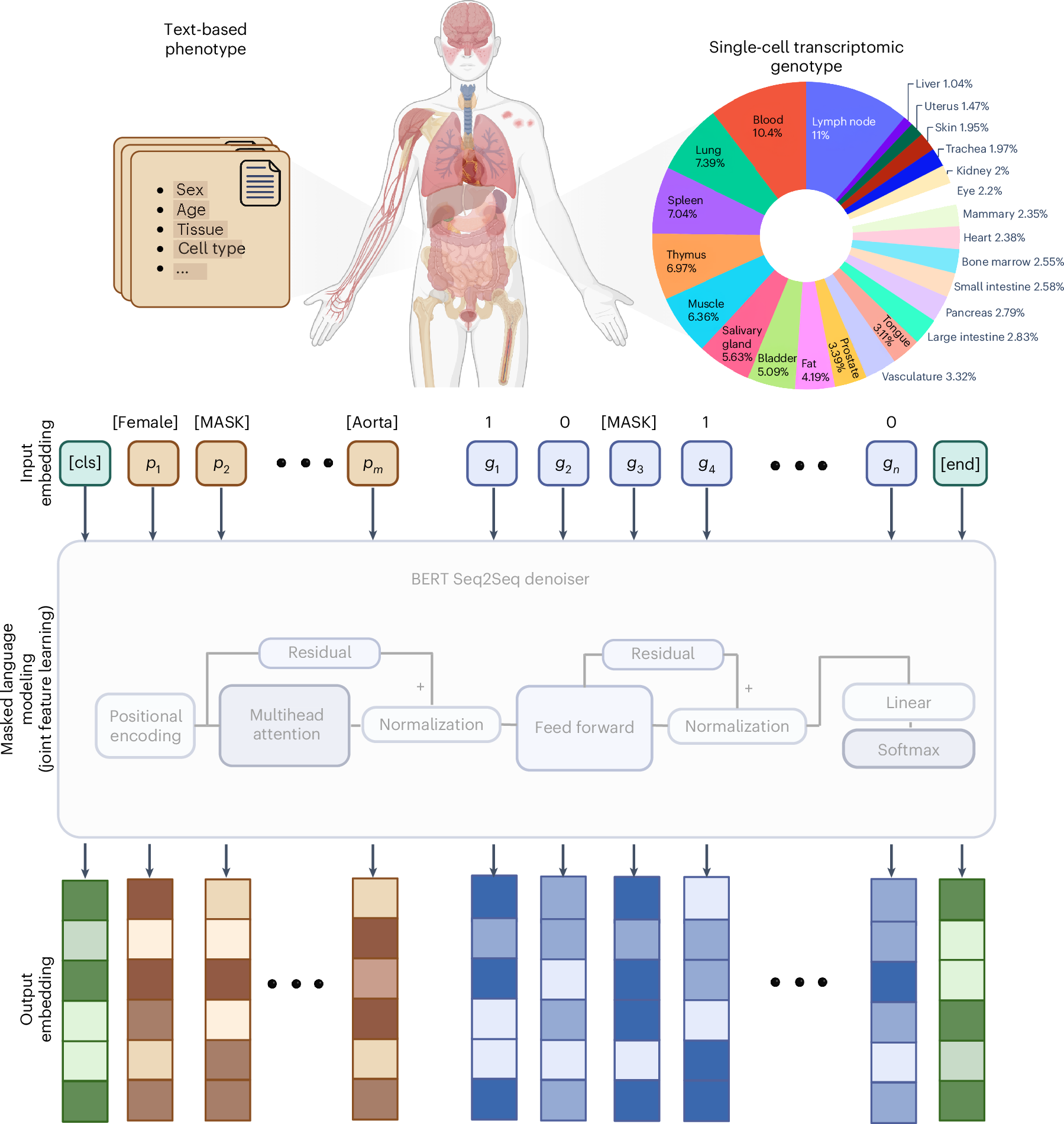
Gene expression data from scRNA-seq and associated phenotypes are embedded as input to a language model. The model learns the genotype–phenotype relationship in an integrated manner, where genes and phenotype are masked simultaneously in the input layer. The outputs of the model are high-dimensional embeddings that are information-rich.
To test this framework, the researchers applied it to human transcriptomics—the study of all the RNA molecules in a cell that are created when genes are turned on or off. By analyzing the data, they were able to gain new insights into how cells are different from one another (called cellular heterogeneity). They even found potential new biomarkers, which are measurable indicators of a specific condition or disease, across different tissues of the body.
One interesting finding in the study was related to the von Willebrand factor (VWF) gene, which plays an important role in blood clotting. By applying this new method to VWF in endothelial cells (cells that line blood vessels), the researchers were able to investigate how this gene might have multiple roles in different contexts—a concept called polyfunctionality.
This approach doesn’t just add another tool to the scientist’s toolbox; it helps to refine our understanding of how genes create the complex biological systems that make us who we are. The potential for this type of analysis goes beyond just studying disease traits—it could help identify new ways to treat a wide range of conditions by providing deeper insights into the molecular interactions that govern cellular function.
Availability – The training script for the PolyGene model, the transcriptome tokenizer and the code for preprocessing data and inference are publicly available via GitHub at https://github.com/roholazandie/polygene
Khodaee F, Zandie R, Edelman ER. (2025) Multimodal Learning for Mapping the Genotype-Phenotype Dynamics. Nat Comp Sci [Epub ahead of print]. [article]
Related Posts


One of the biggest questions in biology is how our genes control complex traits or phenotypes—things like physical characteristics, disease resistance, or behavior. Genes don’t act alone in determining these traits; instead, they interact in complex ways, with each gene contributing to the overall picture. Scientists have been working hard to understand these interactions better, and a new study has introduced an exciting approach that uses advanced tools to break down this complexity.
In this study, researchers at the Massachusetts Institute of Technology combined two powerful technologies: single-cell RNA sequencing and advanced learning methods like language models. Single-cell RNA sequencing allows scientists to measure the gene activity of individual cells, helping them see what’s happening in each cell at a much finer level of detail than ever before. Meanwhile, language models—tools that are used to understand and predict patterns in large sets of information (like how words fit together in sentences)—are now being applied to analyze gene data in much the same way. This combination creates a powerful new way to look at how our genetic information translates into traits.
The scientists developed a “computational integrated genetics framework,” which is essentially a method for analyzing both the genetic code (genotype) and the resulting traits (phenotype) at the same time. This new method allows researchers to look at how different genes interact across a whole system and how they might contribute to complex traits, all at the cellular level.
Overview of the model
Gene expression data from scRNA-seq and associated phenotypes are embedded as input to a language model. The model learns the genotype–phenotype relationship in an integrated manner, where genes and phenotype are masked simultaneously in the input layer. The outputs of the model are high-dimensional embeddings that are information-rich.
To test this framework, the researchers applied it to human transcriptomics—the study of all the RNA molecules in a cell that are created when genes are turned on or off. By analyzing the data, they were able to gain new insights into how cells are different from one another (called cellular heterogeneity). They even found potential new biomarkers, which are measurable indicators of a specific condition or disease, across different tissues of the body.
One interesting finding in the study was related to the von Willebrand factor (VWF) gene, which plays an important role in blood clotting. By applying this new method to VWF in endothelial cells (cells that line blood vessels), the researchers were able to investigate how this gene might have multiple roles in different contexts—a concept called polyfunctionality.
This approach doesn’t just add another tool to the scientist’s toolbox; it helps to refine our understanding of how genes create the complex biological systems that make us who we are. The potential for this type of analysis goes beyond just studying disease traits—it could help identify new ways to treat a wide range of conditions by providing deeper insights into the molecular interactions that govern cellular function.
Availability – The training script for the PolyGene model, the transcriptome tokenizer and the code for preprocessing data and inference are publicly available via GitHub at https://github.com/roholazandie/polygene
Khodaee F, Zandie R, Edelman ER. (2025) Multimodal Learning for Mapping the Genotype-Phenotype Dynamics. Nat Comp Sci [Epub ahead of print]. [article]
Related Posts
Recent Posts
 Researchers create first whole-body single-cell atlas of an adult vertebrate
 RNA sequencing reveals functional gene similarities across species
 UAlbany Joins $10 Million Effort to Map RNA Modifications in the Human Body
 Tempus Receives IVDR Certification for xR RNA Sequencing for Solid Tumor Profiling
 SpliceCOV improves RNA sequencing analysis by filtering transcriptional noise
 Nanopore RNA sequencing reveals new patterns associated with RNA modifications
RNA-Seq Products & Services


Stay Connected