

Single-cell RNA sequencing has become an important tool for understanding the diversity of cells within complex tissues. By examining gene expression in individual cells, researchers can identify cell types and molecular characteristics that are often hidden when analyzing large groups of cells together. However, one major challenge is that most single-cell workflows require fresh samples to be processed immediately, which can make studies difficult when samples are collected far from specialized laboratories.
Researchers from the Dartmouth Cancer Center at Dartmouth College have worked with the Association of Biomolecular Research Facilities (ABRF) to evaluate whether preservation methods could make single-cell studies more flexible. Their goal was to determine how well preserved samples perform when analyzed months after collection.
The team compared three commercially available preservation platforms, 10x Genomics FLEX, Parse Biosciences Evercode WT v2, and Honeycomb Bio HIVE. They examined blood cells collected from a healthy donor and compared preserved samples with fresh samples processed using a standard single-cell RNA sequencing workflow.
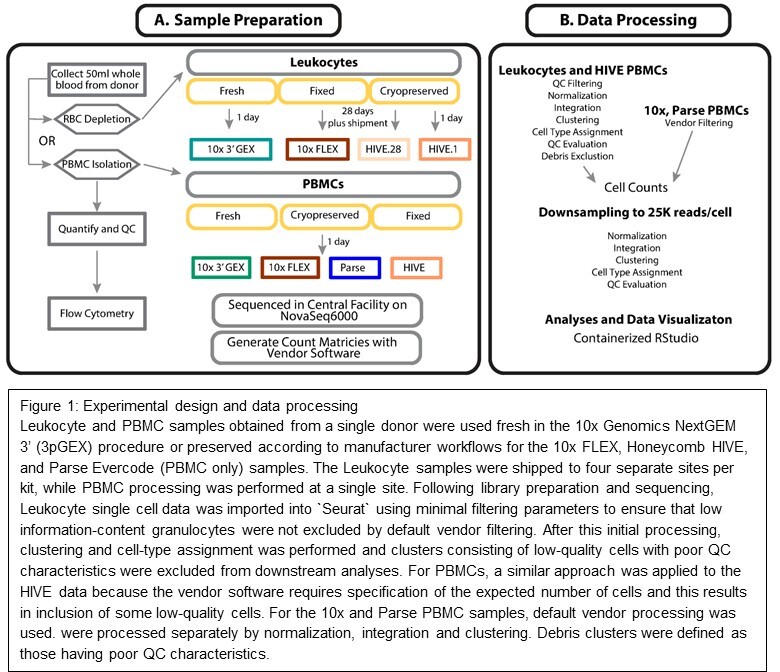
To provide an independent reference, the cells were also analyzed using a sophisticated flow cytometry panel. Samples were then fixed or cryopreserved according to each platform’s instructions and distributed to multiple research facilities. This allowed the investigators to evaluate not only performance but also consistency across different sites.
Overall, all three preservation methods performed well. The data from different platforms could be integrated successfully, and the resulting cell type assignments closely matched those obtained by flow cytometry. Cell populations were identified with similar relative abundances across methods.
Some differences did emerge. Certain genes displayed platform-specific expression patterns, and reproducibility varied among workflows. The 10x Genomics FLEX approach appeared to be more sensitive to variations introduced during sample preparation. Interestingly, preservation-based methods retained fragile granulocyte populations better than fresh samples processed with the conventional workflow.
These findings highlight how improvements in sample preservation are changing the way single-cell experiments are performed. Researchers no longer need to process samples immediately after collection, making it possible to collect material at remote sites and perform sequencing later at specialized centers.
The authors note that no single approach is ideal for every experiment. Instead, investigators and core facilities can choose preservation strategies based on the types of cells being studied, sample collection logistics, and available laboratory infrastructure. As preservation technologies continue to improve, they are likely to expand access to single-cell RNA sequencing and simplify multicenter studies.
Kolling IV F.W., Podnar J.W., Wilkins O., Fraser C.J., MacDonald M.L., Polson S.W., Hebert Z.T., Chittur S.V., Hayden A., Kuentzel M., Heinz M., Huerta G.M., Stevenson H.S., Karmakar A., Fronick C., Cook L., Vargas S., Xuei X., McGuire P., Zeller M., Zhang Y., Dai R., Wang X., Wai C.M., Thimmapuram J., Arora D., Mesa T., Fan J., Alekseyev Y.O., Cervone F., Williams C., Gorham N., Lemenze A., Goodwin S., Preall J., Whittaker C.A. (2026) Multisite Assessment of Methods for Cell Preservation Upstream of Single-Cell RNA Sequencing. Journal of Biomolecular Techniques 37(2): 9-27. [article]
Related Posts






Single-cell RNA sequencing has become an important tool for understanding the diversity of cells within complex tissues. By examining gene expression in individual cells, researchers can identify cell types and molecular characteristics that are often hidden when analyzing large groups of cells together. However, one major challenge is that most single-cell workflows require fresh samples to be processed immediately, which can make studies difficult when samples are collected far from specialized laboratories.
Researchers from the Dartmouth Cancer Center at Dartmouth College have worked with the Association of Biomolecular Research Facilities (ABRF) to evaluate whether preservation methods could make single-cell studies more flexible. Their goal was to determine how well preserved samples perform when analyzed months after collection.
The team compared three commercially available preservation platforms, 10x Genomics FLEX, Parse Biosciences Evercode WT v2, and Honeycomb Bio HIVE. They examined blood cells collected from a healthy donor and compared preserved samples with fresh samples processed using a standard single-cell RNA sequencing workflow.
To provide an independent reference, the cells were also analyzed using a sophisticated flow cytometry panel. Samples were then fixed or cryopreserved according to each platform’s instructions and distributed to multiple research facilities. This allowed the investigators to evaluate not only performance but also consistency across different sites.
Overall, all three preservation methods performed well. The data from different platforms could be integrated successfully, and the resulting cell type assignments closely matched those obtained by flow cytometry. Cell populations were identified with similar relative abundances across methods.
Some differences did emerge. Certain genes displayed platform-specific expression patterns, and reproducibility varied among workflows. The 10x Genomics FLEX approach appeared to be more sensitive to variations introduced during sample preparation. Interestingly, preservation-based methods retained fragile granulocyte populations better than fresh samples processed with the conventional workflow.
These findings highlight how improvements in sample preservation are changing the way single-cell experiments are performed. Researchers no longer need to process samples immediately after collection, making it possible to collect material at remote sites and perform sequencing later at specialized centers.
The authors note that no single approach is ideal for every experiment. Instead, investigators and core facilities can choose preservation strategies based on the types of cells being studied, sample collection logistics, and available laboratory infrastructure. As preservation technologies continue to improve, they are likely to expand access to single-cell RNA sequencing and simplify multicenter studies.
Kolling IV F.W., Podnar J.W., Wilkins O., Fraser C.J., MacDonald M.L., Polson S.W., Hebert Z.T., Chittur S.V., Hayden A., Kuentzel M., Heinz M., Huerta G.M., Stevenson H.S., Karmakar A., Fronick C., Cook L., Vargas S., Xuei X., McGuire P., Zeller M., Zhang Y., Dai R., Wang X., Wai C.M., Thimmapuram J., Arora D., Mesa T., Fan J., Alekseyev Y.O., Cervone F., Williams C., Gorham N., Lemenze A., Goodwin S., Preall J., Whittaker C.A. (2026) Multisite Assessment of Methods for Cell Preservation Upstream of Single-Cell RNA Sequencing. Journal of Biomolecular Techniques 37(2): 9-27. [article]
Related Posts
Recent Posts
 RNAmel simplifies RNA sequencing data analysis with a reproducible, integrated platform
 Heart failure reshapes bone marrow to create inflammation-related immune memory
 Overlooked DNA regions surrounding ‘microexons’ hold missing pieces of autism’s genetic puzzle
 RiboBA improves detection of hidden protein-coding regions using ribosome profiling
 An anti-senescence gene may fight spinal disc deterioration
 Bulk RNA-seq Analysis: A Complete Beginner’s Guide
RNA-Seq Products & Services



Stay Connected