

Understanding RNA and how it functions in the body is essential for studying gene expression and disease. One critical aspect of RNA biology is polyadenylation, the process of adding a string of adenine nucleotides, called a poly(A) tail, to the end of RNA molecules. These tails help determine how long RNAs last and how efficiently they are translated into proteins. However, measuring these tails and capturing all types of RNAs, including noncoding ones, has been a technical challenge.
A research team led by researchers at the Barcelona Institute of Science and Technology has introduced an improved method called Nano3P-seq, which combines nanopore sequencing with a streamlined protocol to measure both the abundance and the poly(A) tail characteristics of RNA molecules at single-molecule resolution. This approach uses a clever trick called “template switching” to capture the 3′ end of RNA molecules without needing amplification steps that can bias results. Importantly, Nano3P-seq can work on both polyadenylated and non-polyadenylated RNAs, including types like ribosomal RNAs and small nucleolar RNAs that are often ignored by other methods.
Schematic overview of the Nano3P-seq library-preparation workflow
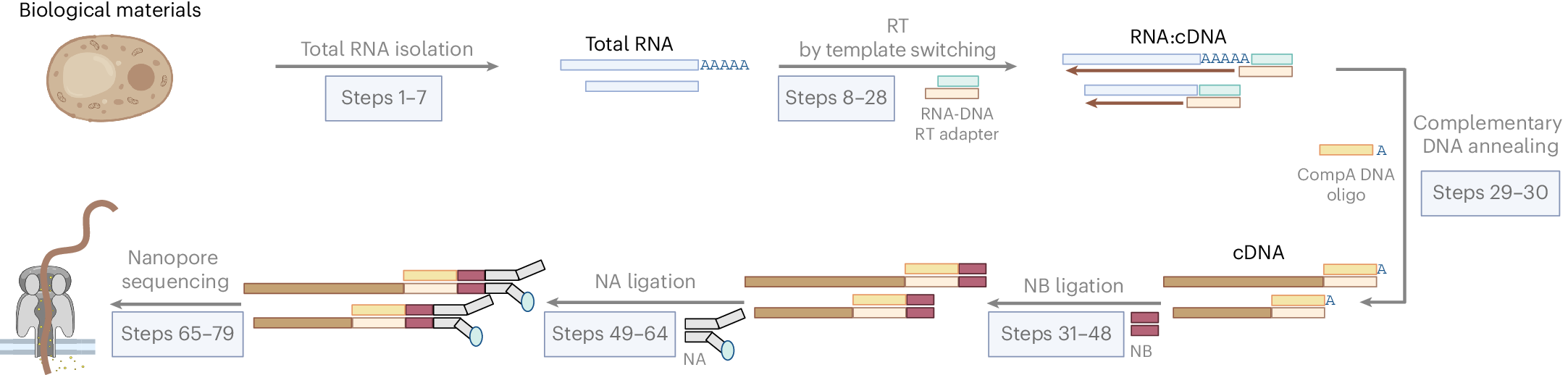
In this example, yeast total RNA is processed to prepare a Nano3P-seq library. The main steps include: (i) total RNA isolation (Steps 1–7): extraction of total RNA from biological samples; (ii) reverse transcription (RT) by template switching (Steps 8–28): conversion of RNA to cDNA while preserving poly(A) tail information; (iii) cDNA annealing for adapter ligation (Steps 29–30); (iv) native barcode (NB) ligation (Steps 31–48): addition of barcodes to enable sample multiplexing; (v) native adapter (NA) ligation (Steps 49–64): preparation of cDNA for sequencing by adding adapters; and (vi) nanopore sequencing (Steps 65–79): real-time sequencing on a nanopore sequencing platform.
The team also created a new software tool called PolyTailor, which helps researchers analyze poly(A) tail lengths and compositions across different RNA types. The method is compatible with Oxford Nanopore’s R10.4 flow cells and allows researchers to complete the sequencing and analysis in just one day. While it does require some basic lab and programming experience, the protocol is now more accessible and reproducible than before, making it easier to study the diversity and regulation of the transcriptome.
Availability – The PolyTailor software used for Nano3P-seq analysis, including test data, has been made publicly available in GitHub at https://github.com/novoalab/polyTailor
Begik O, Pryszcz L, Niazi A, Valen E, Novoa E. (2025) Nano3P-seq: charting the coding and noncoding transcriptome at single-molecule resolution. Nature Protocols [Epub ahead of print]. [article]
Related Posts






Understanding RNA and how it functions in the body is essential for studying gene expression and disease. One critical aspect of RNA biology is polyadenylation, the process of adding a string of adenine nucleotides, called a poly(A) tail, to the end of RNA molecules. These tails help determine how long RNAs last and how efficiently they are translated into proteins. However, measuring these tails and capturing all types of RNAs, including noncoding ones, has been a technical challenge.
A research team led by researchers at the Barcelona Institute of Science and Technology has introduced an improved method called Nano3P-seq, which combines nanopore sequencing with a streamlined protocol to measure both the abundance and the poly(A) tail characteristics of RNA molecules at single-molecule resolution. This approach uses a clever trick called “template switching” to capture the 3′ end of RNA molecules without needing amplification steps that can bias results. Importantly, Nano3P-seq can work on both polyadenylated and non-polyadenylated RNAs, including types like ribosomal RNAs and small nucleolar RNAs that are often ignored by other methods.
Schematic overview of the Nano3P-seq library-preparation workflow
In this example, yeast total RNA is processed to prepare a Nano3P-seq library. The main steps include: (i) total RNA isolation (Steps 1–7): extraction of total RNA from biological samples; (ii) reverse transcription (RT) by template switching (Steps 8–28): conversion of RNA to cDNA while preserving poly(A) tail information; (iii) cDNA annealing for adapter ligation (Steps 29–30); (iv) native barcode (NB) ligation (Steps 31–48): addition of barcodes to enable sample multiplexing; (v) native adapter (NA) ligation (Steps 49–64): preparation of cDNA for sequencing by adding adapters; and (vi) nanopore sequencing (Steps 65–79): real-time sequencing on a nanopore sequencing platform.
The team also created a new software tool called PolyTailor, which helps researchers analyze poly(A) tail lengths and compositions across different RNA types. The method is compatible with Oxford Nanopore’s R10.4 flow cells and allows researchers to complete the sequencing and analysis in just one day. While it does require some basic lab and programming experience, the protocol is now more accessible and reproducible than before, making it easier to study the diversity and regulation of the transcriptome.
Availability – The PolyTailor software used for Nano3P-seq analysis, including test data, has been made publicly available in GitHub at https://github.com/novoalab/polyTailor
Begik O, Pryszcz L, Niazi A, Valen E, Novoa E. (2025) Nano3P-seq: charting the coding and noncoding transcriptome at single-molecule resolution. Nature Protocols [Epub ahead of print]. [article]
Related Posts
Recent Posts
 Machine learning reveals how RNA splicing is regulated in individual cell types
 Illumina releases SpliceAI2 to help advance rare disease research
 Postdoctoral Fellow – Long-Read RNA Methods Development for Neurodegeneration
 Novel biosensor uses DNA ‘barcodes’ to uncover disease signals in cells
 GP-DHT uses single-cell RNA sequencing to map gene regulatory networks
 Boehringer taps Envisagenics’ AI to mine RNA splicing for cancer targets
RNA-Seq Products & Services



Stay Connected