

RNA molecules are not simply copied from DNA and sent directly to make proteins. They can also undergo chemical modifications that influence how they are processed, stabilized and used inside cells. Collectively, these changes are part of the epitranscriptome.
Researchers increasingly use direct RNA sequencing from Oxford Nanopore Technologies, or ONT, to investigate these modifications because the technology can read long RNA molecules directly and detect changes in the electrical signal produced as RNA passes through a nanopore.
Researchers at the Department of Biosciences and Bioinformatics, Center for Intelligent RNA Therapeutics at Xi’an Jiaotong-Liverpool University discuss the computational workflow used for ONT direct RNA sequencing and compared methods for detecting RNA modifications.
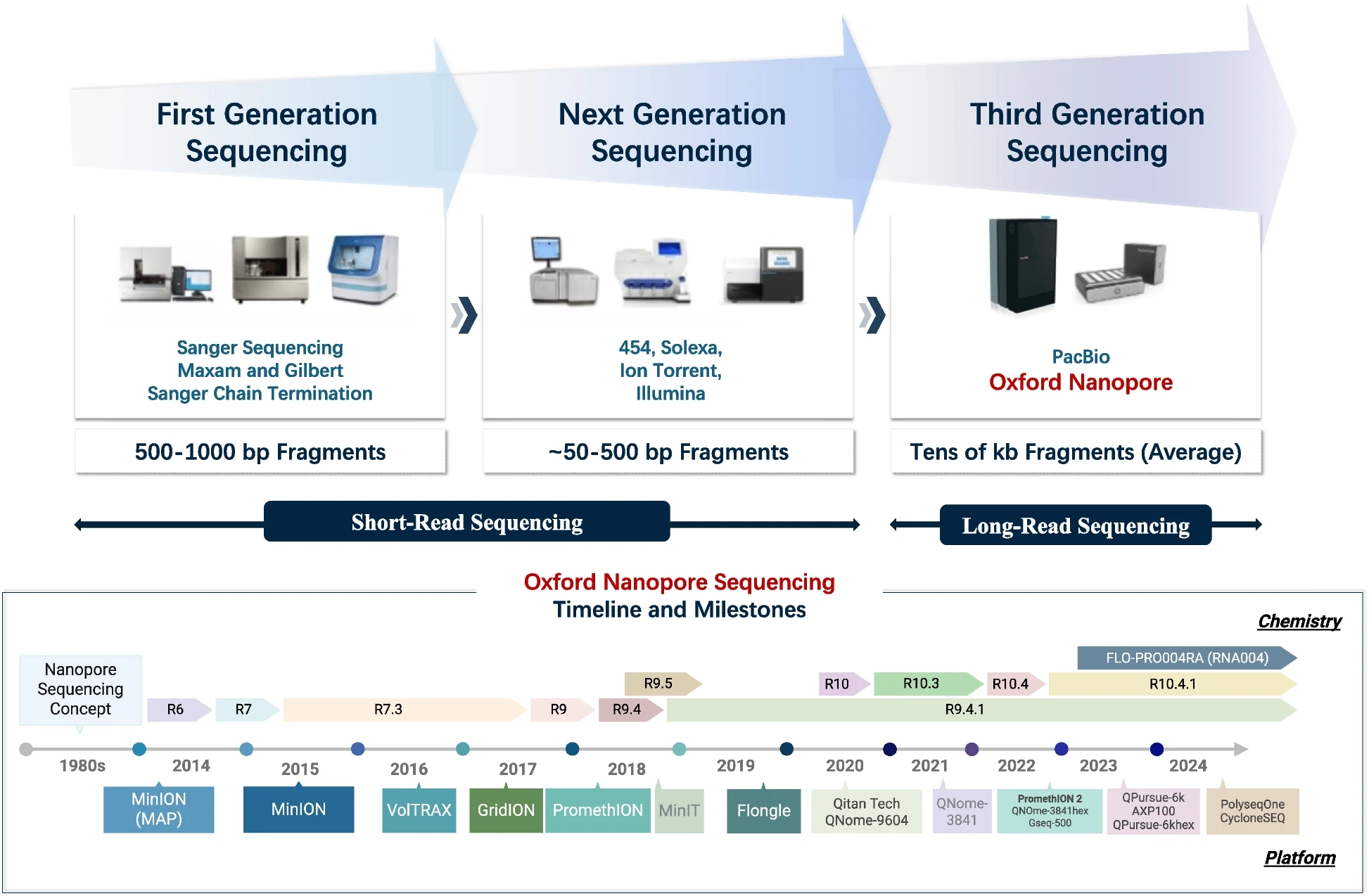
Brief Comparisons of three Sequencing phases with representative devices and features, as well as Timeline of Oxford Nanopore with diversified Chemistry and Platforms.
How nanopore direct RNA sequencing works
Oxford Nanopore sequencing differs from many other RNA sequencing methods because RNA molecules can be read directly rather than first being converted into complementary DNA.
As an RNA molecule moves through a nanopore, different nucleotide sequences alter an electrical current. Software interprets these changes and converts them into RNA sequence information.
The analytical workflow includes several major steps, including base calling, alignment to a reference sequence, signal realignment, sometimes called re-squiggling, and quality control. Different software tools can be used at each stage, and choices made early in the workflow can affect later RNA modification analysis.
Detecting chemical changes in RNA
RNA molecules can contain many chemical modifications. Two commonly investigated examples are N6-methyladenosine, or m6A, and pseudouridine, often represented by the Greek letter Ψ.
These modifications do not change the basic RNA sequence, but they can alter the electrical signal produced during nanopore sequencing. Computational methods attempt to recognize these subtle differences.
The researchers discuss a wide range of approaches for interpreting these signals, including statistical models, machine learning, deep learning and newer methods incorporating large language models.
Different tools can produce different results
To examine how well current methods perform, the authors benchmarked tools for detecting m6A and pseudouridine using publicly available datasets.
The comparisons showed substantial differences in performance among the available tools. A modification detected by one method may not always be identified as confidently by another.
This variability highlights one of the major challenges of nanopore-based RNA modification analysis. The electrical signal is influenced not only by chemical modifications, but also by the surrounding RNA sequence, sequencing noise and other technical factors.
Why direct RNA sequencing is useful
Despite these challenges, direct RNA sequencing offers several important advantages for studying RNA biology.
Because it can read long RNA molecules directly, researchers can examine RNA sequence, transcript structure and potentially multiple chemical modifications on the same molecule. This can provide information that may be difficult to obtain when RNA is fragmented or converted into DNA before sequencing.
Real-time sequencing also allows data to be generated and analyzed as an experiment progresses.
These capabilities make nanopore sequencing particularly useful for epitranscriptomic research, where researchers want to understand both the sequence of an RNA molecule and the chemical changes occurring along it.
Improving RNA modification analysis
The authors identify several areas where ONT-based RNA modification analysis still needs improvement. These include sequencing error rates, large computational requirements, limited training datasets and the difficulty of distinguishing multiple modifications that may occur on the same RNA molecule.
More standardized benchmarking datasets and improved computational methods could help researchers determine which tools are most reliable for different types of RNA modifications.
As direct RNA sequencing continues to improve, combining better sequencing accuracy with more robust computational analysis may make it possible to build increasingly detailed maps of RNA modifications and understand how they contribute to gene regulation and disease.
Wu Z, Li J, Xia R, Dai J, Su J, Meng J, Zhang Y. (2026) Nanopore direct RNA sequencing for RNA modification analysis: workflow assessment and computational tool benchmarking. Advanced Biotechnology 4(1): 9. [article]
Related Posts





RNA molecules are not simply copied from DNA and sent directly to make proteins. They can also undergo chemical modifications that influence how they are processed, stabilized and used inside cells. Collectively, these changes are part of the epitranscriptome.
Researchers increasingly use direct RNA sequencing from Oxford Nanopore Technologies, or ONT, to investigate these modifications because the technology can read long RNA molecules directly and detect changes in the electrical signal produced as RNA passes through a nanopore.
Researchers at the Department of Biosciences and Bioinformatics, Center for Intelligent RNA Therapeutics at Xi’an Jiaotong-Liverpool University discuss the computational workflow used for ONT direct RNA sequencing and compared methods for detecting RNA modifications.
Brief Comparisons of three Sequencing phases with representative devices and features, as well as Timeline of Oxford Nanopore with diversified Chemistry and Platforms.
How nanopore direct RNA sequencing works
Oxford Nanopore sequencing differs from many other RNA sequencing methods because RNA molecules can be read directly rather than first being converted into complementary DNA.
As an RNA molecule moves through a nanopore, different nucleotide sequences alter an electrical current. Software interprets these changes and converts them into RNA sequence information.
The analytical workflow includes several major steps, including base calling, alignment to a reference sequence, signal realignment, sometimes called re-squiggling, and quality control. Different software tools can be used at each stage, and choices made early in the workflow can affect later RNA modification analysis.
Detecting chemical changes in RNA
RNA molecules can contain many chemical modifications. Two commonly investigated examples are N6-methyladenosine, or m6A, and pseudouridine, often represented by the Greek letter Ψ.
These modifications do not change the basic RNA sequence, but they can alter the electrical signal produced during nanopore sequencing. Computational methods attempt to recognize these subtle differences.
The researchers discuss a wide range of approaches for interpreting these signals, including statistical models, machine learning, deep learning and newer methods incorporating large language models.
Different tools can produce different results
To examine how well current methods perform, the authors benchmarked tools for detecting m6A and pseudouridine using publicly available datasets.
The comparisons showed substantial differences in performance among the available tools. A modification detected by one method may not always be identified as confidently by another.
This variability highlights one of the major challenges of nanopore-based RNA modification analysis. The electrical signal is influenced not only by chemical modifications, but also by the surrounding RNA sequence, sequencing noise and other technical factors.
Why direct RNA sequencing is useful
Despite these challenges, direct RNA sequencing offers several important advantages for studying RNA biology.
Because it can read long RNA molecules directly, researchers can examine RNA sequence, transcript structure and potentially multiple chemical modifications on the same molecule. This can provide information that may be difficult to obtain when RNA is fragmented or converted into DNA before sequencing.
Real-time sequencing also allows data to be generated and analyzed as an experiment progresses.
These capabilities make nanopore sequencing particularly useful for epitranscriptomic research, where researchers want to understand both the sequence of an RNA molecule and the chemical changes occurring along it.
Improving RNA modification analysis
The authors identify several areas where ONT-based RNA modification analysis still needs improvement. These include sequencing error rates, large computational requirements, limited training datasets and the difficulty of distinguishing multiple modifications that may occur on the same RNA molecule.
More standardized benchmarking datasets and improved computational methods could help researchers determine which tools are most reliable for different types of RNA modifications.
As direct RNA sequencing continues to improve, combining better sequencing accuracy with more robust computational analysis may make it possible to build increasingly detailed maps of RNA modifications and understand how they contribute to gene regulation and disease.
Wu Z, Li J, Xia R, Dai J, Su J, Meng J, Zhang Y. (2026) Nanopore direct RNA sequencing for RNA modification analysis: workflow assessment and computational tool benchmarking. Advanced Biotechnology 4(1): 9. [article]
Related Posts
Recent Posts
 Scientists identify the neuroblastoma cells that signal poor outcomes
 GARAGE improves rare cell detection in single-cell RNA sequencing analysis using AI
 Machine learning reveals how RNA splicing is regulated in individual cell types
 Illumina releases SpliceAI2 to help advance rare disease research
 Postdoctoral Fellow – Long-Read RNA Methods Development for Neurodegeneration
 Novel biosensor uses DNA ‘barcodes’ to uncover disease signals in cells
RNA-Seq Products & Services



Stay Connected