

RNA molecules undergo chemical modifications that influence gene expression, RNA stability and cellular function. Although researchers have identified more than 170 types of RNA modifications, the sequence patterns associated with many of them remain poorly understood.
Researchers at the Institute of Human Genetics, University Medical Center Mainz, have developed a computational approach to identify potential sequence patterns associated with RNA modifications. Their research demonstrates how nanopore direct RNA sequencing can help uncover previously unrecognized features of RNA biology.
Identifying RNA modification patterns
RNA modifications often occur within specific nucleotide sequences called motifs. One well-characterized example is N6-methyladenosine (m⁶A), which commonly occurs within the DRACH sequence motif.
However, the sequence preferences of many other modifications are largely unknown. The researchers focused on three:
- Pseudouridine (Ψ): A modification that influences RNA structure and stability.
- Inosine (I): Produced through RNA editing and capable of altering how RNA sequences are interpreted.
- 5-methylcytosine (m⁵C): A modification associated with RNA regulation.
Identifying motifs associated with these modifications could improve our understanding of RNA processing and function.
Normalized counts over indexed 5-mer (blue circles) with relative population fitting (orange line) for m6A (a,b), Ψ, (e,f), I (i,j) and m5C (m,n) for Hek293 and human peripherical blood samples, respectively.
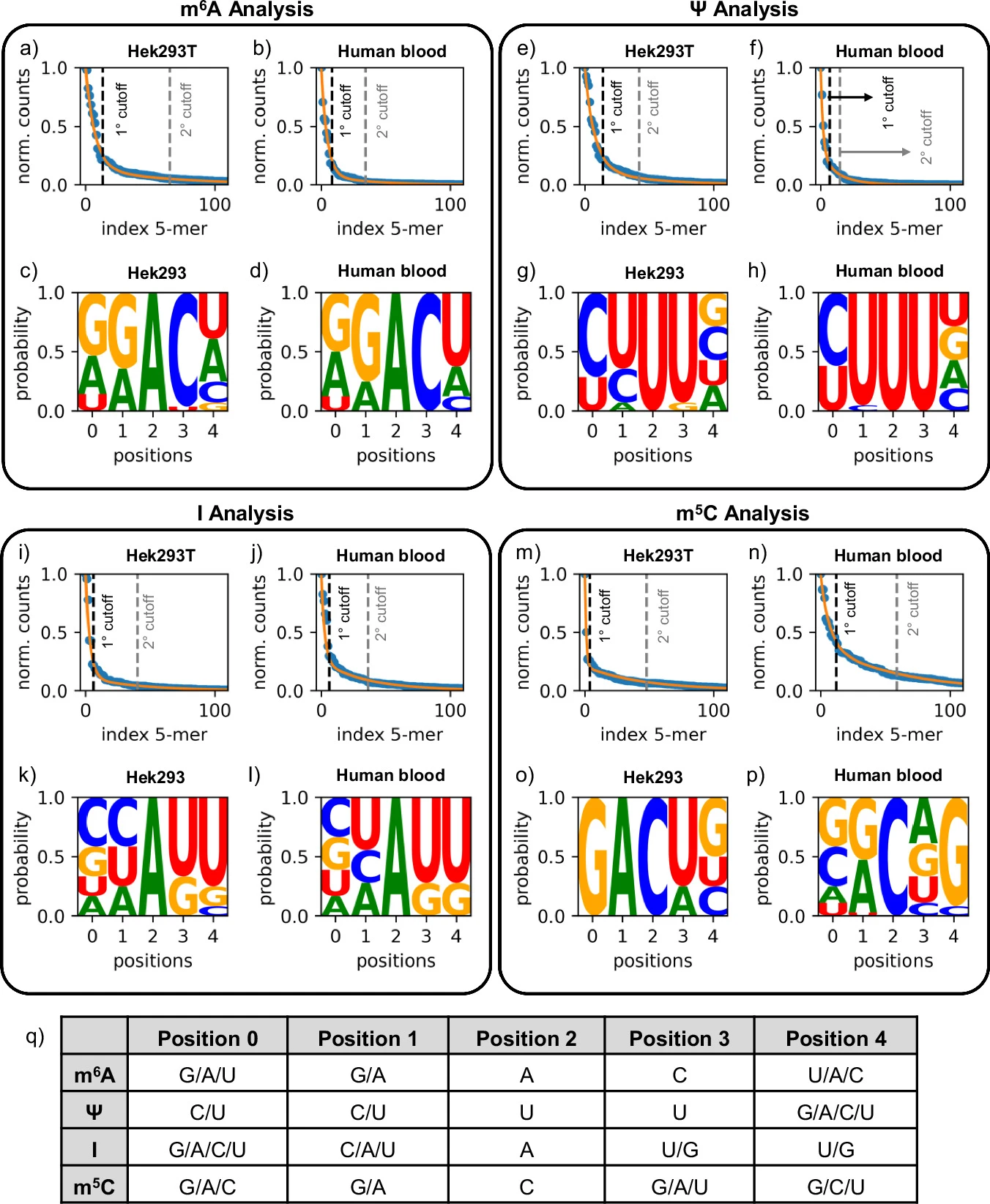
Selecting the first population (underlined by each motif before the vertical black dashed line) a logo plot was calculated for m6A (c,d), Ψ, (g,h), I (k,l) and m5C (o,p) for both cell lines. Clear motif paths can be observed, which can be reproduced in both cell lines analyzed here. Vertical grey dashed lines show the cutoff index including the second population. q Combinations of 5-mer motifs for m6A, I, Ψ and m5C. Each position (zero-indexed) shows the possible nucleotide that can be used to obtain all 5-mer combinations of the motifs appearing with high frequency
Using nanopore sequencing to discover motifs
Unlike conventional RNA sequencing, nanopore direct RNA sequencing analyzes RNA molecules without converting them into DNA. This allows researchers to detect electrical signal changes associated with chemical modifications.
The team analyzed sequencing data from human HEK293T cells and peripheral blood using a computational method called **exponential population analysis**. This approach identifies recurring nucleotide patterns near predicted RNA modification sites.
The researchers first validated their method by successfully recovering the established DRACH motif associated with m⁶A.
They then identified candidate sequence patterns for pseudouridine, inosine and 5-methylcytosine. Pseudouridine showed consistent patterns across both sample types, while inosine displayed recognizable sequence preferences with some variation. Results for 5-methylcytosine were less consistent, suggesting further investigation is needed.
Improving RNA modification analysis
Identifying sequence motifs could help researchers predict RNA modification sites more accurately and improve computational tools used in epitranscriptomics, the study of chemical modifications to RNA.
Rather than examining every possible nucleotide sequence, researchers could prioritize patterns most likely to contain particular modifications, making transcriptome-wide analysis more efficient.
However, the identified motifs remain computational predictions. Additional experimental validation is necessary to confirm their biological significance.
By combining nanopore RNA sequencing with computational analysis, this research provides a systematic approach for investigating poorly characterized RNA modifications and advancing our understanding of RNA regulation.
Alagna N, Miedema J, Basiony Y, Gerber S. (2026) Extracting candidate motif patterns for multiple RNA modifications using direct RNA sequencing. BMC Bioinformatics 27(1): 246. [article]
Related Posts







RNA molecules undergo chemical modifications that influence gene expression, RNA stability and cellular function. Although researchers have identified more than 170 types of RNA modifications, the sequence patterns associated with many of them remain poorly understood.
Researchers at the Institute of Human Genetics, University Medical Center Mainz, have developed a computational approach to identify potential sequence patterns associated with RNA modifications. Their research demonstrates how nanopore direct RNA sequencing can help uncover previously unrecognized features of RNA biology.
Identifying RNA modification patterns
RNA modifications often occur within specific nucleotide sequences called motifs. One well-characterized example is N6-methyladenosine (m⁶A), which commonly occurs within the DRACH sequence motif.
However, the sequence preferences of many other modifications are largely unknown. The researchers focused on three:
- Pseudouridine (Ψ): A modification that influences RNA structure and stability.
- Inosine (I): Produced through RNA editing and capable of altering how RNA sequences are interpreted.
- 5-methylcytosine (m⁵C): A modification associated with RNA regulation.
Identifying motifs associated with these modifications could improve our understanding of RNA processing and function.
Normalized counts over indexed 5-mer (blue circles) with relative population fitting (orange line) for m6A (a,b), Ψ, (e,f), I (i,j) and m5C (m,n) for Hek293 and human peripherical blood samples, respectively.
Selecting the first population (underlined by each motif before the vertical black dashed line) a logo plot was calculated for m6A (c,d), Ψ, (g,h), I (k,l) and m5C (o,p) for both cell lines. Clear motif paths can be observed, which can be reproduced in both cell lines analyzed here. Vertical grey dashed lines show the cutoff index including the second population. q Combinations of 5-mer motifs for m6A, I, Ψ and m5C. Each position (zero-indexed) shows the possible nucleotide that can be used to obtain all 5-mer combinations of the motifs appearing with high frequency
Using nanopore sequencing to discover motifs
Unlike conventional RNA sequencing, nanopore direct RNA sequencing analyzes RNA molecules without converting them into DNA. This allows researchers to detect electrical signal changes associated with chemical modifications.
The team analyzed sequencing data from human HEK293T cells and peripheral blood using a computational method called **exponential population analysis**. This approach identifies recurring nucleotide patterns near predicted RNA modification sites.
The researchers first validated their method by successfully recovering the established DRACH motif associated with m⁶A.
They then identified candidate sequence patterns for pseudouridine, inosine and 5-methylcytosine. Pseudouridine showed consistent patterns across both sample types, while inosine displayed recognizable sequence preferences with some variation. Results for 5-methylcytosine were less consistent, suggesting further investigation is needed.
Improving RNA modification analysis
Identifying sequence motifs could help researchers predict RNA modification sites more accurately and improve computational tools used in epitranscriptomics, the study of chemical modifications to RNA.
Rather than examining every possible nucleotide sequence, researchers could prioritize patterns most likely to contain particular modifications, making transcriptome-wide analysis more efficient.
However, the identified motifs remain computational predictions. Additional experimental validation is necessary to confirm their biological significance.
By combining nanopore RNA sequencing with computational analysis, this research provides a systematic approach for investigating poorly characterized RNA modifications and advancing our understanding of RNA regulation.
Alagna N, Miedema J, Basiony Y, Gerber S. (2026) Extracting candidate motif patterns for multiple RNA modifications using direct RNA sequencing. BMC Bioinformatics 27(1): 246. [article]
Related Posts
Recent Posts
 PANGEA – an integrated cell atlas across diverse biological contexts enables systematic profiling of multicellular responses in human diseases
 UMIche – a UMI-centric analysis platform for enhancing molecular quantification accuracy in bulk and single-cell sequencing
 New AI tool uses RNA sequencing to uncover gene interactions in Alzheimer’s disease
 New RNA sequencing tool reveals how stem cells develop into heart cells
 Estimating the completeness of large-scale single-cell sequencing projects
 New RNA sequencing tool improves transcriptome reconstruction using machine learning
RNA-Seq Products & Services


Stay Connected