Researchers at Karolinska Institutet have identified a new mechanism where circular RNA plays a crucial role in wound healing, which could lead to new therapies to improve wound healing and reduce scarring. The study was published in Advanced Science.
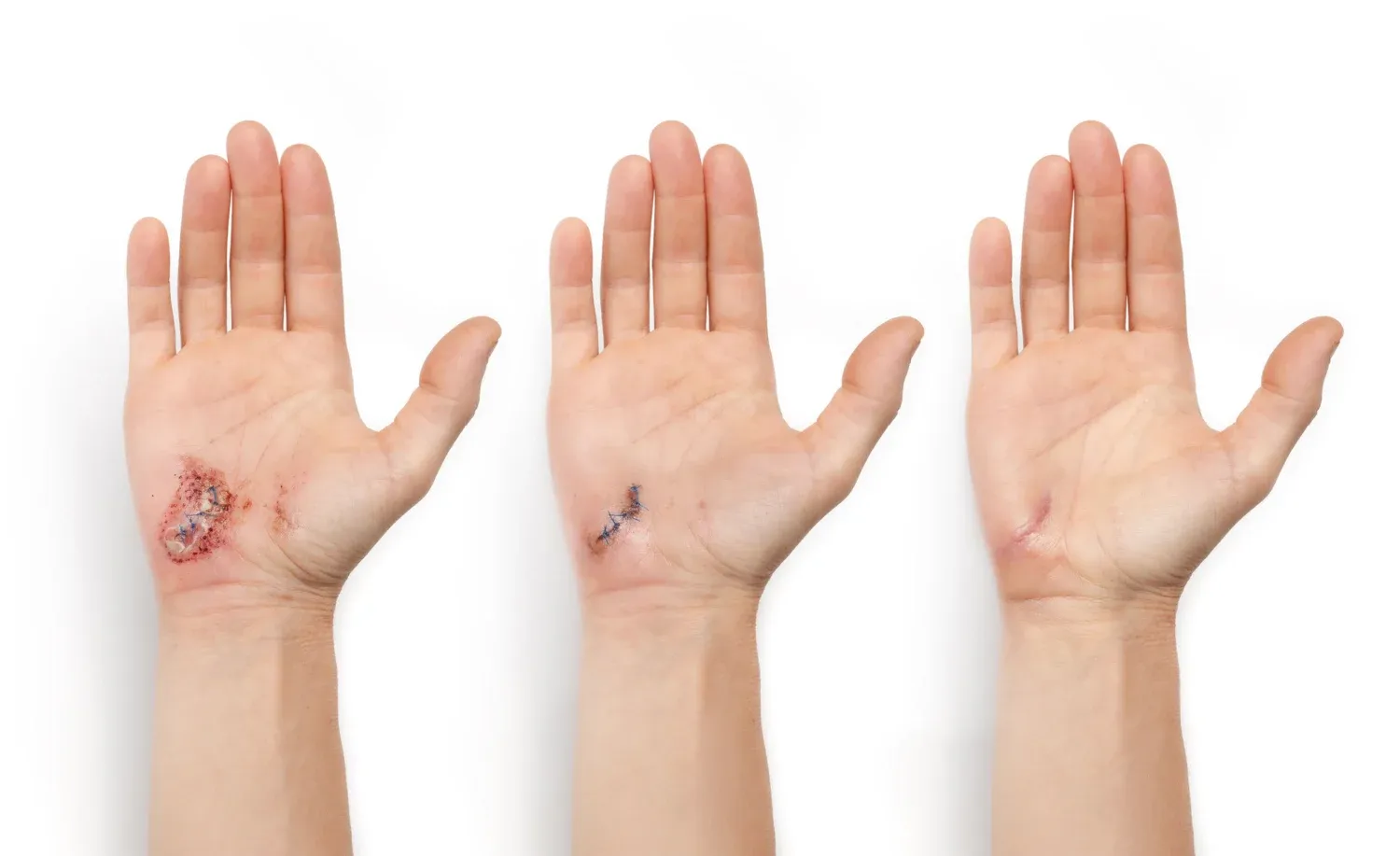
A new study shows how circular RNA (circRNA) affects wound healing in human skin. Researchers have discovered a unique circRNA, CircGLIS3(2), which temporarily increases in skin cells, known as fibroblasts, after an injury. CircGLIS3(2) is activated by common injury signals such as inflammation, low oxygen levels, and cell stress.
“What makes CircGLIS3(2) special is its dual role in wound healing,” says Guanglin Niu, postdoctoral researcher at the Department of Medicine, and continues: – Its RNA stabilizes the cytoplasmic protein PCOLCE and activates fibroblasts to rebuild damaged tissue, while its protein binds to BTF3 in the cell nucleus and promotes cell growth.
Versatile RNA with dual function
The study shows that CircGLIS3(2) functions both as a regulatory RNA and as a protein-coding molecule. This dual function broadens our understanding of the versatility of non-coding RNAs in controlling complex cellular behaviors, such as fibroblast activation and proliferation in response to injury. Biologically, it highlights how cells utilize a single transcript to adapt to dynamic environmental changes.
To conduct the study, the researchers developed a unique model for human wound healing and collected full-thickness excision wounds from healthy volunteers at multiple time points. RNA sequencing of wound healing and isolated skin revealed differentially expressed circRNA, with CircGLIS3(2) showing increased levels in fibroblasts and wound biopsies. Sequence analysis identified an open reading frame (ORF) within CircGLIS3(2), leading to further investigation of its protein-coding potential.
CircGLIS3(2) expression is upregulated in human wound fibroblasts

A) Excisional wounds were created on the skin of 27 healthy volunteers and collected 1 (Wound1), 7 (Wound7), and 30 days later (Wound30) from the same donor. CD45− epidermal cells and CD90+ fibroblasts were isolated from matched skin and Wound7 samples. Biopsies were also collected from lesional sites and surrounding skin of 8 keloid patients. CircRNAs were analyzed in these clinical samples by RNA-seq, qRT-PCR, and laser capture microdissection (LCM). B) Venn diagram showing the commonly identified differentially expressed (DE) circRNAs in the isolated cell types and tissue biopsies of the skin and Wound7 analyzed by RNA-seq. CircGLIS3(2) expression in the skin and wound biopsies (n = 5 donors) C) and isolated fibroblasts (n = 5 donors) D) was analyzed by RNA-seq. qRT-PCR validation of CircGLIS3(2) expression in additional skin and wound biopsies (n = 5 donors) E), epidermal and dermal compartments of skin and wounds separated by LCM (n = 7 donors) F), CD45− epidermal cells G) and CD90+ fibroblasts H) from skin and wounds (n = 5 donors), donor matched skin and keloid biopsies (n = 8 donors) I). Data are presented as means ± SD. ns P ≥ 0.05, *P< 0.05, **P< 0.01 and ***P< 0.001 by Wilcoxon test (C, D), or one-way ANOVA and Tukey’s multiple comparisons test (G, H), or Paired t test (E, F and I).
“Our findings uncover a novel regulatory mechanism in wound healing,” says Maria A. Toma, co-first author and former PhD student in Ning Xu Landén’s research group. Ning Xu Landén, associate professor in the same department, adds: “The dual function of CircGLIS3(2) makes it a promising therapeutic target, particularly for enhancing outcomes in fibrotic or hard-to-heal wounds.”
Further research is needed to explore the broader implications of RNA with dual coding and non-coding functions. Gaining deeper insight into this phenomenon may reveal new aspects of gene regulation, cellular adaptability, and potential therapeutic opportunities.
Source – Karolinska Institutet


Researchers at Karolinska Institutet have identified a new mechanism where circular RNA plays a crucial role in wound healing, which could lead to new therapies to improve wound healing and reduce scarring. The study was published in Advanced Science.
A new study shows how circular RNA (circRNA) affects wound healing in human skin. Researchers have discovered a unique circRNA, CircGLIS3(2), which temporarily increases in skin cells, known as fibroblasts, after an injury. CircGLIS3(2) is activated by common injury signals such as inflammation, low oxygen levels, and cell stress.
Versatile RNA with dual function
The study shows that CircGLIS3(2) functions both as a regulatory RNA and as a protein-coding molecule. This dual function broadens our understanding of the versatility of non-coding RNAs in controlling complex cellular behaviors, such as fibroblast activation and proliferation in response to injury. Biologically, it highlights how cells utilize a single transcript to adapt to dynamic environmental changes.
To conduct the study, the researchers developed a unique model for human wound healing and collected full-thickness excision wounds from healthy volunteers at multiple time points. RNA sequencing of wound healing and isolated skin revealed differentially expressed circRNA, with CircGLIS3(2) showing increased levels in fibroblasts and wound biopsies. Sequence analysis identified an open reading frame (ORF) within CircGLIS3(2), leading to further investigation of its protein-coding potential.
CircGLIS3(2) expression is upregulated in human wound fibroblasts
A) Excisional wounds were created on the skin of 27 healthy volunteers and collected 1 (Wound1), 7 (Wound7), and 30 days later (Wound30) from the same donor. CD45− epidermal cells and CD90+ fibroblasts were isolated from matched skin and Wound7 samples. Biopsies were also collected from lesional sites and surrounding skin of 8 keloid patients. CircRNAs were analyzed in these clinical samples by RNA-seq, qRT-PCR, and laser capture microdissection (LCM). B) Venn diagram showing the commonly identified differentially expressed (DE) circRNAs in the isolated cell types and tissue biopsies of the skin and Wound7 analyzed by RNA-seq. CircGLIS3(2) expression in the skin and wound biopsies (n = 5 donors) C) and isolated fibroblasts (n = 5 donors) D) was analyzed by RNA-seq. qRT-PCR validation of CircGLIS3(2) expression in additional skin and wound biopsies (n = 5 donors) E), epidermal and dermal compartments of skin and wounds separated by LCM (n = 7 donors) F), CD45− epidermal cells G) and CD90+ fibroblasts H) from skin and wounds (n = 5 donors), donor matched skin and keloid biopsies (n = 8 donors) I). Data are presented as means ± SD. ns P ≥ 0.05, *P< 0.05, **P< 0.01 and ***P< 0.001 by Wilcoxon test (C, D), or one-way ANOVA and Tukey’s multiple comparisons test (G, H), or Paired t test (E, F and I).
Further research is needed to explore the broader implications of RNA with dual coding and non-coding functions. Gaining deeper insight into this phenomenon may reveal new aspects of gene regulation, cellular adaptability, and potential therapeutic opportunities.
Source – Karolinska Institutet
Niu G, Toma M A, Geara J, Bian X, Chen Y, Luo L, Wang Q, Xiao Y, Vij M, Piipponen M, Liu Z, Oasa S, Zhang L, Schlesinger D, Végvári Á, Li D, Wang A, Vukojević V, Elsässer S J, Sommar P, Xu Landén N. (2025) Collaborative duality of CircGLIS3(2) RNA and protein in human wound repair. Advanced Science 12(18): 2200786. [article]
Related Posts
RNAmel simplifies RNA sequencing data analysis with a reproducible, integrated platform
Heart failure reshapes bone marrow to create inflammation-related immune memory
Overlooked DNA regions surrounding ‘microexons’ hold missing pieces of autism’s genetic puzzle
RiboBA improves detection of hidden protein-coding regions using ribosome profiling
An anti-senescence gene may fight spinal disc deterioration
Scientists identify the neuroblastoma cells that signal poor outcomes
Novel biosensor uses DNA ‘barcodes’ to uncover disease signals in cells
CellART extracts single-cell information from high-resolution spatial transcriptomics
Cell2space restores spatial context to single-cell RNA sequencing data
Urine test may improve bladder cancer diagnosis and guide treatment decisions
DeCoRE – a computational method to resolve RNA structural heterogeneity from RNA structure probing data by direct RNA sequencing
Tracing 700 million years of cell evolution
How should biological replicates be handled in long-read RNA sequencing?
RNA-Seq reveals a new way the developing heart controls its growth
The Human RNome Project Consortium seeks to publish first-ever complete sequence of the body’s RNA
scFlowReport brings multiple single-cell RNA sequencing analyses into one workflow
Long-read RNA sequencing reveals how neurons choose alternative RNA endings
DeOPUS improves cell-type estimates from bulk RNA sequencing
ResolVI improves accuracy in spatial transcriptomics analysis
RNA sequencing reveals transcriptional allele differences in prostate cancer stem cells
Stay Connected
Submit a Post to the Blog
Recent Posts
Subscribe to the RNA-Seq Blog
RNA-Seq Products & Services