

Cancer is a complex disease, and even within a single tumor, not all cells are the same. Some are aggressive malignant cells, while others are normal or supportive cells. Identifying these malignant cells at the single-cell level is essential for understanding tumor progression and improving treatments. A team led by researchers at the Shanghai Institute for Biomedical and Pharmaceutical Technologies has developed scMalignantFinder, a powerful new machine learning tool designed to accurately distinguish malignant cells from normal ones in single-cell RNA sequencing (scRNA-seq) and spatial transcriptomics data.
How scMalignantFinder Works
To build this tool, researchers compiled over 400,000 single-cell transcriptomes from multiple cancer datasets and refined their malignant cell annotations using nine curated pan-cancer gene signatures. Instead of relying on a single method, the team used a data- and knowledge-driven strategy to identify genes that consistently define cancer cells.
Workflow of scMalignantFinder
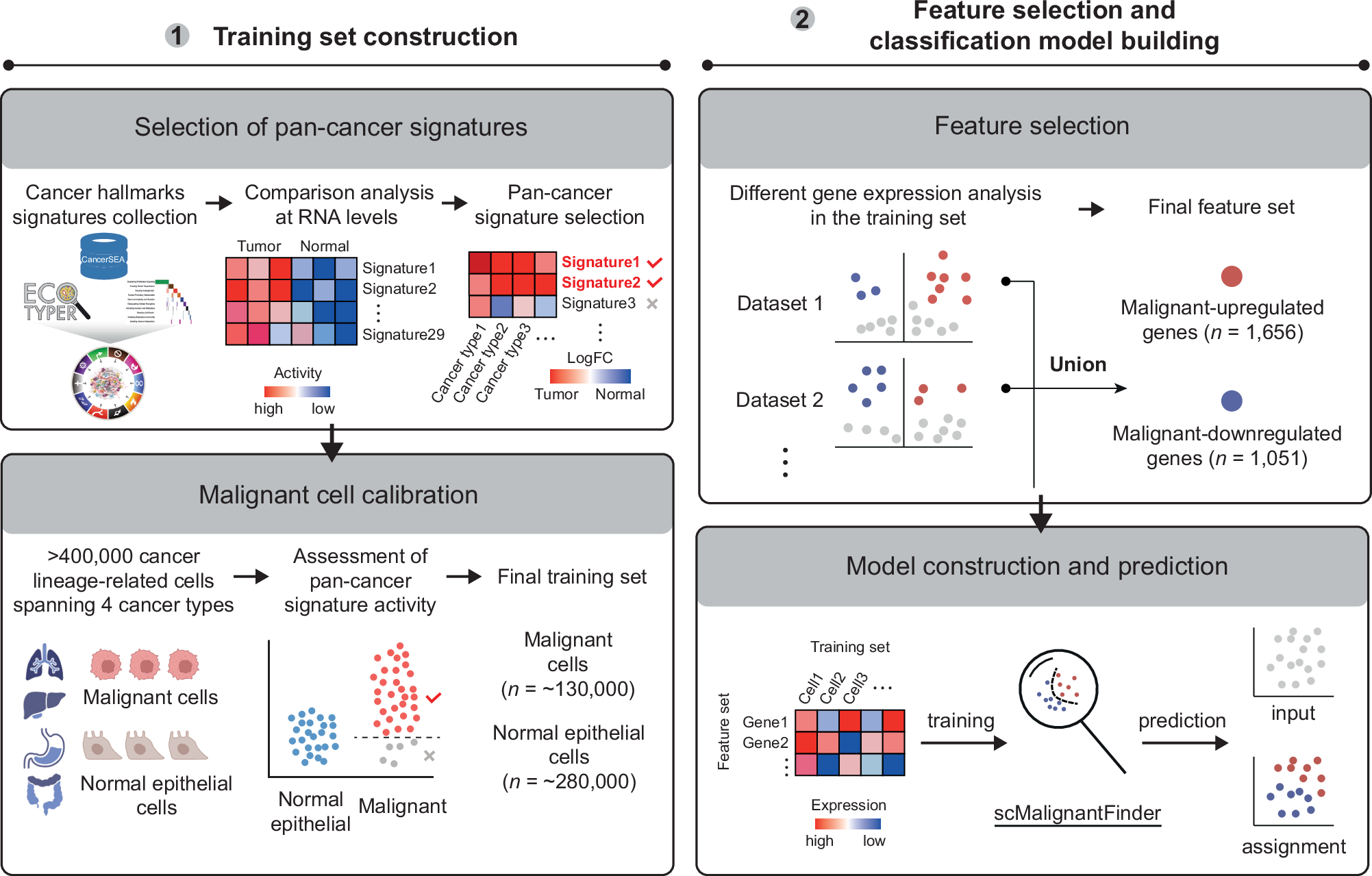
scMalignantFinder identifies malignant cells through two steps: (1) constructing a training set by calibrating malignant cells using nine curated cancer gene signatures across over 400,000 epithelial cells from four cancer types, and (2) performing feature selection by taking the union of differentially expressed genes (DEGs) across datasets, which captures both common DEGs and those unique to specific datasets. These refined steps provide the foundation for building a logistic regression model that classifies cells as malignant or normal based on single-cell RNA-seq (scRNA-seq) data.
Better Cancer Detection with Machine Learning
scMalignantFinder outperformed existing methods across 13 independent datasets, including two gold-standard datasets. By analyzing gene expression patterns, the tool provides a malignancy probability score, allowing scientists to track tumor evolution and identify malignant regions within tumor tissues.
Why This is Important
This advancement in scRNA-seq analysis means more accurate tumor profiling, which could help
- Improve cancer diagnosis by distinguishing malignant from normal cells
- Enhance treatment strategies by identifying dynamic tumor changes
- Aid spatial transcriptomics research, allowing for precise mapping of malignant regions within tissues
With scMalignantFinder, researchers now have a more reliable and efficient method to study tumor heterogeneity, bringing us one step closer to more precise and personalized cancer treatments.
Availability – The open-source package of scMalignantFinder is available on GitHub (https://github.com/Jonyyqn/scMalignantFinder).
Yu Q, Li YY, Chen Y. (2025) scMalignantFinder distinguishes malignant cells in single-cell and spatial transcriptomics by leveraging cancer signatures. Commun Biol 8(1): 504. [article]
Related Posts




Cancer is a complex disease, and even within a single tumor, not all cells are the same. Some are aggressive malignant cells, while others are normal or supportive cells. Identifying these malignant cells at the single-cell level is essential for understanding tumor progression and improving treatments. A team led by researchers at the Shanghai Institute for Biomedical and Pharmaceutical Technologies has developed scMalignantFinder, a powerful new machine learning tool designed to accurately distinguish malignant cells from normal ones in single-cell RNA sequencing (scRNA-seq) and spatial transcriptomics data.
How scMalignantFinder Works
To build this tool, researchers compiled over 400,000 single-cell transcriptomes from multiple cancer datasets and refined their malignant cell annotations using nine curated pan-cancer gene signatures. Instead of relying on a single method, the team used a data- and knowledge-driven strategy to identify genes that consistently define cancer cells.
Workflow of scMalignantFinder
scMalignantFinder identifies malignant cells through two steps: (1) constructing a training set by calibrating malignant cells using nine curated cancer gene signatures across over 400,000 epithelial cells from four cancer types, and (2) performing feature selection by taking the union of differentially expressed genes (DEGs) across datasets, which captures both common DEGs and those unique to specific datasets. These refined steps provide the foundation for building a logistic regression model that classifies cells as malignant or normal based on single-cell RNA-seq (scRNA-seq) data.
Better Cancer Detection with Machine Learning
scMalignantFinder outperformed existing methods across 13 independent datasets, including two gold-standard datasets. By analyzing gene expression patterns, the tool provides a malignancy probability score, allowing scientists to track tumor evolution and identify malignant regions within tumor tissues.
Why This is Important
This advancement in scRNA-seq analysis means more accurate tumor profiling, which could help
- Improve cancer diagnosis by distinguishing malignant from normal cells
- Enhance treatment strategies by identifying dynamic tumor changes
- Aid spatial transcriptomics research, allowing for precise mapping of malignant regions within tissues
With scMalignantFinder, researchers now have a more reliable and efficient method to study tumor heterogeneity, bringing us one step closer to more precise and personalized cancer treatments.
Availability – The open-source package of scMalignantFinder is available on GitHub (https://github.com/Jonyyqn/scMalignantFinder).
Yu Q, Li YY, Chen Y. (2025) scMalignantFinder distinguishes malignant cells in single-cell and spatial transcriptomics by leveraging cancer signatures. Commun Biol 8(1): 504. [article]
Related Posts
Recent Posts
 Scientists identify the neuroblastoma cells that signal poor outcomes
 GARAGE improves rare cell detection in single-cell RNA sequencing analysis using AI
 Machine learning reveals how RNA splicing is regulated in individual cell types
 Illumina releases SpliceAI2 to help advance rare disease research
 Postdoctoral Fellow – Long-Read RNA Methods Development for Neurodegeneration
 Novel biosensor uses DNA ‘barcodes’ to uncover disease signals in cells
RNA-Seq Products & Services


Stay Connected