

Researchers from the Plant Breeding and Acclimatization Institute-National Research Institute in Poland have developed an innovative protocol that makes it possible to study gene regulation using even badly degraded RNA samples. Their work focuses on degradome sequencing, a powerful method used to identify how small molecules called microRNAs (miRNAs) control gene expression by cutting RNA targets in the cell.
Until now, degradome sequencing has required high-quality RNA, which made it hard to study samples from older or poorly preserved tissues. The new method overcomes this by optimizing each step of the process, especially the purification of small RNA fragments. The team introduced a novel tube-spin purification step using gauze, along with sodium acetate and glycogen to recover more of the correct RNA fragments from degraded samples.
The scheme for constructing a degradome library
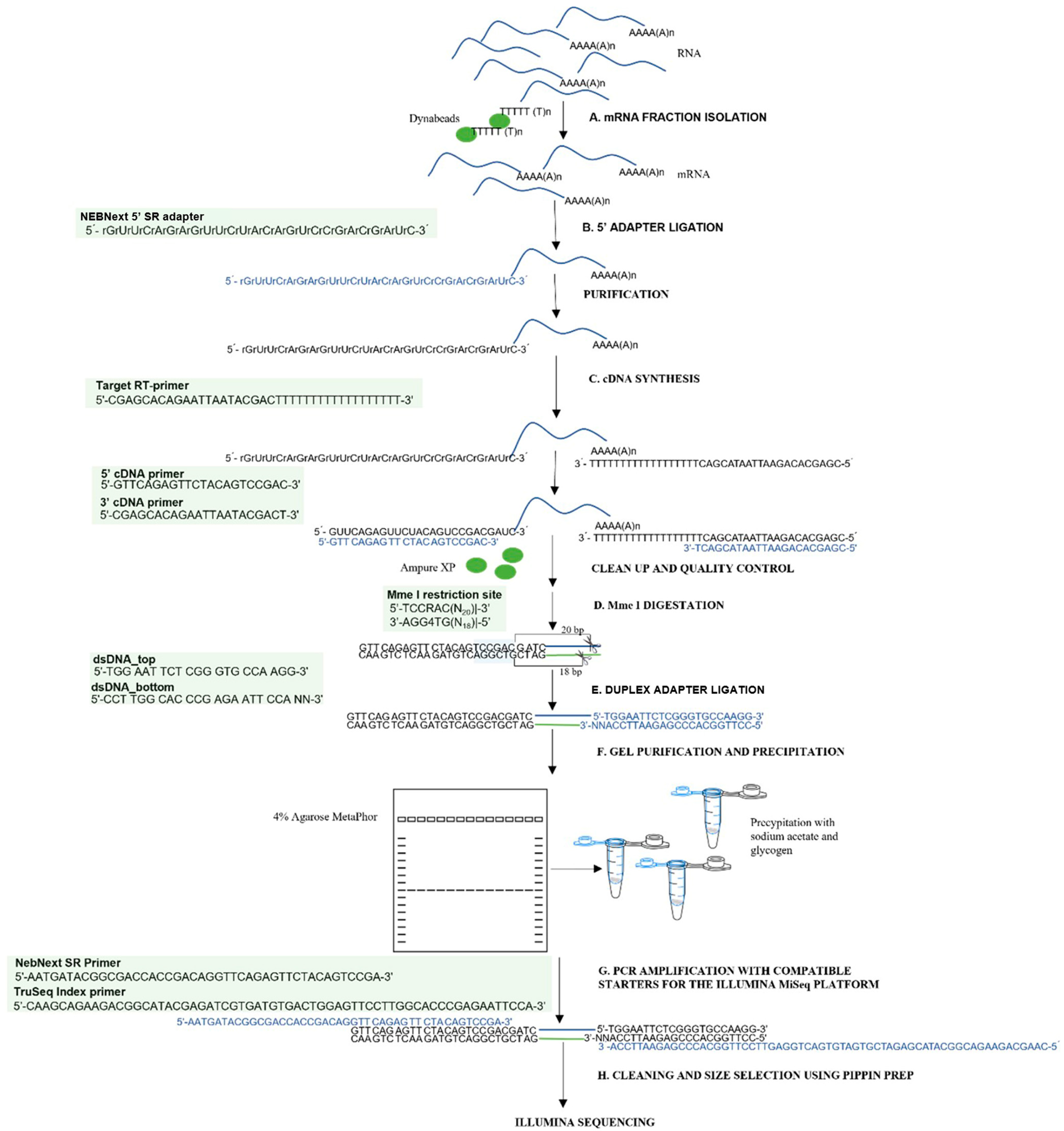
The procedure comprises the following steps: (A) mRNA fraction isolation, (B) 5’ adapter ligation, (C) cDNA synthesis, (D) Mme I digestion, (E) duplex adapter ligation, (F) gel purification and precipitation, (G) PCR amplification with Illumina primers, and (H) cleaning and size selection library using Pippin Prep.
They also cleverly reused reagents from standard RNA sequencing kits and designed their own primers, which cuts both the cost and time needed for preparing sequencing libraries. Importantly, they validated the new approach by cloning and sequencing the resulting fragments, confirming that the protocol reliably generates high-quality data.
This development is a big step forward for researchers working with clinical samples or archived materials where RNA quality is often compromised. By expanding access to degradome sequencing, it opens the door to discovering new miRNA targets and understanding gene regulation in more challenging samples.
Puchta-Jasińska M, Groszyk J, Boczkowska M. (2025) Improved degradome sequencing protocol via reagent recycling from sRNAseq library preparations. International Journal of Molecular Sciences 26(14): 7020. https://doi.org/10.3390/ijms26147020
Related Posts






Researchers from the Plant Breeding and Acclimatization Institute-National Research Institute in Poland have developed an innovative protocol that makes it possible to study gene regulation using even badly degraded RNA samples. Their work focuses on degradome sequencing, a powerful method used to identify how small molecules called microRNAs (miRNAs) control gene expression by cutting RNA targets in the cell.
Until now, degradome sequencing has required high-quality RNA, which made it hard to study samples from older or poorly preserved tissues. The new method overcomes this by optimizing each step of the process, especially the purification of small RNA fragments. The team introduced a novel tube-spin purification step using gauze, along with sodium acetate and glycogen to recover more of the correct RNA fragments from degraded samples.
The scheme for constructing a degradome library
The procedure comprises the following steps: (A) mRNA fraction isolation, (B) 5’ adapter ligation, (C) cDNA synthesis, (D) Mme I digestion, (E) duplex adapter ligation, (F) gel purification and precipitation, (G) PCR amplification with Illumina primers, and (H) cleaning and size selection library using Pippin Prep.
They also cleverly reused reagents from standard RNA sequencing kits and designed their own primers, which cuts both the cost and time needed for preparing sequencing libraries. Importantly, they validated the new approach by cloning and sequencing the resulting fragments, confirming that the protocol reliably generates high-quality data.
This development is a big step forward for researchers working with clinical samples or archived materials where RNA quality is often compromised. By expanding access to degradome sequencing, it opens the door to discovering new miRNA targets and understanding gene regulation in more challenging samples.
Puchta-Jasińska M, Groszyk J, Boczkowska M. (2025) Improved degradome sequencing protocol via reagent recycling from sRNAseq library preparations. International Journal of Molecular Sciences 26(14): 7020. https://doi.org/10.3390/ijms26147020
Related Posts
Recent Posts
 Overlooked DNA regions surrounding ‘microexons’ hold missing pieces of autism’s genetic puzzle
 RiboBA improves detection of hidden protein-coding regions using ribosome profiling
 An anti-senescence gene may fight spinal disc deterioration
 Bulk RNA-seq Analysis: A Complete Beginner’s Guide
 Lexogen and Mithrl connect RNA-Seq library prep to AI-powered biological interpretation
 Scientists identify the neuroblastoma cells that signal poor outcomes
RNA-Seq Products & Services


Stay Connected