Discovery of smOOPs sheds light on why certain RNAs cluster into condensates – a breakthrough that opens new avenues for disease research
Inside cells, RNAs and proteins form tiny, liquid-like droplets called biomolecular condensates. These droplets are essential for organizing cellular life, yet why some RNAs cluster more readily than others has remained unclear. Disruptions in condensate formation are linked to developmental defects, cancer, and neurodegenerative diseases. Researchers at Karlsruhe Institute of Technology (KIT) have now identified a new class of RNA called smOOPs and gained a better understanding of how biomolecular condensates form. The findings were published in the journal Cell Genomics.
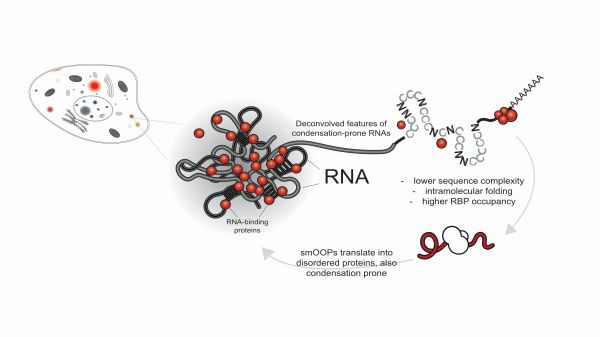
The new class of RNA, named smOOPs, was identified by their unique sequence and structural features (figure: Klobučar et al.)
Within human cells lies a dynamic interior. Biological condensates act as organizational hubs, supporting a wide range of cellular functions from gene regulation to stress responses.
“These biological condensates are accumulations that arise through phase separation, a process in which molecules segregate from their surroundings – much like how oil separates from water”, Professor Miha Modic from the Zoological Institute at KIT explains. “Inside cells, this process causes RNA and proteins to form distinct membrane-less droplets.”
In a new study, conducted in collaboration with researchers from the National Institute of Chemistry in Slovenia and The Francis Crick Institute, Modic’s team combined experimental analyses with deep learning to determine which RNAs tend to cluster during condensate formation. Using this approach, the researchers identified a previously unknown RNA class active during early development and called them smOOPs (semi-extractable and orthogonal organic phase separation-enriched RNAs).

Sticky RNAs influence cellular organization
“During early development, each cell state expresses a distinct set of condensation-prone RNAs. These RNAs ‘tune’ or scaffold the phase-separation landscape of that cell,” says Modic. “We have discovered that smOOPs are unusually “sticky”, highly cell-type specific, and are present during early development. They resist standard RNA extraction methods and are heavily bound by RNA-binding proteins.”
Moreover, the researchers observed that smOOPs cluster visibly within cells and are more interconnected than expected, demonstrating that they naturally prefer to condense inside cells.
Using deep learning, the researchers found that smOOPs share distinctive features; long transcripts with lower sequence complexity, strong internal folding, and characteristic protein-binding patterns. It was found that the proteins encoded by these RNAs also tend to contain long, flexible segments, that also promote condensation.
“This indicates an intriguing interplay between RNA- and protein-based features in phase separation, says Modic. “The discovery of smOOPs not only expands our understanding of condensation-prone RNAs but also demonstrates how combining biochemical experiments with deep machine learning can reveal the hidden logic of life’s molecular networks”.
New clues on condensate formation guides further research
Investigating how cells maintain their internal organization is crucial for understanding our biology.
“Both RNA and protein contribute to condensate formation. That coupling becomes particularly relevant in development. When this machinery malfunctions it causes diseases”, explains Modic. “By identifying smOOPs and their RNA–RNA interaction network, we now have a conceptual and mechanistic framework to interpret pathogenic condensates in disease.”
Source – Karlsruhe Institute of Technology (KIT)


Discovery of smOOPs sheds light on why certain RNAs cluster into condensates – a breakthrough that opens new avenues for disease research
Inside cells, RNAs and proteins form tiny, liquid-like droplets called biomolecular condensates. These droplets are essential for organizing cellular life, yet why some RNAs cluster more readily than others has remained unclear. Disruptions in condensate formation are linked to developmental defects, cancer, and neurodegenerative diseases. Researchers at Karlsruhe Institute of Technology (KIT) have now identified a new class of RNA called smOOPs and gained a better understanding of how biomolecular condensates form. The findings were published in the journal Cell Genomics.
The new class of RNA, named smOOPs, was identified by their unique sequence and structural features (figure: Klobučar et al.)
Within human cells lies a dynamic interior. Biological condensates act as organizational hubs, supporting a wide range of cellular functions from gene regulation to stress responses.
In a new study, conducted in collaboration with researchers from the National Institute of Chemistry in Slovenia and The Francis Crick Institute, Modic’s team combined experimental analyses with deep learning to determine which RNAs tend to cluster during condensate formation. Using this approach, the researchers identified a previously unknown RNA class active during early development and called them smOOPs (semi-extractable and orthogonal organic phase separation-enriched RNAs).
Sticky RNAs influence cellular organization
Moreover, the researchers observed that smOOPs cluster visibly within cells and are more interconnected than expected, demonstrating that they naturally prefer to condense inside cells.
Using deep learning, the researchers found that smOOPs share distinctive features; long transcripts with lower sequence complexity, strong internal folding, and characteristic protein-binding patterns. It was found that the proteins encoded by these RNAs also tend to contain long, flexible segments, that also promote condensation.
New clues on condensate formation guides further research
Investigating how cells maintain their internal organization is crucial for understanding our biology.
Source – Karlsruhe Institute of Technology (KIT)
Klobučar T, Novljan J, Iosub I A, Kokot B, Urbančič I, Jones D M, Chakrabarti A M, Luscombe N M, Ule J, Modic M. (2025) Integrative profiling of condensation-prone RNAs during early development. Cell Genomics : 101065. [article]
Related Posts
Novel biosensor uses DNA ‘barcodes’ to uncover disease signals in cells
CellART extracts single-cell information from high-resolution spatial transcriptomics
Cell2space restores spatial context to single-cell RNA sequencing data
Urine test may improve bladder cancer diagnosis and guide treatment decisions
DeCoRE – a computational method to resolve RNA structural heterogeneity from RNA structure probing data by direct RNA sequencing
Tracing 700 million years of cell evolution
How should biological replicates be handled in long-read RNA sequencing?
RNA-Seq reveals a new way the developing heart controls its growth
The Human RNome Project Consortium seeks to publish first-ever complete sequence of the body’s RNA
scFlowReport brings multiple single-cell RNA sequencing analyses into one workflow
Long-read RNA sequencing reveals how neurons choose alternative RNA endings
DeOPUS improves cell-type estimates from bulk RNA sequencing
ResolVI improves accuracy in spatial transcriptomics analysis
RNA sequencing reveals transcriptional allele differences in prostate cancer stem cells
Unmasking “zombie cells” in aging tissue with an AI-powered barcode
RNA variant imaging for cancer diagnosis
Autism-risk mutations reveal two opposing patterns of brain gene activity
A real-data approach to evaluating RNA transcript analysis methods
Detection and sequencing of Ap2N-capped RNAs in human cells
Single-cell RNA sequencing provides a closer look at the Aedes aegypti midgut
Stay Connected
Submit a Post to the Blog
Recent Posts
Subscribe to the RNA-Seq Blog
RNA-Seq Products & Services