


RNA molecules do much more than simply carry instructions for making proteins. Inside cells, RNA molecules constantly interact with other RNAs and with proteins called RNA-binding proteins, or RBPs. These interactions help control how genes are turned on and off, how RNA molecules are processed, and how cells respond to changing conditions.
Because RNA interactions are so important, scientists have been searching for better ways to map and study these complex networks. Researchers from Sun Yat-sen University and the City of Hope have developed new computational tools called rbsSeeker and rriScan to improve detection of RNA-protein and RNA-RNA interactions.
The team integrated these tools into a large online resource called the Encyclopedia of RNA Interactomes, also known as ENCORI. This web-based platform allows researchers to explore many different types of RNA interactions and regulatory networks in a single location.
Computational frameworks of novel algorithms and integrative workflow of ENCORI atlas
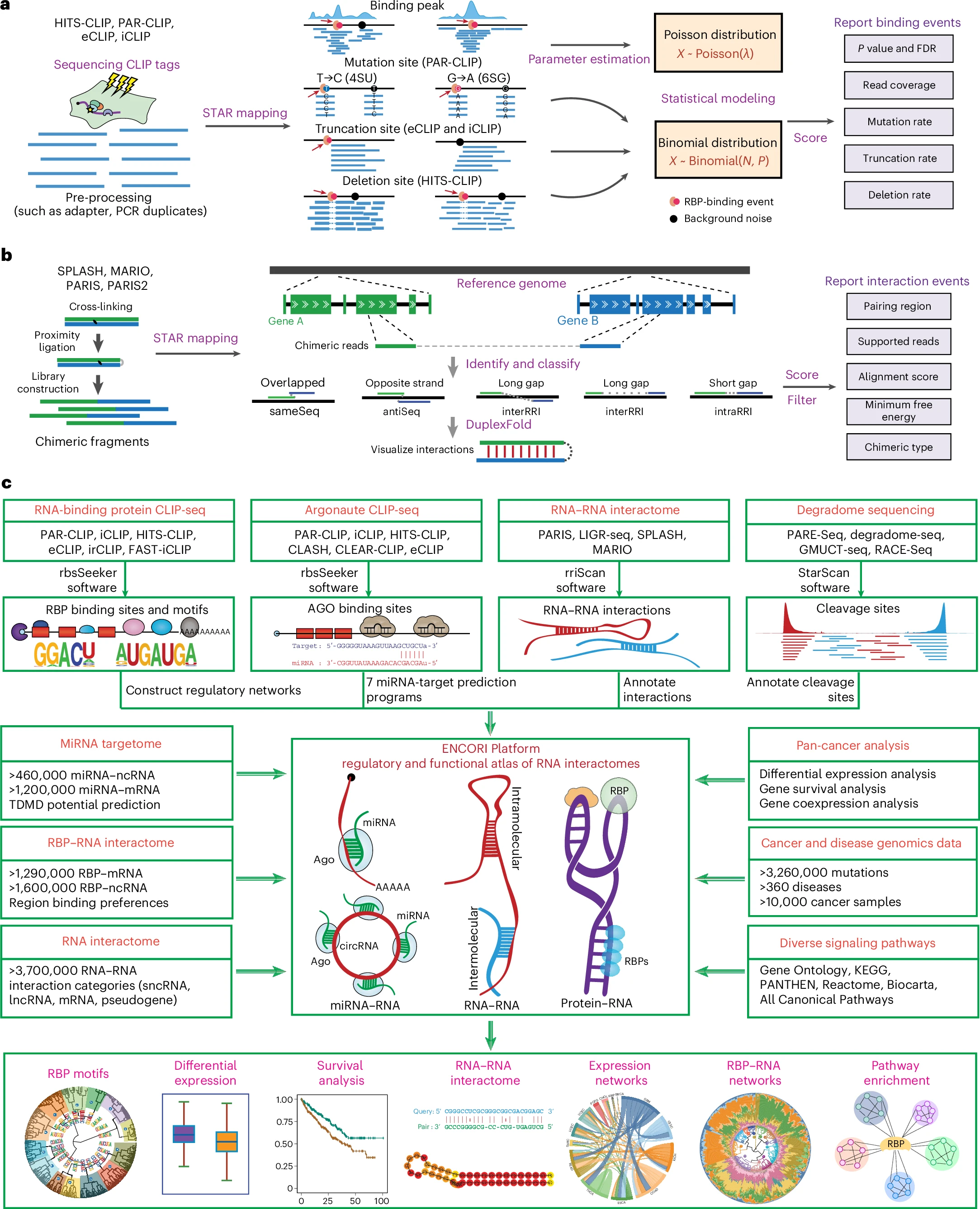
a, The core algorithmic structure of rbsSeeker for identifying RBP-binding peaks and cross-linking sites from CLIP-seq data. b, The main algorithm framework of rriScan for detecting and characterizing RNA–RNA interactions. c, Overview of the ENCORI atlas. ENCORI integrates large-scale public RBP and AGO CLIP-seq, RNA–RNA interactome and degradome sequencing data. We constructed the most comprehensive miRNA–RNA, RNA–RNA and protein–RNA interaction networks. By mining datasets on thousands of cancers and diseases, and other functional genomics datasets, ENCORI enables the exploration of the potential functions of various interactions in human diseases. Additionally, we developed more than 30 web-based modules, allowing users to browse and explore millions of interactions and their relationships with diseases in a simple and intuitive way.
One major goal of the project was to better understand how RNA modifications and RNA-binding proteins work together to regulate gene expression. Using the ENCORI platform, the researchers identified previously unknown proteins associated with N6-methyladenosine, or m6A, one of the most common RNA modifications found in cells.
The researchers also identified a previously uncharacterized small nucleolar RNA involved in guiding pseudouridylation of ribosomal RNA. Pseudouridylation is a chemical modification that can influence how ribosomes function during protein synthesis.
In addition, the platform helped reveal examples of target-directed microRNA degradation, a process in which microRNAs are actively broken down after interacting with specific RNA targets. This process is believed to play an important role in regulating cellular RNA levels.
The ENCORI resource combines large amounts of experimental data with computational analysis, creating an extensive atlas of RNA interactomes. By organizing these interactions into searchable modules, researchers can more easily investigate how RNA networks contribute to normal biology and disease.
As RNA sequencing technologies continue to improve, platforms like ENCORI may help scientists better understand cancer, neurological disorders, and other diseases linked to abnormal RNA regulation. The work also highlights the growing importance of computational biology in analyzing increasingly large and complex RNA datasets.
Availability – All analysis codes used to process miRNA–target, RBP–RNA and RNA–RNA interaction data are publicly available on GitHub at https://github.com/kerenzhou062/ENCORI.
Zhou K, Huang J, Liu S, Zheng W, Liu S, Xing Y, Cao Y, Chen Y, Hu X, Cai L, Zhou J, Lin P, Xuan J, Xie F, Xu L, Li J, Zheng L, Qu L, Chen J, Li B, Yang J. (2026) An encyclopedic regulatory and functional atlas of RNA interactomes. Nature Methods [Epub ahead of print]. [article]
Related Posts








RNA molecules do much more than simply carry instructions for making proteins. Inside cells, RNA molecules constantly interact with other RNAs and with proteins called RNA-binding proteins, or RBPs. These interactions help control how genes are turned on and off, how RNA molecules are processed, and how cells respond to changing conditions.
Because RNA interactions are so important, scientists have been searching for better ways to map and study these complex networks. Researchers from Sun Yat-sen University and the City of Hope have developed new computational tools called rbsSeeker and rriScan to improve detection of RNA-protein and RNA-RNA interactions.
The team integrated these tools into a large online resource called the Encyclopedia of RNA Interactomes, also known as ENCORI. This web-based platform allows researchers to explore many different types of RNA interactions and regulatory networks in a single location.
Computational frameworks of novel algorithms and integrative workflow of ENCORI atlas
a, The core algorithmic structure of rbsSeeker for identifying RBP-binding peaks and cross-linking sites from CLIP-seq data. b, The main algorithm framework of rriScan for detecting and characterizing RNA–RNA interactions. c, Overview of the ENCORI atlas. ENCORI integrates large-scale public RBP and AGO CLIP-seq, RNA–RNA interactome and degradome sequencing data. We constructed the most comprehensive miRNA–RNA, RNA–RNA and protein–RNA interaction networks. By mining datasets on thousands of cancers and diseases, and other functional genomics datasets, ENCORI enables the exploration of the potential functions of various interactions in human diseases. Additionally, we developed more than 30 web-based modules, allowing users to browse and explore millions of interactions and their relationships with diseases in a simple and intuitive way.
One major goal of the project was to better understand how RNA modifications and RNA-binding proteins work together to regulate gene expression. Using the ENCORI platform, the researchers identified previously unknown proteins associated with N6-methyladenosine, or m6A, one of the most common RNA modifications found in cells.
The researchers also identified a previously uncharacterized small nucleolar RNA involved in guiding pseudouridylation of ribosomal RNA. Pseudouridylation is a chemical modification that can influence how ribosomes function during protein synthesis.
In addition, the platform helped reveal examples of target-directed microRNA degradation, a process in which microRNAs are actively broken down after interacting with specific RNA targets. This process is believed to play an important role in regulating cellular RNA levels.
The ENCORI resource combines large amounts of experimental data with computational analysis, creating an extensive atlas of RNA interactomes. By organizing these interactions into searchable modules, researchers can more easily investigate how RNA networks contribute to normal biology and disease.
As RNA sequencing technologies continue to improve, platforms like ENCORI may help scientists better understand cancer, neurological disorders, and other diseases linked to abnormal RNA regulation. The work also highlights the growing importance of computational biology in analyzing increasingly large and complex RNA datasets.
Availability – All analysis codes used to process miRNA–target, RBP–RNA and RNA–RNA interaction data are publicly available on GitHub at https://github.com/kerenzhou062/ENCORI.
Zhou K, Huang J, Liu S, Zheng W, Liu S, Xing Y, Cao Y, Chen Y, Hu X, Cai L, Zhou J, Lin P, Xuan J, Xie F, Xu L, Li J, Zheng L, Qu L, Chen J, Li B, Yang J. (2026) An encyclopedic regulatory and functional atlas of RNA interactomes. Nature Methods [Epub ahead of print]. [article]
Related Posts
Recent Posts
 Scientists identify the neuroblastoma cells that signal poor outcomes
 GARAGE improves rare cell detection in single-cell RNA sequencing analysis using AI
 Machine learning reveals how RNA splicing is regulated in individual cell types
 Illumina releases SpliceAI2 to help advance rare disease research
 Postdoctoral Fellow – Long-Read RNA Methods Development for Neurodegeneration
 Novel biosensor uses DNA ‘barcodes’ to uncover disease signals in cells
RNA-Seq Products & Services


Stay Connected