

Medulloblastoma, a cancer that primarily affects children, is the most common malignant brain tumor in this age group. Particularly for the group 3/4 subtypes of medulloblastoma, treatment remains a major challenge. These tumors are notorious for their complexity and the difficulty in predicting how they will behave, making it difficult to provide tailored treatments for patients. The problem is compounded by the fact that each tumor exhibits a great deal of variation, both between different patients and within a single tumor. Understanding how these tumors evolve over time and respond to treatment has been a major research focus.
In a groundbreaking new study, researchers from the Hopp Children’s Cancer Center (KiTZ) and the German Cancer Research Center (DKFZ) used cutting-edge single-cell technologies, including single-nucleus RNA sequencing (snRNA-seq), single-nucleus assay for transposase-accessible chromatin with high-throughput sequencing (snATAC-seq), and spatial transcriptomics, to delve into the inner workings of group 3/4 medulloblastomas. By analyzing a cohort of these tumors with known alterations in key oncogenes such as MYC, MYCN, and PRDM6, the researchers aimed to better understand how genetic changes contribute to tumor development and progression.
Key Findings: How Tumors Start and Evolve
The study uncovered that large-scale chromosomal changes are the earliest events in tumor initiation. These early genetic alterations are widespread and serve as a foundation for the tumor’s development. Interestingly, the specific mutations in individual oncogenes like MYC and MYCN arise much later in the tumor’s life cycle. These mutations are typically subclonal, meaning they affect only a portion of the tumor’s cells. However, the research showed that as the tumor progresses, MYC mutations can become clonal, meaning they spread to almost all the cells within the tumor, contributing to its continued growth and the development of resistance to therapies.
One of the most intriguing discoveries in the study was how subclonal cells—cells that carry different mutations from one another—are spread throughout the tumor. The spatial transcriptomics data showed that while these subclones are usually mixed throughout the tumor tissue, there are also regions where distinct subclones are segregated. This variation within the tumor, known as intratumoral heterogeneity, plays a key role in the tumor’s ability to evolve and adapt, which is a major factor in why medulloblastomas are so difficult to treat effectively.
Single-nucleus transcriptional profiling of 16 oncogene-associated
group 3/4 medulloblastoma primary tumour samples
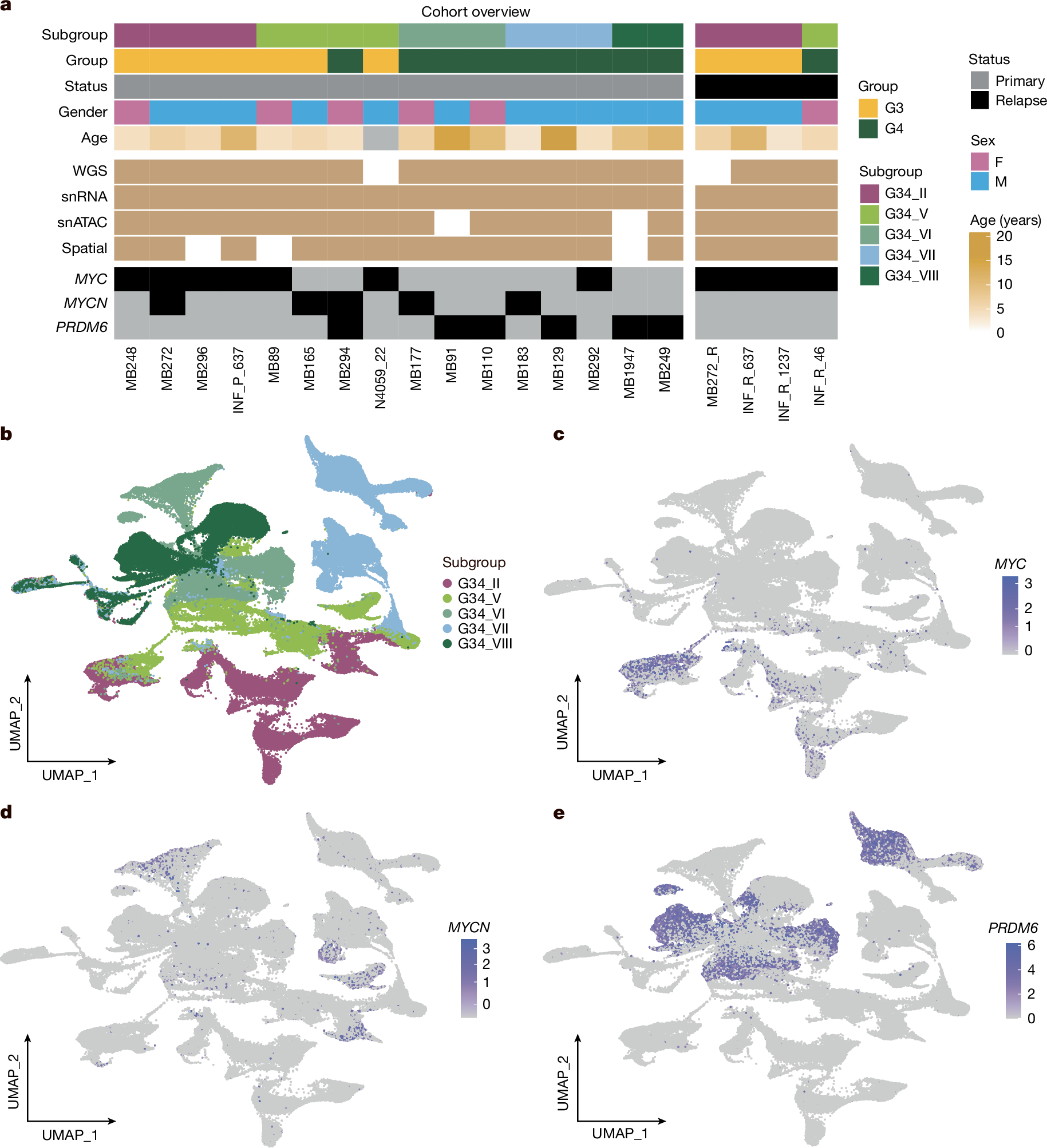
a, Overview of target cohort with annotation. Two primary-relapse pairs (MB272/R, INF_P/R_637) are from the same patients. b, UMAP of snRNA-seq merged dataset, with medulloblastoma subgroups annotated. c–e, Feature plots showing MYC (c), MYCN (d) and PRDM6 (e) expression within the UMAP of the merged snRNA-seq dataset. G3, group 3; G4, group 4; G34, group 3/4 medulloblastoma; F, female; M, male.
A Genetic Timeline of Tumor Development
The researchers also used a population genetics model to estimate the timing of medulloblastoma initiation. Their model suggests that these tumors likely begin to form in the first trimester of pregnancy, specifically within a type of brain cell known as the unipolar brush cell in the cerebellum. This finding gives us new insight into when and how these tumors start, which is crucial for improving early detection methods.
Implications for Early Detection and Treatment
The findings of this study underscore the power of single-cell technologies, such as RNA sequencing and spatial transcriptomics, in unraveling the complexities of tumor biology. By gaining a deeper understanding of how medulloblastomas evolve from their early stages and how specific genetic changes influence tumor progression and therapy resistance, the research paves the way for better diagnostic tools and more precise treatments for this devastating disease. These technologies could allow doctors to detect tumors at earlier stages, monitor their development in real-time, and tailor treatment strategies to target the specific mutations driving each patient’s cancer.
With more research and clinical testing, these insights could eventually lead to treatments that can halt tumor growth before it becomes aggressive or resistant to common therapies. In the long run, this could significantly improve survival rates and quality of life for children diagnosed with medulloblastoma.
Okonechnikov K, Joshi P, Körber V, Rademacher A, Bortolomeazzi M, Mallm JP, Vaillant J, da Silva PBG, Statz B, Sepp M, Sarropoulos I, Yamada T, Wittmann A, Schramm K, Blattner-Johnson M, Fiesel P, Jones B, Jäger N, Milde T, Pajtler KW, van Tilburg CM, Witt O, Bochennek K, Weber KJ, Nonnenmacher L, Reimann C, Ghasemi DR, Schüller U, Mynarek M, Rutkowski S, Jones DTW, Korshunov A, Rippe K, Westermann F, Thongjuea S, Höfer T, Kaessmann H, Kutscher LM, Pfister SM. (2025) Oncogene aberrations drive medulloblastoma progression, not initiation. Nature [Epub ahead of print]. [article]
Related Posts






Medulloblastoma, a cancer that primarily affects children, is the most common malignant brain tumor in this age group. Particularly for the group 3/4 subtypes of medulloblastoma, treatment remains a major challenge. These tumors are notorious for their complexity and the difficulty in predicting how they will behave, making it difficult to provide tailored treatments for patients. The problem is compounded by the fact that each tumor exhibits a great deal of variation, both between different patients and within a single tumor. Understanding how these tumors evolve over time and respond to treatment has been a major research focus.
In a groundbreaking new study, researchers from the Hopp Children’s Cancer Center (KiTZ) and the German Cancer Research Center (DKFZ) used cutting-edge single-cell technologies, including single-nucleus RNA sequencing (snRNA-seq), single-nucleus assay for transposase-accessible chromatin with high-throughput sequencing (snATAC-seq), and spatial transcriptomics, to delve into the inner workings of group 3/4 medulloblastomas. By analyzing a cohort of these tumors with known alterations in key oncogenes such as MYC, MYCN, and PRDM6, the researchers aimed to better understand how genetic changes contribute to tumor development and progression.
Key Findings: How Tumors Start and Evolve
The study uncovered that large-scale chromosomal changes are the earliest events in tumor initiation. These early genetic alterations are widespread and serve as a foundation for the tumor’s development. Interestingly, the specific mutations in individual oncogenes like MYC and MYCN arise much later in the tumor’s life cycle. These mutations are typically subclonal, meaning they affect only a portion of the tumor’s cells. However, the research showed that as the tumor progresses, MYC mutations can become clonal, meaning they spread to almost all the cells within the tumor, contributing to its continued growth and the development of resistance to therapies.
One of the most intriguing discoveries in the study was how subclonal cells—cells that carry different mutations from one another—are spread throughout the tumor. The spatial transcriptomics data showed that while these subclones are usually mixed throughout the tumor tissue, there are also regions where distinct subclones are segregated. This variation within the tumor, known as intratumoral heterogeneity, plays a key role in the tumor’s ability to evolve and adapt, which is a major factor in why medulloblastomas are so difficult to treat effectively.
Single-nucleus transcriptional profiling of 16 oncogene-associated
group 3/4 medulloblastoma primary tumour samples
a, Overview of target cohort with annotation. Two primary-relapse pairs (MB272/R, INF_P/R_637) are from the same patients. b, UMAP of snRNA-seq merged dataset, with medulloblastoma subgroups annotated. c–e, Feature plots showing MYC (c), MYCN (d) and PRDM6 (e) expression within the UMAP of the merged snRNA-seq dataset. G3, group 3; G4, group 4; G34, group 3/4 medulloblastoma; F, female; M, male.
A Genetic Timeline of Tumor Development
The researchers also used a population genetics model to estimate the timing of medulloblastoma initiation. Their model suggests that these tumors likely begin to form in the first trimester of pregnancy, specifically within a type of brain cell known as the unipolar brush cell in the cerebellum. This finding gives us new insight into when and how these tumors start, which is crucial for improving early detection methods.
Implications for Early Detection and Treatment
The findings of this study underscore the power of single-cell technologies, such as RNA sequencing and spatial transcriptomics, in unraveling the complexities of tumor biology. By gaining a deeper understanding of how medulloblastomas evolve from their early stages and how specific genetic changes influence tumor progression and therapy resistance, the research paves the way for better diagnostic tools and more precise treatments for this devastating disease. These technologies could allow doctors to detect tumors at earlier stages, monitor their development in real-time, and tailor treatment strategies to target the specific mutations driving each patient’s cancer.
With more research and clinical testing, these insights could eventually lead to treatments that can halt tumor growth before it becomes aggressive or resistant to common therapies. In the long run, this could significantly improve survival rates and quality of life for children diagnosed with medulloblastoma.
Okonechnikov K, Joshi P, Körber V, Rademacher A, Bortolomeazzi M, Mallm JP, Vaillant J, da Silva PBG, Statz B, Sepp M, Sarropoulos I, Yamada T, Wittmann A, Schramm K, Blattner-Johnson M, Fiesel P, Jones B, Jäger N, Milde T, Pajtler KW, van Tilburg CM, Witt O, Bochennek K, Weber KJ, Nonnenmacher L, Reimann C, Ghasemi DR, Schüller U, Mynarek M, Rutkowski S, Jones DTW, Korshunov A, Rippe K, Westermann F, Thongjuea S, Höfer T, Kaessmann H, Kutscher LM, Pfister SM. (2025) Oncogene aberrations drive medulloblastoma progression, not initiation. Nature [Epub ahead of print]. [article]
Related Posts
Recent Posts
 Scientists identify the neuroblastoma cells that signal poor outcomes
 GARAGE improves rare cell detection in single-cell RNA sequencing analysis using AI
 Machine learning reveals how RNA splicing is regulated in individual cell types
 Illumina releases SpliceAI2 to help advance rare disease research
 Postdoctoral Fellow – Long-Read RNA Methods Development for Neurodegeneration
 Novel biosensor uses DNA ‘barcodes’ to uncover disease signals in cells
RNA-Seq Products & Services


Stay Connected