

Researchers are constantly trying to understand how small differences in our DNA can increase the risk of diseases. One powerful tool in this effort is identifying expression quantitative trait loci, or eQTLs, which are spots in the genome that affect how much a gene is turned on or off. However, many of these genetic effects only happen in specific types of cells or under certain conditions, making them hard to find with traditional methods.
Now single-cell RNA sequencing (scRNA-seq) allows scientists to look at gene activity in individual cells, offering a much more detailed picture than older bulk methods. But there’s a catch. These studies often involve a small number of participants, which makes it hard to detect subtle genetic effects.
To overcome this, a team led by researchers at the University Medical Center Groningen compared different ways to combine results from multiple scRNA-seq studies without sharing private genetic information. They used a technique called federated weighted meta-analysis (WMA), which allows researchers to pool data while accounting for differences in how the experiments were done.
Workflow and weighting strategies for meta-analysis of single-cell eQTL data
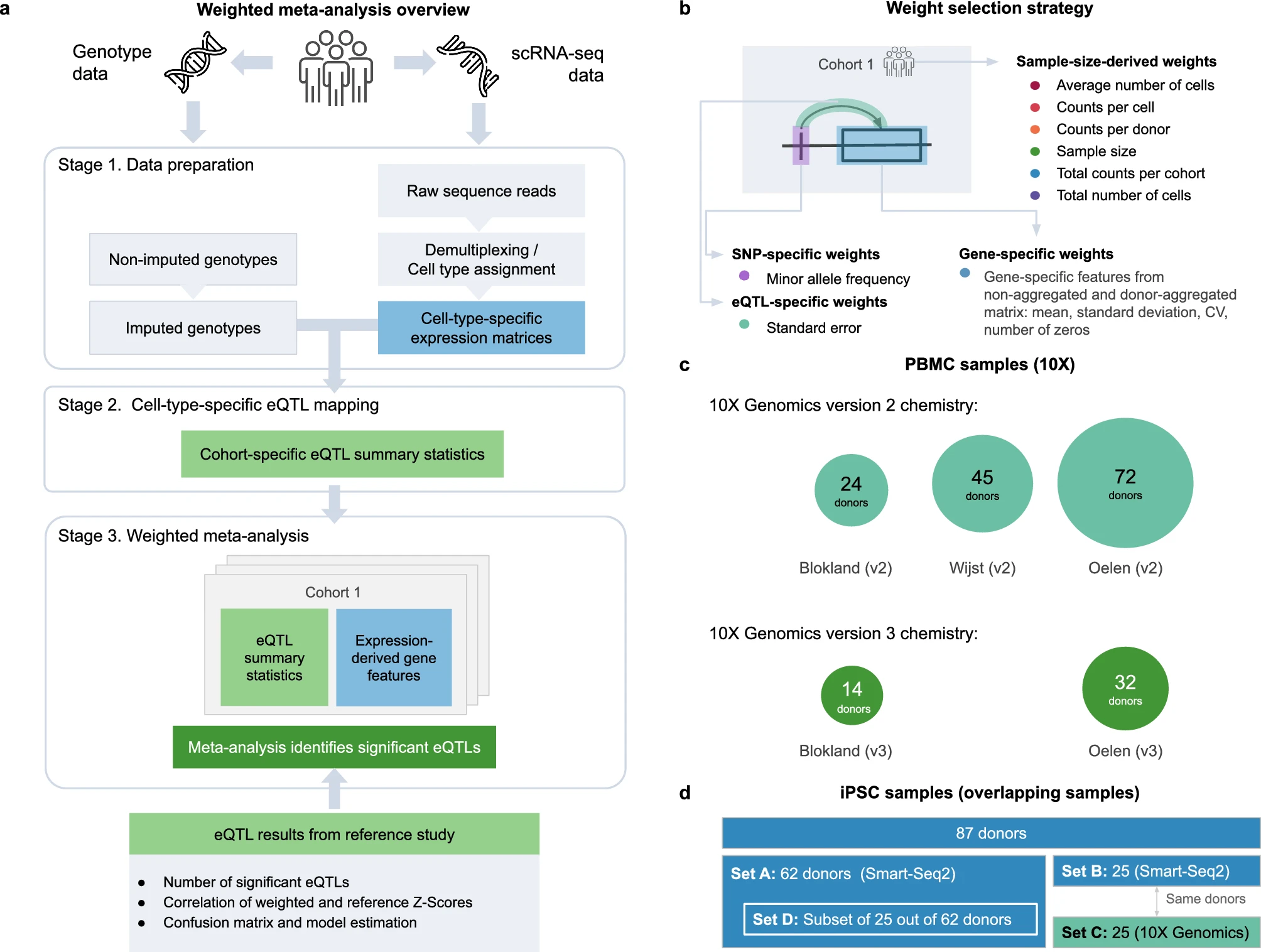
(a) The general workflow for weighted meta-analysis. (b) The cohort-, gene-, SNP-, and eQTL-specific weights used in the meta-analysis. (c, d) Description of the (c) peripheral blood mononuclear cell (PBMC) and (d) induced pluripotent stem cell (iPSC) datasets used in the analysis. The PBMC data consists of five single-cell datasets (n = 187 donors: 141 with 10X V2 and 46 with 10X V3 chemistry). The iPSC data consists of two single-cell datasets (n = 87 donors: 87 Smart-Seq2 and 25 donor-matched 10X V2). To analyze independent sample sets and test for the effects of combining smaller datasets, we split the 87 Smart-Seq2 samples into Set A (62 non-10X-matched samples) and Set C (25 10X-matched samples). Set A was further split into a smaller set of 25 non-10X-matched samples (Set D).
Their work, part of the sc-eQTLGen Consortium, outlines best practices for this approach, helping to improve the reliability and power of single-cell eQTL discovery. This advancement could bring us closer to pinpointing exactly which genetic variants affect disease risk and in which cell types they matter most.
Korshevniuk M, Westra HJ, Oelen R, van der Wijst MGP, Franke L, Bonder MJ, sc-eQTLGen Consortium. (2025) Optimized summary-statistic-based single-cell eQTL meta-analysis. Sci Rep 15(1): 28407. [article]
Related Posts






Researchers are constantly trying to understand how small differences in our DNA can increase the risk of diseases. One powerful tool in this effort is identifying expression quantitative trait loci, or eQTLs, which are spots in the genome that affect how much a gene is turned on or off. However, many of these genetic effects only happen in specific types of cells or under certain conditions, making them hard to find with traditional methods.
Now single-cell RNA sequencing (scRNA-seq) allows scientists to look at gene activity in individual cells, offering a much more detailed picture than older bulk methods. But there’s a catch. These studies often involve a small number of participants, which makes it hard to detect subtle genetic effects.
To overcome this, a team led by researchers at the University Medical Center Groningen compared different ways to combine results from multiple scRNA-seq studies without sharing private genetic information. They used a technique called federated weighted meta-analysis (WMA), which allows researchers to pool data while accounting for differences in how the experiments were done.
Workflow and weighting strategies for meta-analysis of single-cell eQTL data
(a) The general workflow for weighted meta-analysis. (b) The cohort-, gene-, SNP-, and eQTL-specific weights used in the meta-analysis. (c, d) Description of the (c) peripheral blood mononuclear cell (PBMC) and (d) induced pluripotent stem cell (iPSC) datasets used in the analysis. The PBMC data consists of five single-cell datasets (n = 187 donors: 141 with 10X V2 and 46 with 10X V3 chemistry). The iPSC data consists of two single-cell datasets (n = 87 donors: 87 Smart-Seq2 and 25 donor-matched 10X V2). To analyze independent sample sets and test for the effects of combining smaller datasets, we split the 87 Smart-Seq2 samples into Set A (62 non-10X-matched samples) and Set C (25 10X-matched samples). Set A was further split into a smaller set of 25 non-10X-matched samples (Set D).
Their work, part of the sc-eQTLGen Consortium, outlines best practices for this approach, helping to improve the reliability and power of single-cell eQTL discovery. This advancement could bring us closer to pinpointing exactly which genetic variants affect disease risk and in which cell types they matter most.
Korshevniuk M, Westra HJ, Oelen R, van der Wijst MGP, Franke L, Bonder MJ, sc-eQTLGen Consortium. (2025) Optimized summary-statistic-based single-cell eQTL meta-analysis. Sci Rep 15(1): 28407. [article]
Related Posts
Recent Posts
 Machine learning reveals how RNA splicing is regulated in individual cell types
 Illumina releases SpliceAI2 to help advance rare disease research
 Postdoctoral Fellow – Long-Read RNA Methods Development for Neurodegeneration
 Novel biosensor uses DNA ‘barcodes’ to uncover disease signals in cells
 GP-DHT uses single-cell RNA sequencing to map gene regulatory networks
 Boehringer taps Envisagenics’ AI to mine RNA splicing for cancer targets
RNA-Seq Products & Services



Stay Connected