

In the ever-evolving field of RNA research, N6-methyladenosine (m6A) has emerged as a key player in regulating gene expression. m6A is a chemical modification on RNA that influences various processes, including RNA stability, translation, and cellular responses. To study m6A patterns, researchers use a method called m6A RNA immunoprecipitation sequencing (MeRIP-seq), which involves isolating and analyzing RNA fragments that contain this specific modification. The success of this method depends heavily on one critical factor: the antibody used to detect m6A.
Despite its importance, selecting the best anti-m6A antibody and optimizing its use across different tissue types has been a challenge. Researchers at the Nanjing Medical University sought to address this gap by systematically testing five different anti-m6A antibodies on RNA samples from various tissues, including the liver.
Overall differential m6A profiling in human fetal and mouse livers with five anti-m6A antibodies
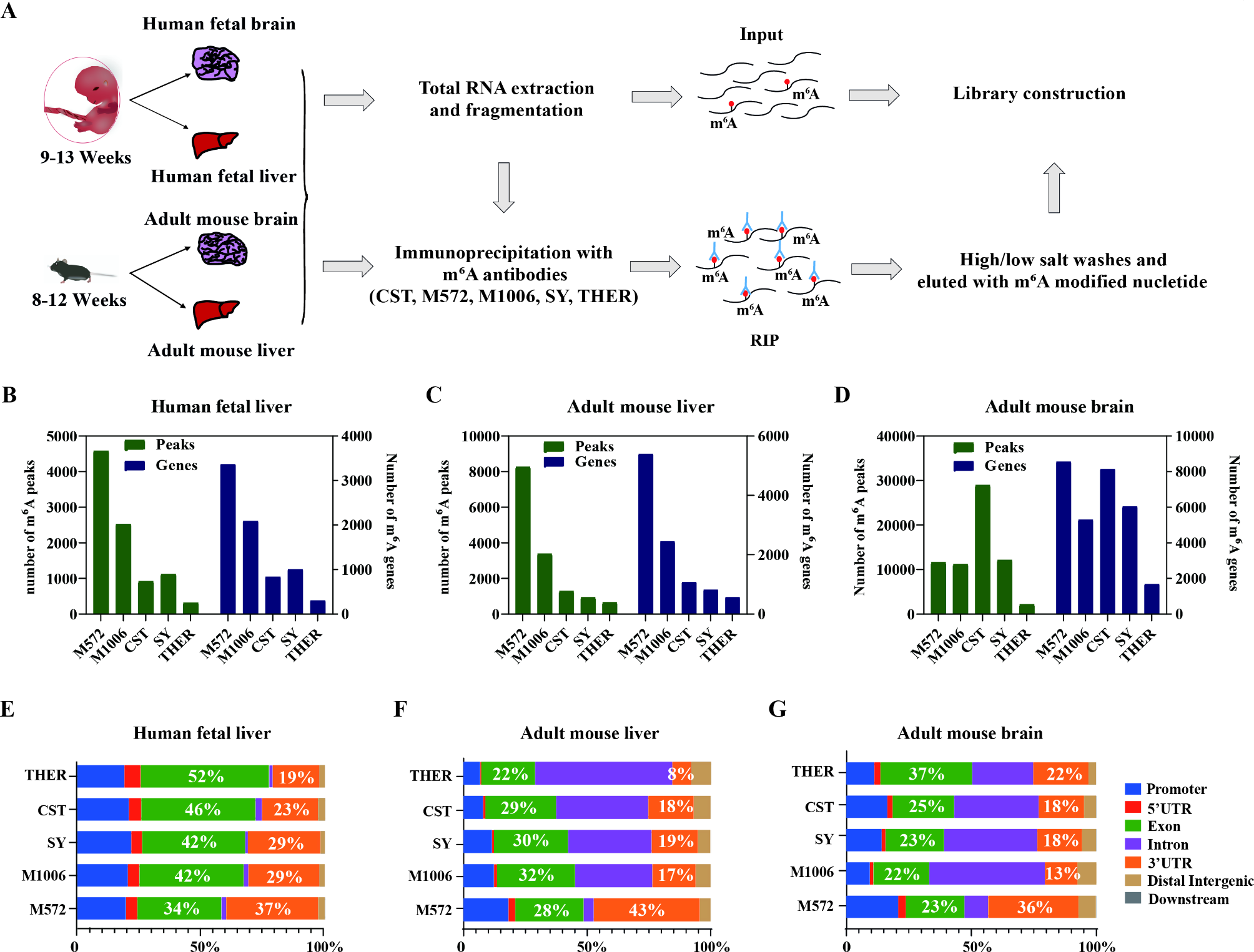
(A) Schematics of the selected organs, such as the livers and brains of human fetuses (9–13 gestational weeks) and mouse (8–12 weeks after birth), and the procedure of improved MeRIP sequencing for low-input samples. (B) The total number of m6A peaks and m6A genes of libraries constructed from five antibodies in human fetal liver. (C) The total number of m6A peaks and m6A genes in libraries constructed from five antibodies in the livers of adult mice. (D) The total number of m6A peaks and m6A genes in libraries constructed from five antibodies in the brains of adult mice. (E) The percentage of m6A peaks belonging to five libraries in human fetal liver distributed across different genomic regions, including the promoter, 5’ UTR, exon, intron, 3’ UTR, distal intergenic and downstream regions. (F) The percentage of m6A peaks belonging to five libraries in the livers of adult mice distributed across different genomic regions. (G) The percentage of m6A peaks belonging to five libraries in the brains of adult mice distributed across different genomic regions.
Key Findings from the Study
- Millipore Antibodies for High RNA Input:
When the researchers started with 15 micrograms of total RNA (a relatively large amount for experiments), two antibodies from Millipore—ABE572 and MABE1006—performed particularly well. Using 5 micrograms of these antibodies ensured reliable detection of m6A-modified RNA. - Cell Signaling Technology (CST) Antibodies for Low RNA Input:
For experiments with lower amounts of RNA, such as rare samples or small tissue biopsies, the CST antibody (#56593) was highly effective. Using just 1.25 micrograms of this antibody with small amounts of total RNA yielded robust results. - Guidelines for Different Tissues:
The study’s comprehensive testing across various tissues provided specific recommendations for researchers, helping them select the best antibody and concentration for their experiments, whether they’re working with abundant or limited RNA samples.
Why This Is Important
Studying m6A modifications is essential for understanding how cells regulate genes in response to different conditions, such as stress or disease. By optimizing the use of anti-m6A antibodies, this study makes it easier for researchers to generate high-quality data, even when working with challenging samples like those with low RNA input.
In short, this work provides a roadmap for RNA scientists to fine-tune their MeRIP-seq experiments, ensuring reliable results regardless of the sample type or size. These findings pave the way for more precise and accessible RNA modification research, furthering our understanding of gene regulation in health and disease.
For anyone diving into RNA studies, having this kind of guidance is invaluable—it saves time, resources, and ensures that the data generated is both accurate and meaningful.
Lu J, Xia W, Li J. et al. (2025) Comparative analysis of improved m6A sequencing based on antibody optimization for low-input samples. Sci Rep [Epub ahead of print]. [article]
Related Posts




In the ever-evolving field of RNA research, N6-methyladenosine (m6A) has emerged as a key player in regulating gene expression. m6A is a chemical modification on RNA that influences various processes, including RNA stability, translation, and cellular responses. To study m6A patterns, researchers use a method called m6A RNA immunoprecipitation sequencing (MeRIP-seq), which involves isolating and analyzing RNA fragments that contain this specific modification. The success of this method depends heavily on one critical factor: the antibody used to detect m6A.
Despite its importance, selecting the best anti-m6A antibody and optimizing its use across different tissue types has been a challenge. Researchers at the Nanjing Medical University sought to address this gap by systematically testing five different anti-m6A antibodies on RNA samples from various tissues, including the liver.
Overall differential m6A profiling in human fetal and mouse livers with five anti-m6A antibodies
(A) Schematics of the selected organs, such as the livers and brains of human fetuses (9–13 gestational weeks) and mouse (8–12 weeks after birth), and the procedure of improved MeRIP sequencing for low-input samples. (B) The total number of m6A peaks and m6A genes of libraries constructed from five antibodies in human fetal liver. (C) The total number of m6A peaks and m6A genes in libraries constructed from five antibodies in the livers of adult mice. (D) The total number of m6A peaks and m6A genes in libraries constructed from five antibodies in the brains of adult mice. (E) The percentage of m6A peaks belonging to five libraries in human fetal liver distributed across different genomic regions, including the promoter, 5’ UTR, exon, intron, 3’ UTR, distal intergenic and downstream regions. (F) The percentage of m6A peaks belonging to five libraries in the livers of adult mice distributed across different genomic regions. (G) The percentage of m6A peaks belonging to five libraries in the brains of adult mice distributed across different genomic regions.
Key Findings from the Study
- Millipore Antibodies for High RNA Input:
When the researchers started with 15 micrograms of total RNA (a relatively large amount for experiments), two antibodies from Millipore—ABE572 and MABE1006—performed particularly well. Using 5 micrograms of these antibodies ensured reliable detection of m6A-modified RNA. - Cell Signaling Technology (CST) Antibodies for Low RNA Input:
For experiments with lower amounts of RNA, such as rare samples or small tissue biopsies, the CST antibody (#56593) was highly effective. Using just 1.25 micrograms of this antibody with small amounts of total RNA yielded robust results. - Guidelines for Different Tissues:
The study’s comprehensive testing across various tissues provided specific recommendations for researchers, helping them select the best antibody and concentration for their experiments, whether they’re working with abundant or limited RNA samples.
Why This Is Important
Studying m6A modifications is essential for understanding how cells regulate genes in response to different conditions, such as stress or disease. By optimizing the use of anti-m6A antibodies, this study makes it easier for researchers to generate high-quality data, even when working with challenging samples like those with low RNA input.
In short, this work provides a roadmap for RNA scientists to fine-tune their MeRIP-seq experiments, ensuring reliable results regardless of the sample type or size. These findings pave the way for more precise and accessible RNA modification research, furthering our understanding of gene regulation in health and disease.
For anyone diving into RNA studies, having this kind of guidance is invaluable—it saves time, resources, and ensures that the data generated is both accurate and meaningful.
Lu J, Xia W, Li J. et al. (2025) Comparative analysis of improved m6A sequencing based on antibody optimization for low-input samples. Sci Rep [Epub ahead of print]. [article]
Related Posts
Recent Posts
 RNAmel simplifies RNA sequencing data analysis with a reproducible, integrated platform
 Heart failure reshapes bone marrow to create inflammation-related immune memory
 Overlooked DNA regions surrounding ‘microexons’ hold missing pieces of autism’s genetic puzzle
 RiboBA improves detection of hidden protein-coding regions using ribosome profiling
 An anti-senescence gene may fight spinal disc deterioration
 Bulk RNA-seq Analysis: A Complete Beginner’s Guide
RNA-Seq Products & Services


Stay Connected