Breakthrough using AI helps explain how genetic variation outside tiny gene segments is linked to autism
New research from scientists at the University of Toronto, the Sloan Kettering Institute, King’s College London and the Francis Crick Institute, is helping piece together the missing genetics of autism spectrum disorder (ASD).
In a study published today in Nature, researchers identified hundreds of new microexons, short gene segments that appear to play a key role in ASD and other neurological conditions, and developed a machine learning approach to predict the impact of ASD-associated genetic variants on the regulation of these segments.
“Autism is characterized by multifactorial genetics,” says Benjamin Blencowe, the study’s co-senior author and a professor at U of T’s Donnelly Centre for Cellular and Biomolecular Research and in the department of molecular genetics at the Temerty Faculty of Medicine.
“Hundreds of genomic variants have been associated with autism, and these deliver a genetic diagnosis in 15 per cent of autistic individuals,” says Blencowe, who is also a part-time professor at King’s and the Crick.
That means that for 85 per cent of people with an ASD diagnosis, the genetic explanation for their condition remains unknown. Blencowe believes that many contributing genetic factors may have remained undetected because they occur in regions of the genome that do not have a known function.
The genomic regions surrounding microexons are one such example. Through a process known as alternative splicing, these very short snippets of DNA — which range from three to 27 DNA “letters” long — can be included or excluded from the messenger RNA instructions used to make proteins. The resulting proteins vary slightly in composition yet contribute to a greater diversity of critical protein functions.
Characterization of new neuronal microexons
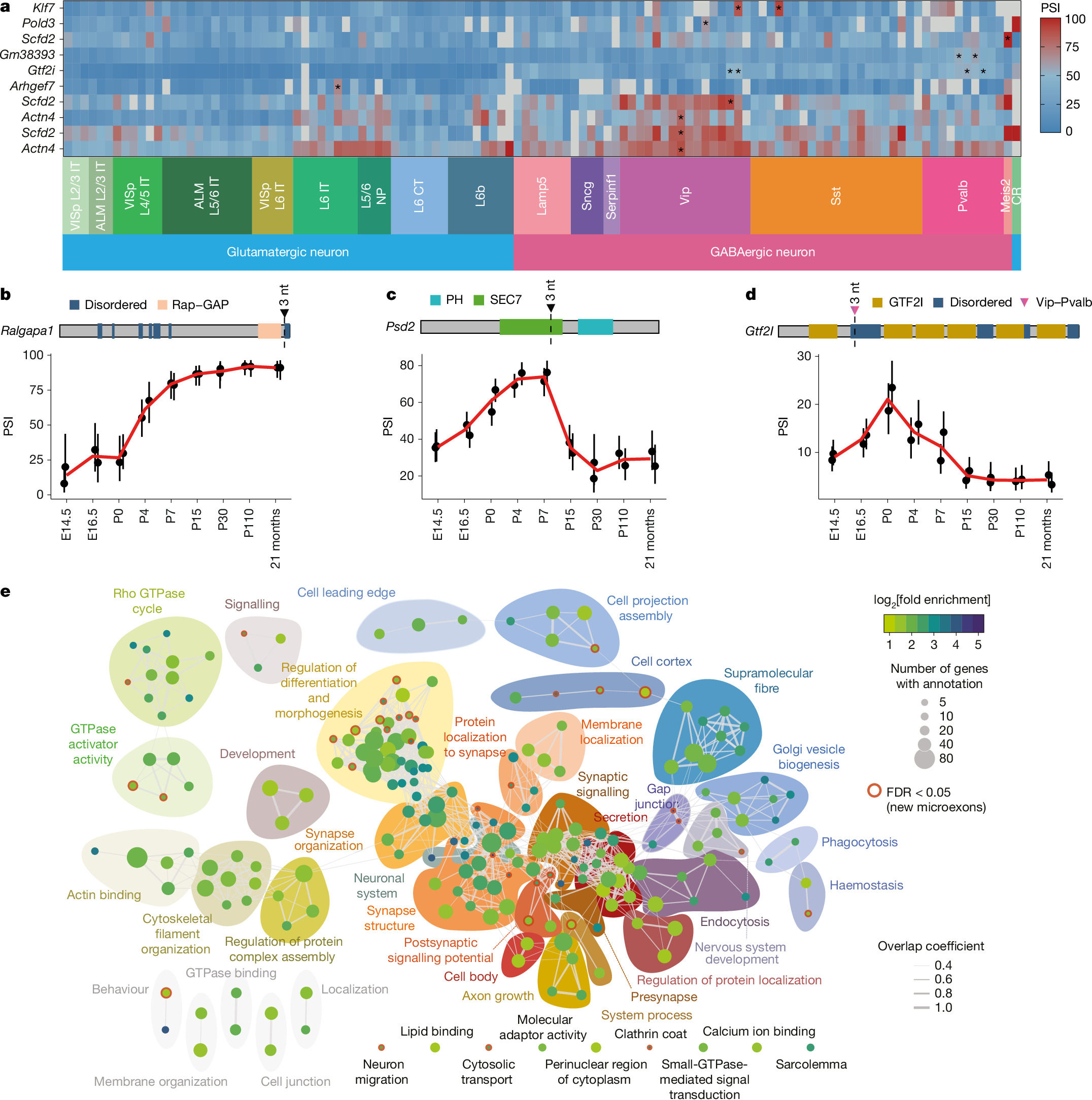
a, Splicing profiles of detected new microexons that exhibit deviation from the mean PSI levels across mouse neuronal subtypes. The asterisks indicate cell type-specific inclusion, defined as at least two pseudobulk pools whose PSI has a binomial 95% confidence interval with a lower bound at least 20 PSI units above the median PSI across all pools. Specific subtypes of glutamatergic and GABAergic neurons are indicated. Examples include microexons in Actn4, preferentially included in Vip-expressing GABAergic neurons, and a three-nucleotide microexon in Klf7, predominantly included in the Vip- and Sst-expressing GABAergic subclusters (Extended Data. IT, intratelencephalic; CT, corticothalamic; NP, near-projecting; CR, Cajal–Retzius. b–d, Developmental PSI profiles of new microexons in Ralgapa1 (b), Psd2 (c) and Gtf2i (d) across mouse cortex development. Jittered points correspond to biologically independent samples (n = 2 per developmental stage); the vertical bars show binomial 95% confidence intervals of the PSI measurements for each sample; the red line connects the mean PSI across samples at each developmental stage. Schematics above each plot show protein domain structures and the relative positions of the microexons. The Ralgapa1 microexon overlaps an intrinsically disordered region adjacent to the catalytic Rap-GAP domain, the Psd2 microexon overlaps a Sec7 domain and the Gtf2i microexon overlaps an intrinsically disordered region. E14.5, embryonic day 14.5. e, Functional enrichment of mouse genes containing known and new neuronal microexons. The vertices indicate enriched categories (false-discovery rate (FDR) < 0.05) from GO and Reactome, and the edges indicate the overlap between categories (combined Jaccard-overlap coefficient; edges > 0.375 are shown).
In the newly published study, Guillermo Parada, the study’s co-lead author and a postdoctoral fellow in Blencowe’s London group at King’s and the Crick, used a computational tool he developed called MicroExonator to analyze over 100 terabytes — enough storage for 25 million smartphone photos — of publicly available RNA sequencing data. He identified more than 1,500 new microexons, of which nearly 300 appeared to be specifically spliced in the brain.
The researchers also observed that many of the newly discovered microexons are concentrated in genes associated with critical brain-specific processes, further supporting the idea that these tiny DNA fragments contribute to neurological health.
The researchers then asked whether DNA variants found in autistic individuals might preferentially impact the expanded repertoire of microexons.
To answer that question, Parada and study co-lead author and postdoctoral fellow Hannes Bretschneider teamed up with Quaid Morris, a faculty member at Memorial Sloan Kettering Cancer Center and Vector Institute and co-senior author on the study, to build and apply a machine learning model that identifies the key regulatory features governing whether a microexon is spliced in or out of messengers RNAs. This so-called regulatory code encompasses specific sequences of DNA letters flanking microexons.
“What surprised me was that the sequences the model identified as important closely matched those conserved throughout vertebrate evolution” says Parada, noting that DNA sequences that are highly conserved, or the same, between species generally have critical functions.
Through a collaboration with Stephen Scherer and Brett Trost, both scientists at The Hospital for Sick Children (SickKids) and professors of molecular genetics at Temerty Medicine, the researchers applied their model to whole genome sequence data from thousands of autistic people and neurotypical sibling pairs, and analyzed the predicted impact of ASD-associated genetic variants on the microexon regulatory code.
“Using our model, we were able to show that rare genetic variants generally have the largest predicted effects on the splicing of neuronal microexons,” says Blencowe. The model further pinpointed a subset of rare variants predicted to alter microexon splicing that are associated with autism.
The research team also found that the variants predicted to affect microexons are predominantly detected among the 85 per cent of autistic individuals previously lacking a genetic link to autism.
These new findings build on over a decade of research from the Blencowe lab to uncover the role of microexons in ASD, including earlier work showing that microexons are frequently misregulated in the brains of autistic people and that mice lacking microexon splicing display multiple ASD-like behaviours.
“In terms of future work, it will be important to understand how disrupted microexons affect interactions between proteins that are important for nervous system development and function,” says Blencowe. One of the research programs in his lab is also exploring new therapeutic approaches to target microexon dysregulation.
Blencowe says that beyond helping to define some of the missing genetics of ASD, their study provides a valuable resource to advance research in the field.
The researchers believe that the machine learning model they developed can be used to characterize newly discovered genetic variants and their effects in other neurological conditions, like schizophrenia and epilepsy, where microexons are believed to play a role.
Source – University of Toronto


Breakthrough using AI helps explain how genetic variation outside tiny gene segments is linked to autism
New research from scientists at the University of Toronto, the Sloan Kettering Institute, King’s College London and the Francis Crick Institute, is helping piece together the missing genetics of autism spectrum disorder (ASD).
In a study published today in Nature, researchers identified hundreds of new microexons, short gene segments that appear to play a key role in ASD and other neurological conditions, and developed a machine learning approach to predict the impact of ASD-associated genetic variants on the regulation of these segments.
That means that for 85 per cent of people with an ASD diagnosis, the genetic explanation for their condition remains unknown. Blencowe believes that many contributing genetic factors may have remained undetected because they occur in regions of the genome that do not have a known function.
The genomic regions surrounding microexons are one such example. Through a process known as alternative splicing, these very short snippets of DNA — which range from three to 27 DNA “letters” long — can be included or excluded from the messenger RNA instructions used to make proteins. The resulting proteins vary slightly in composition yet contribute to a greater diversity of critical protein functions.
Characterization of new neuronal microexons
a, Splicing profiles of detected new microexons that exhibit deviation from the mean PSI levels across mouse neuronal subtypes. The asterisks indicate cell type-specific inclusion, defined as at least two pseudobulk pools whose PSI has a binomial 95% confidence interval with a lower bound at least 20 PSI units above the median PSI across all pools. Specific subtypes of glutamatergic and GABAergic neurons are indicated. Examples include microexons in Actn4, preferentially included in Vip-expressing GABAergic neurons, and a three-nucleotide microexon in Klf7, predominantly included in the Vip- and Sst-expressing GABAergic subclusters (Extended Data. IT, intratelencephalic; CT, corticothalamic; NP, near-projecting; CR, Cajal–Retzius. b–d, Developmental PSI profiles of new microexons in Ralgapa1 (b), Psd2 (c) and Gtf2i (d) across mouse cortex development. Jittered points correspond to biologically independent samples (n = 2 per developmental stage); the vertical bars show binomial 95% confidence intervals of the PSI measurements for each sample; the red line connects the mean PSI across samples at each developmental stage. Schematics above each plot show protein domain structures and the relative positions of the microexons. The Ralgapa1 microexon overlaps an intrinsically disordered region adjacent to the catalytic Rap-GAP domain, the Psd2 microexon overlaps a Sec7 domain and the Gtf2i microexon overlaps an intrinsically disordered region. E14.5, embryonic day 14.5. e, Functional enrichment of mouse genes containing known and new neuronal microexons. The vertices indicate enriched categories (false-discovery rate (FDR) < 0.05) from GO and Reactome, and the edges indicate the overlap between categories (combined Jaccard-overlap coefficient; edges > 0.375 are shown).
In the newly published study, Guillermo Parada, the study’s co-lead author and a postdoctoral fellow in Blencowe’s London group at King’s and the Crick, used a computational tool he developed called MicroExonator to analyze over 100 terabytes — enough storage for 25 million smartphone photos — of publicly available RNA sequencing data. He identified more than 1,500 new microexons, of which nearly 300 appeared to be specifically spliced in the brain.
The researchers also observed that many of the newly discovered microexons are concentrated in genes associated with critical brain-specific processes, further supporting the idea that these tiny DNA fragments contribute to neurological health.
The researchers then asked whether DNA variants found in autistic individuals might preferentially impact the expanded repertoire of microexons.
To answer that question, Parada and study co-lead author and postdoctoral fellow Hannes Bretschneider teamed up with Quaid Morris, a faculty member at Memorial Sloan Kettering Cancer Center and Vector Institute and co-senior author on the study, to build and apply a machine learning model that identifies the key regulatory features governing whether a microexon is spliced in or out of messengers RNAs. This so-called regulatory code encompasses specific sequences of DNA letters flanking microexons.
Through a collaboration with Stephen Scherer and Brett Trost, both scientists at The Hospital for Sick Children (SickKids) and professors of molecular genetics at Temerty Medicine, the researchers applied their model to whole genome sequence data from thousands of autistic people and neurotypical sibling pairs, and analyzed the predicted impact of ASD-associated genetic variants on the microexon regulatory code.
The research team also found that the variants predicted to affect microexons are predominantly detected among the 85 per cent of autistic individuals previously lacking a genetic link to autism.
These new findings build on over a decade of research from the Blencowe lab to uncover the role of microexons in ASD, including earlier work showing that microexons are frequently misregulated in the brains of autistic people and that mice lacking microexon splicing display multiple ASD-like behaviours.
Blencowe says that beyond helping to define some of the missing genetics of ASD, their study provides a valuable resource to advance research in the field.
The researchers believe that the machine learning model they developed can be used to characterize newly discovered genetic variants and their effects in other neurological conditions, like schizophrenia and epilepsy, where microexons are believed to play a role.
Source – University of Toronto
Parada GE, Bretschneider H, Li JD, Fine JL, Dupas SJ, Ellis JD, Braunschweig U, Bonnal S, Dalal T, Engchuan W, Zarrei M, Wei W, Zafar N, Hemberg M, Attisano L, Ellis J, Irimia M, Wainberg M, Trost B, Scherer SW, Morris QD, Blencowe BJ. (2026) A microexon regulatory code reveals autism-linked genetic variation. Nature [Epub ahead of print]. [article]
Related Posts
UMIche – a UMI-centric analysis platform for enhancing molecular quantification accuracy in bulk and single-cell sequencing
New RNA sequencing tool reveals how stem cells develop into heart cells
Estimating the completeness of large-scale single-cell sequencing projects
New RNA sequencing tool improves transcriptome reconstruction using machine learning
DeMixNB: deconvolution of sparse-count RNA sequencing data for tumor cells
New RNA sequencing method improves tRNA analysis using deep learning
Researchers create first whole-body single-cell atlas of an adult vertebrate
UAlbany Joins $10 Million Effort to Map RNA Modifications in the Human Body
SpliceCOV improves RNA sequencing analysis by filtering transcriptional noise
Overlooked ‘off switch’ in lung tumors may explain why immunotherapy doesn’t work for everyone
Squids Edit RNA for Novel Protein Functions
New marker panel and web tool help define early human cell fates
RNA sequencing reveals molecular changes driving right ventricular heart failure
Researchers Develop AI Tool to Map MicroRNA Binding Sites on Circular RNAs
Single-cell RNA sequencing reveals the diversity of human neutrophils across health and disease
Yale researchers improve RNA extraction from precision-cut lung slices
RNA sequencing reveals how genes combine to regulate inflammation and immune responses
RNAffinityDB – a curated database of experimental RNA–protein binding affinities
“Raman Genome” for SARS-CoV-2: new Raman technology distinguishes viral variants by their molecular RNA architecture
Advanced paternal age has sex-specific effects on fetal brain gene expression
Stay Connected
Submit a Post to the Blog
Recent Posts
Subscribe to the RNA-Seq Blog
RNA-Seq Products & Services