

A team led by researchers at Baylor College of Medicine has uncovered a surprising mechanism that helps determine how stem cells decide what type of cell they will become. Their work focuses on RNA condensates, tiny, droplet-like structures inside cells that organize and store RNA molecules. One type of RNA condensate, known as a P-body, appears to play a critical role in regulating which genes are translated into proteins during cell development.
Using advanced RNA sequencing across multiple vertebrate species, the researchers discovered that P-bodies store untranslated RNAs that control cell fate. Interestingly, the RNA found in these P-bodies represents genes that were active in earlier stages of development, suggesting that cells use these stored messages as a kind of molecular memory to guide their next steps.
P-body-seq permits comprehensive profiling of P-body contents
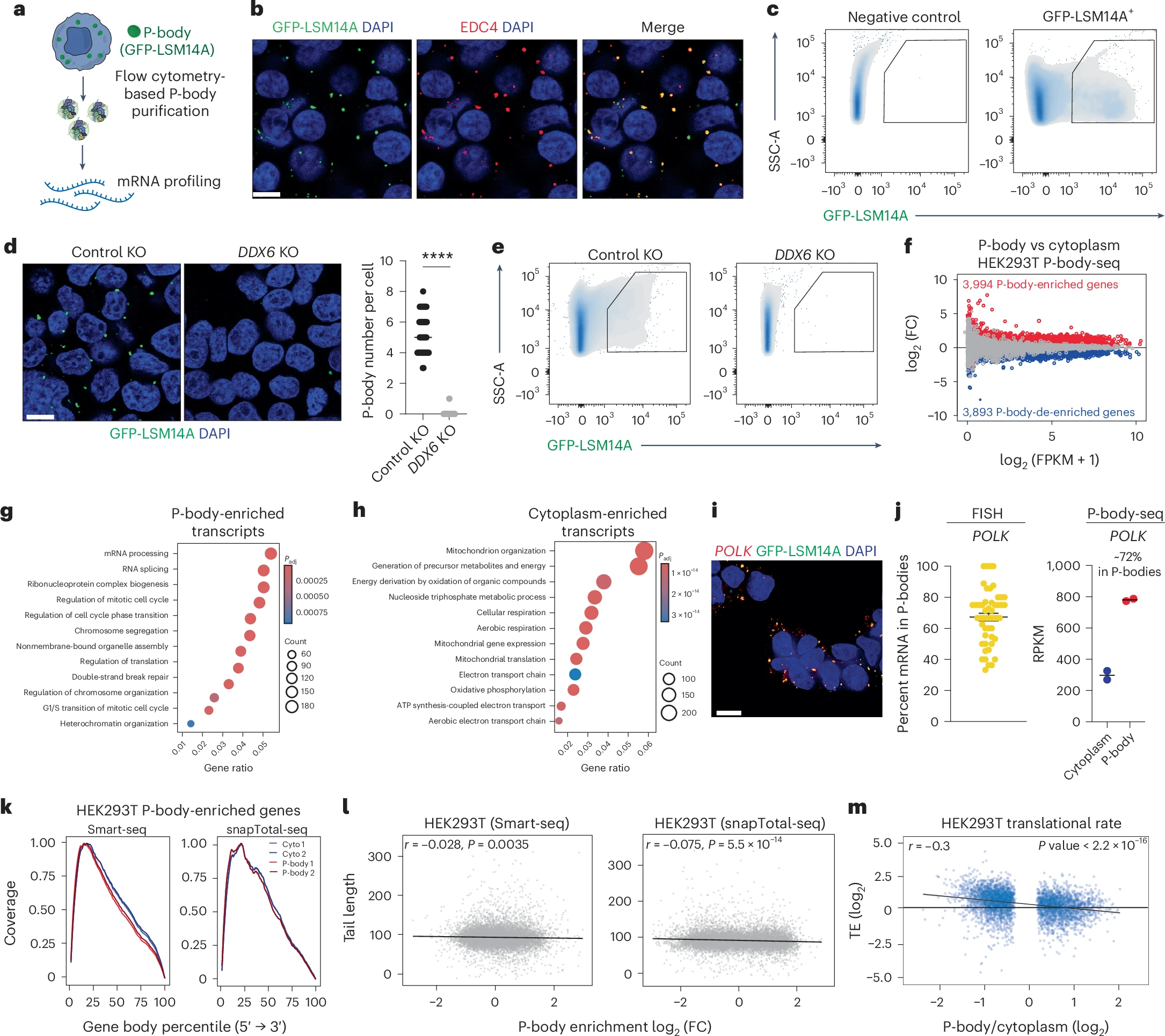
a, Schematic for the purification and transcriptomic profiling of P-bodies from HEK293T cells based on GFP-LSM14A expression. b, Representative IF imaging of GFP-LSM14A puncta (green), colocalizing with EDC4 puncta (red) in HEK293T cells. Nuclei were counterstained with 4,6-diamidino-2-phenylindole (DAPI; blue) (scale bar, 10 μm). n = 3 independent experiments. c, Representative flow cytometry plots showing gating for GFP-LSM14A+ P-bodies in HEK293T cells. SSC, side scatter. d, Representative imaging of GFP-LSM14A puncta (green) in control and DDX6-KO HEK293T cells. Nuclei were counterstained with DAPI (blue) (scale bar, 10 μm) (left). P-body number in control (n = 50 cells) and DDX6-KO (n = 50 cells) HEK293T cells (right). Unpaired two-sided Student’s t-test, median ± s.d., ****P < 0.0001. e, Representative flow cytometry plots showing gating for GFP-LSM14A+ P-bodies in control and DDX6-KO HEK293T cells. f, MA plot of RNA-seq data depicting P-body-enriched genes in red and cytoplasm-enriched genes in blue in HEK293T cells (n = 2 biological independent samples per group, P < 0.05). FC, fold change; FPKM, fragments per kilobase of transcript per million mapped reads. g, GO pathway analysis of P-body-enriched mRNA in HEK293T cells, using expressed genes as background. Enrichment was tested using two-sided Fisher’s exact test with multiple-testing correction (Benjamini–Hochbergfalse discovery rate (FDR)). Padj, adjusted P value. h, GO pathway analysis of cytoplasm-enriched mRNA in HEK293T cells, using expressed genes as background. Enrichment was tested using two-sided Fisher’s exact test with multiple-testing correction (Benjamini–Hochberg FDR). i, Representative FISH imaging of POLK RNA molecules (red) combined with imaging of GFP-LSM14A puncta (green). Nuclei were counterstained with DAPI (blue) (scale bar, 10 μm). n = 3 independent experiments. j, Quantification of POLK mRNA molecules in P-bodies based on FISH (n = 50 cells; right) and P-body sequencing (right); median ± s.d. RPKM, reads per kilobase per million mapped reads. k, Read coverage distribution over the gene body of the longest annotated isoforms for genes enriched in P-bodies or the cytoplasm (cyto) in HEK293T cells. l, PolyA tail length as determined in compared to P-body enrichment based on Smart-seq and snapTotal-seq (Pearson correlation test). m, Translation efficiency (TE; log2 (Ribo-seq counts/RNA-seq counts)) negatively correlates with mRNA enrichment in P-bodies in HEK293T cells (Pearson correlation test (two sided), P = 3.94 × 10−98).
The team also found that the composition of these RNA droplets is influenced by microRNAs and proteins such as AGO2, which control which RNAs are kept inactive. By manipulating P-body assembly or microRNA activity, the scientists were able to guide stem cells into specific developmental paths, including pushing them toward totipotency (the ability to form all cell types) or toward germ cells.
This discovery reveals a new layer of gene regulation that operates beyond the DNA level, linking the behavior of RNA condensates directly to how cells acquire their identity. It could open new possibilities for regenerative medicine by allowing researchers to more precisely control stem cell differentiation.
Pessina P, Nevo M, Shi J, Kodali S, Casas E, Cui Y, Richards A L, Park E J, Chen X, Levin-Ferreyra F, Rivera Tostado A, Stevenson E, Krogan N J, Swaney D L, Ying Q, Chen Q, Brumbaugh J, Di Stefano B. (2025) Selective RNA sequestration in biomolecular condensates directs cell fate transitions. Nat Biotechnol 43(10). [article]
Related Posts




A team led by researchers at Baylor College of Medicine has uncovered a surprising mechanism that helps determine how stem cells decide what type of cell they will become. Their work focuses on RNA condensates, tiny, droplet-like structures inside cells that organize and store RNA molecules. One type of RNA condensate, known as a P-body, appears to play a critical role in regulating which genes are translated into proteins during cell development.
Using advanced RNA sequencing across multiple vertebrate species, the researchers discovered that P-bodies store untranslated RNAs that control cell fate. Interestingly, the RNA found in these P-bodies represents genes that were active in earlier stages of development, suggesting that cells use these stored messages as a kind of molecular memory to guide their next steps.
P-body-seq permits comprehensive profiling of P-body contents
a, Schematic for the purification and transcriptomic profiling of P-bodies from HEK293T cells based on GFP-LSM14A expression. b, Representative IF imaging of GFP-LSM14A puncta (green), colocalizing with EDC4 puncta (red) in HEK293T cells. Nuclei were counterstained with 4,6-diamidino-2-phenylindole (DAPI; blue) (scale bar, 10 μm). n = 3 independent experiments. c, Representative flow cytometry plots showing gating for GFP-LSM14A+ P-bodies in HEK293T cells. SSC, side scatter. d, Representative imaging of GFP-LSM14A puncta (green) in control and DDX6-KO HEK293T cells. Nuclei were counterstained with DAPI (blue) (scale bar, 10 μm) (left). P-body number in control (n = 50 cells) and DDX6-KO (n = 50 cells) HEK293T cells (right). Unpaired two-sided Student’s t-test, median ± s.d., ****P < 0.0001. e, Representative flow cytometry plots showing gating for GFP-LSM14A+ P-bodies in control and DDX6-KO HEK293T cells. f, MA plot of RNA-seq data depicting P-body-enriched genes in red and cytoplasm-enriched genes in blue in HEK293T cells (n = 2 biological independent samples per group, P < 0.05). FC, fold change; FPKM, fragments per kilobase of transcript per million mapped reads. g, GO pathway analysis of P-body-enriched mRNA in HEK293T cells, using expressed genes as background. Enrichment was tested using two-sided Fisher’s exact test with multiple-testing correction (Benjamini–Hochbergfalse discovery rate (FDR)). Padj, adjusted P value. h, GO pathway analysis of cytoplasm-enriched mRNA in HEK293T cells, using expressed genes as background. Enrichment was tested using two-sided Fisher’s exact test with multiple-testing correction (Benjamini–Hochberg FDR). i, Representative FISH imaging of POLK RNA molecules (red) combined with imaging of GFP-LSM14A puncta (green). Nuclei were counterstained with DAPI (blue) (scale bar, 10 μm). n = 3 independent experiments. j, Quantification of POLK mRNA molecules in P-bodies based on FISH (n = 50 cells; right) and P-body sequencing (right); median ± s.d. RPKM, reads per kilobase per million mapped reads. k, Read coverage distribution over the gene body of the longest annotated isoforms for genes enriched in P-bodies or the cytoplasm (cyto) in HEK293T cells. l, PolyA tail length as determined in compared to P-body enrichment based on Smart-seq and snapTotal-seq (Pearson correlation test). m, Translation efficiency (TE; log2 (Ribo-seq counts/RNA-seq counts)) negatively correlates with mRNA enrichment in P-bodies in HEK293T cells (Pearson correlation test (two sided), P = 3.94 × 10−98).
The team also found that the composition of these RNA droplets is influenced by microRNAs and proteins such as AGO2, which control which RNAs are kept inactive. By manipulating P-body assembly or microRNA activity, the scientists were able to guide stem cells into specific developmental paths, including pushing them toward totipotency (the ability to form all cell types) or toward germ cells.
This discovery reveals a new layer of gene regulation that operates beyond the DNA level, linking the behavior of RNA condensates directly to how cells acquire their identity. It could open new possibilities for regenerative medicine by allowing researchers to more precisely control stem cell differentiation.
Pessina P, Nevo M, Shi J, Kodali S, Casas E, Cui Y, Richards A L, Park E J, Chen X, Levin-Ferreyra F, Rivera Tostado A, Stevenson E, Krogan N J, Swaney D L, Ying Q, Chen Q, Brumbaugh J, Di Stefano B. (2025) Selective RNA sequestration in biomolecular condensates directs cell fate transitions. Nat Biotechnol 43(10). [article]
Related Posts
Recent Posts
 RNAmel simplifies RNA sequencing data analysis with a reproducible, integrated platform
 Heart failure reshapes bone marrow to create inflammation-related immune memory
 Overlooked DNA regions surrounding ‘microexons’ hold missing pieces of autism’s genetic puzzle
 RiboBA improves detection of hidden protein-coding regions using ribosome profiling
 An anti-senescence gene may fight spinal disc deterioration
 Bulk RNA-seq Analysis: A Complete Beginner’s Guide
RNA-Seq Products & Services



Stay Connected