

Machine learning has become a powerful tool for cancer research, but it depends heavily on the quality of the data that is used to train it. RNA sequencing data can contain information on thousands of genes at once, making it difficult to decide which genes are the most meaningful for predicting cancer behavior. A research team from LG AI Research explored whether gene sets created from single cell RNA sequencing data could improve predictions across many cancer types.
The team analyzed single cell profiles from 181 tumor samples representing 13 different cancers. Unlike traditional bulk RNA sequencing, which averages signals across millions of cells, single cell methods allow researchers to see how individual cells behave. This helps identify more precise gene networks that may be important for cancer growth or treatment response.
Schematic overview of the study workflow
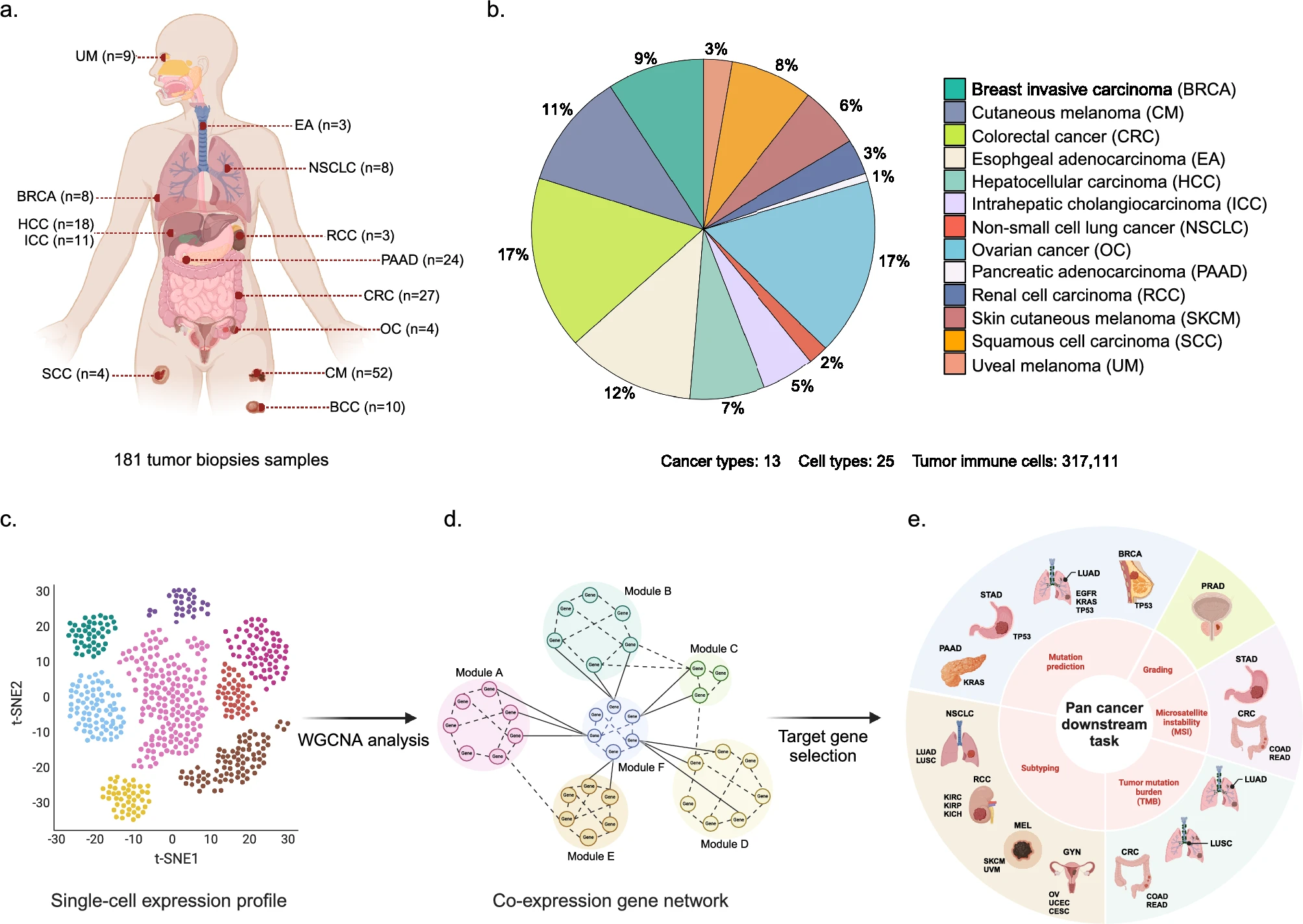
a. Each cancer type is indicated along with the number of samples analyzed: Uveal melanoma (UM, n=9), esophageal adenocarcinoma (EA, n=3), non-small cell lung cancer (NSCLC, n=8), breast invasive carcinoma (BRCA, n=8), hepatocellular carcinoma (HCC, n=18), intrahepatic cholangiocarcinoma (ICC, n=11), renal cell carcinoma (RCC, n=3), pancreatic adenocarcinoma (PAAD, n=24), colorectal cancer (CRC, n=27), ovarian cancer (OC, n=4), squamous cell carcinoma (SCC, n=4), cutaneous melanoma (CM, n=52), basal cell carcinoma (BCC, n=10). b. Proportional distribution of the 13 cancer types within the scRNA-seq dataset, highlighting the diversity and representation of different tumor types used in the study. The dataset includes 317,111 tumor immune cells classified into 25 distinct cell types. c. Schematic UMAP visualization of single-cell expression profiles, which were prepared for hdWGCNA. d. Schematic of the co-expression gene network derived from hdWGCNA. The genes comprising this biological module were used for various downstream analyses through the target gene process. e. (e) Application of selected co-expressed gene modules to various pan-cancer downstream tasks. These tasks include mutation prediction, cancer subtyping, tumor mutation burden (TMB) assessment, microsatellite instability (MSI) classification, cancer subtyping, and grading.
To identify the most informative gene sets, the researchers used a technique called high dimensional weighted gene co expression network analysis. They then refined these gene sets using the machine learning approach XGBoost to find the genes that carried the most predictive value.
Next, they tested how well these gene sets performed in a wide range of tasks using large scale cancer datasets, including those from The Cancer Genome Atlas. These tasks included predicting tumor mutation burden, identifying microsatellite instability, determining cancer grade, classifying cancer subtype, and predicting specific genetic mutations. They compared the new gene sets to well known reference sets and oncogene lists.
The gene sets generated from single cell data consistently outperformed the others in most tasks. Three genes in particular stood out across many analyses. DPM1, BAD and FKBP4 emerged as strong pan cancer biomarkers, with DPM1 showing especially consistent importance.
This work highlights how combining single cell RNA sequencing with modern machine learning techniques can uncover gene sets that help improve accuracy in cancer prediction. These advances may support the development of more effective diagnostic tools and personalized treatment strategies in the future.
Kim JH, Lee S, Jang J, (2025) Pan cancer gene set discovery via scRNA seq for optimal deep learning based downstream tasks. Sci Rep 15(1):43159 [article]
Related Posts


Machine learning has become a powerful tool for cancer research, but it depends heavily on the quality of the data that is used to train it. RNA sequencing data can contain information on thousands of genes at once, making it difficult to decide which genes are the most meaningful for predicting cancer behavior. A research team from LG AI Research explored whether gene sets created from single cell RNA sequencing data could improve predictions across many cancer types.
The team analyzed single cell profiles from 181 tumor samples representing 13 different cancers. Unlike traditional bulk RNA sequencing, which averages signals across millions of cells, single cell methods allow researchers to see how individual cells behave. This helps identify more precise gene networks that may be important for cancer growth or treatment response.
Schematic overview of the study workflow
a. Each cancer type is indicated along with the number of samples analyzed: Uveal melanoma (UM, n=9), esophageal adenocarcinoma (EA, n=3), non-small cell lung cancer (NSCLC, n=8), breast invasive carcinoma (BRCA, n=8), hepatocellular carcinoma (HCC, n=18), intrahepatic cholangiocarcinoma (ICC, n=11), renal cell carcinoma (RCC, n=3), pancreatic adenocarcinoma (PAAD, n=24), colorectal cancer (CRC, n=27), ovarian cancer (OC, n=4), squamous cell carcinoma (SCC, n=4), cutaneous melanoma (CM, n=52), basal cell carcinoma (BCC, n=10). b. Proportional distribution of the 13 cancer types within the scRNA-seq dataset, highlighting the diversity and representation of different tumor types used in the study. The dataset includes 317,111 tumor immune cells classified into 25 distinct cell types. c. Schematic UMAP visualization of single-cell expression profiles, which were prepared for hdWGCNA. d. Schematic of the co-expression gene network derived from hdWGCNA. The genes comprising this biological module were used for various downstream analyses through the target gene process. e. (e) Application of selected co-expressed gene modules to various pan-cancer downstream tasks. These tasks include mutation prediction, cancer subtyping, tumor mutation burden (TMB) assessment, microsatellite instability (MSI) classification, cancer subtyping, and grading.
To identify the most informative gene sets, the researchers used a technique called high dimensional weighted gene co expression network analysis. They then refined these gene sets using the machine learning approach XGBoost to find the genes that carried the most predictive value.
Next, they tested how well these gene sets performed in a wide range of tasks using large scale cancer datasets, including those from The Cancer Genome Atlas. These tasks included predicting tumor mutation burden, identifying microsatellite instability, determining cancer grade, classifying cancer subtype, and predicting specific genetic mutations. They compared the new gene sets to well known reference sets and oncogene lists.
The gene sets generated from single cell data consistently outperformed the others in most tasks. Three genes in particular stood out across many analyses. DPM1, BAD and FKBP4 emerged as strong pan cancer biomarkers, with DPM1 showing especially consistent importance.
This work highlights how combining single cell RNA sequencing with modern machine learning techniques can uncover gene sets that help improve accuracy in cancer prediction. These advances may support the development of more effective diagnostic tools and personalized treatment strategies in the future.
Kim JH, Lee S, Jang J, (2025) Pan cancer gene set discovery via scRNA seq for optimal deep learning based downstream tasks. Sci Rep 15(1):43159 [article]
Related Posts
Recent Posts
 Scientists identify the neuroblastoma cells that signal poor outcomes
 GARAGE improves rare cell detection in single-cell RNA sequencing analysis using AI
 Machine learning reveals how RNA splicing is regulated in individual cell types
 Illumina releases SpliceAI2 to help advance rare disease research
 Postdoctoral Fellow – Long-Read RNA Methods Development for Neurodegeneration
 Novel biosensor uses DNA ‘barcodes’ to uncover disease signals in cells
RNA-Seq Products & Services


Stay Connected