

RNA sequencing (RNA-seq) is an invaluable tool for studying how genes are regulated in the body. It allows researchers to measure gene expression—the amount of RNA produced by a gene—and gain insights into cellular functions and disease mechanisms. However, gene regulation is far more complex than simply measuring gene expression. It involves various processes such as how RNA is spliced, how different gene versions (isoforms) are used, and even how stable the RNA molecules are. These various processes, called RNA phenotypes, are difficult to study together because of the challenges in extracting and analyzing them from RNA-seq data.
To address this, researchers at UC San Diego have introduced Pantry, a new framework that helps scientists generate and analyze diverse RNA phenotypes from RNA-seq data. Pantry works by capturing six different aspects of gene regulation, including:
- Gene expression: The amount of RNA produced by a gene.
- Isoform ratios: How different versions of a gene are used in different cells.
- Splice junction usage: How RNA is spliced together to form different gene versions.
- Alternative TSS (transcription start sites) and polyA usage: How the start and end of RNA molecules are chosen.
- RNA stability: How long RNA molecules last in the cell before being degraded.
Pantry’s multimodal RNA phenotyping
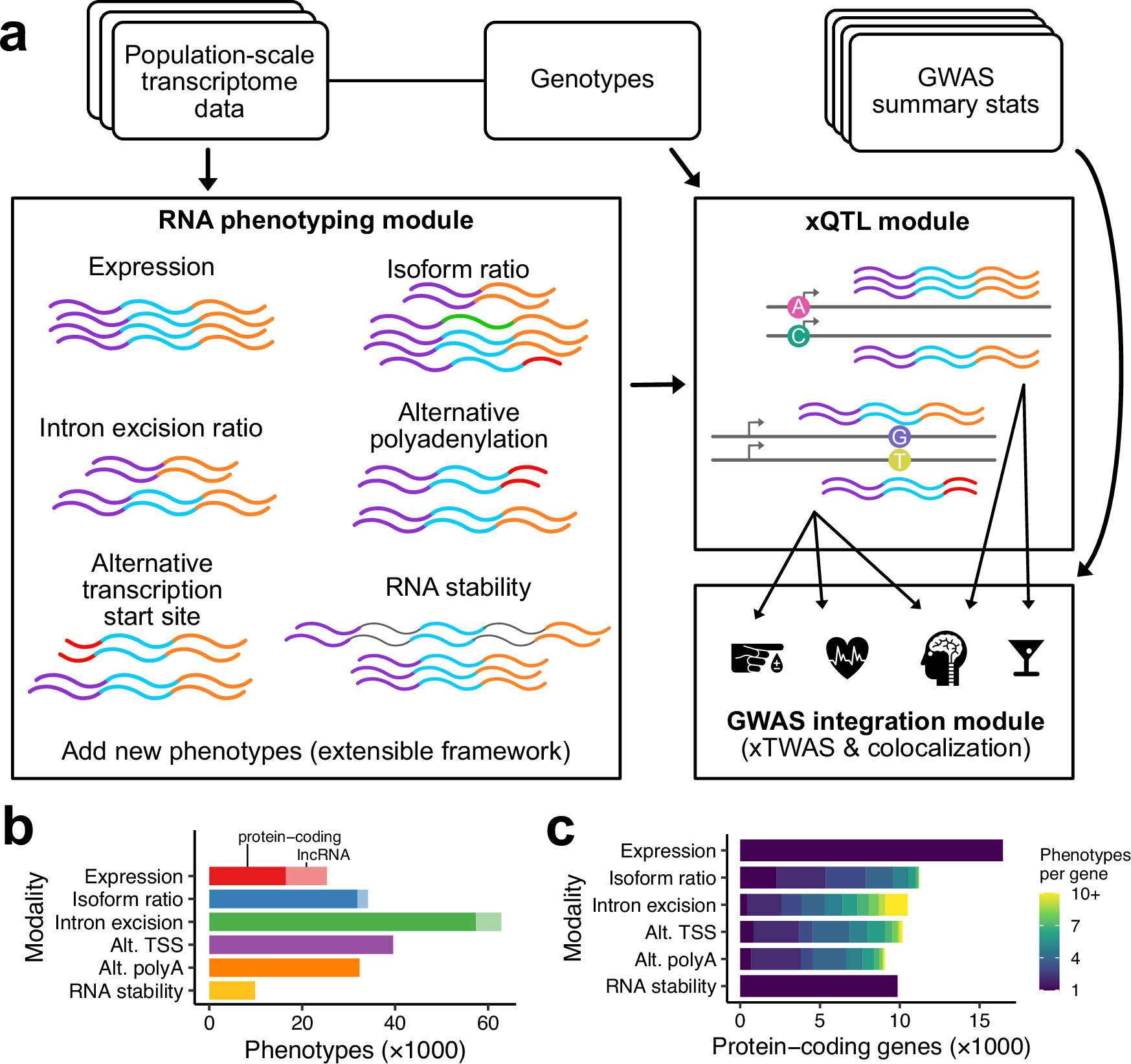
a Flow chart of the Pantry procedure. b Number of phenotypes extracted per modality for the Geuvadis dataset. Bars are colored by modality and the shading indicates the gene type: protein-coding gene or lncRNA. c Number of protein-coding genes represented by the phenotypes in (b), and the number of phenotypes extracted per gene in each modality. Source data are provided as a Source Data file.
By capturing these different RNA phenotypes, Pantry allows researchers to perform more detailed analyses of how genes are regulated. It also enables the integration of RNA-seq data with genetic information through techniques like QTL mapping (which looks at genetic variations affecting RNA levels) and TWAS (which identifies gene-trait associations by linking gene expression with disease traits).
To demonstrate the power of Pantry, the researchers applied it to large genetic datasets, including the Geuvadis and GTEx studies. They discovered that many genes, which previously showed no evidence of regulatory influence based on gene expression alone (known as eQTL), actually had genetic influences on other RNA phenotypes. This finding resulted in a 66% increase in the number of genes identified with regulatory variants. These findings also revealed that each RNA phenotype has unique regulatory properties, and when analyzed together, they provide a more comprehensive view of gene regulation.
Furthermore, by expanding TWAS to include multiple RNA modalities, the researchers doubled the number of gene-trait associations they could identify. This expanded analysis also helped uncover regulatory mechanisms underlying previously identified gene-trait associations in genome-wide association studies (GWAS).
In conclusion, Pantry provides a powerful tool for researchers to explore the many layers of gene regulation in greater detail. By integrating multiple RNA phenotypes with genetic data, this framework promises to enhance our understanding of how genes are regulated and how this regulation influences diseases and traits. This deeper insight could help identify new therapeutic targets and improve our understanding of complex genetic diseases.
Munro D, Ehsan N, Esmaeili-Fard SM, Gusev A, Palmer AA, Mohammadi P. (2024) Multimodal analysis of RNA sequencing data powers discovery of complex trait genetics. Nat Commun 15(1):10387. [article]
Related Posts


RNA sequencing (RNA-seq) is an invaluable tool for studying how genes are regulated in the body. It allows researchers to measure gene expression—the amount of RNA produced by a gene—and gain insights into cellular functions and disease mechanisms. However, gene regulation is far more complex than simply measuring gene expression. It involves various processes such as how RNA is spliced, how different gene versions (isoforms) are used, and even how stable the RNA molecules are. These various processes, called RNA phenotypes, are difficult to study together because of the challenges in extracting and analyzing them from RNA-seq data.
To address this, researchers at UC San Diego have introduced Pantry, a new framework that helps scientists generate and analyze diverse RNA phenotypes from RNA-seq data. Pantry works by capturing six different aspects of gene regulation, including:
- Gene expression: The amount of RNA produced by a gene.
- Isoform ratios: How different versions of a gene are used in different cells.
- Splice junction usage: How RNA is spliced together to form different gene versions.
- Alternative TSS (transcription start sites) and polyA usage: How the start and end of RNA molecules are chosen.
- RNA stability: How long RNA molecules last in the cell before being degraded.
Pantry’s multimodal RNA phenotyping
a Flow chart of the Pantry procedure. b Number of phenotypes extracted per modality for the Geuvadis dataset. Bars are colored by modality and the shading indicates the gene type: protein-coding gene or lncRNA. c Number of protein-coding genes represented by the phenotypes in (b), and the number of phenotypes extracted per gene in each modality. Source data are provided as a Source Data file.
By capturing these different RNA phenotypes, Pantry allows researchers to perform more detailed analyses of how genes are regulated. It also enables the integration of RNA-seq data with genetic information through techniques like QTL mapping (which looks at genetic variations affecting RNA levels) and TWAS (which identifies gene-trait associations by linking gene expression with disease traits).
To demonstrate the power of Pantry, the researchers applied it to large genetic datasets, including the Geuvadis and GTEx studies. They discovered that many genes, which previously showed no evidence of regulatory influence based on gene expression alone (known as eQTL), actually had genetic influences on other RNA phenotypes. This finding resulted in a 66% increase in the number of genes identified with regulatory variants. These findings also revealed that each RNA phenotype has unique regulatory properties, and when analyzed together, they provide a more comprehensive view of gene regulation.
Furthermore, by expanding TWAS to include multiple RNA modalities, the researchers doubled the number of gene-trait associations they could identify. This expanded analysis also helped uncover regulatory mechanisms underlying previously identified gene-trait associations in genome-wide association studies (GWAS).
In conclusion, Pantry provides a powerful tool for researchers to explore the many layers of gene regulation in greater detail. By integrating multiple RNA phenotypes with genetic data, this framework promises to enhance our understanding of how genes are regulated and how this regulation influences diseases and traits. This deeper insight could help identify new therapeutic targets and improve our understanding of complex genetic diseases.
Munro D, Ehsan N, Esmaeili-Fard SM, Gusev A, Palmer AA, Mohammadi P. (2024) Multimodal analysis of RNA sequencing data powers discovery of complex trait genetics. Nat Commun 15(1):10387. [article]
Related Posts
Recent Posts
 PANGEA – an integrated cell atlas across diverse biological contexts enables systematic profiling of multicellular responses in human diseases
 UMIche – a UMI-centric analysis platform for enhancing molecular quantification accuracy in bulk and single-cell sequencing
 New AI tool uses RNA sequencing to uncover gene interactions in Alzheimer’s disease
 New RNA sequencing tool reveals how stem cells develop into heart cells
 Estimating the completeness of large-scale single-cell sequencing projects
 New RNA sequencing tool improves transcriptome reconstruction using machine learning
RNA-Seq Products & Services


Stay Connected