

Single-cell RNA sequencing (scRNA-seq) has revolutionized our understanding of cellular diversity by allowing scientists to examine gene expression at an individual cell level. However, a major challenge in scRNA-seq data analysis is the presence of “dropout zeros”—instances where genes appear to have no expression, not because they are truly inactive, but due to technical limitations like low mRNA capture efficiency. These dropouts can distort downstream analyses, making it difficult to accurately characterize cell populations and gene expression patterns.
Researchers from the Guilin University of Technology have developed a novel computational method called PbImpute to address this issue. PbImpute takes a unique approach by carefully distinguishing between technical dropouts and true biological zeros while ensuring that imputed values accurately reflect real gene expression levels.
How PbImpute Works
PbImpute employs a five-stage process to correct dropout zeros:
- Zero Discrimination: It first distinguishes between technical and biological zeros using a statistical model called a zero-inflated negative binomial (ZINB) distribution.
- Initial Imputation: Dropout zeros are then adjusted through an initial repair process.
- Secondary Dropout Identification: The algorithm re-evaluates the data using gene expression frequency and variation to ensure accuracy.
- Neural Network-Based Imputation: A graph-embedding neural network enhances data accuracy by preserving relationships between genes and cells.
- Dynamic Repair Mechanism: The final step fine-tunes imputed values to prevent excessive alterations.
By integrating statistical modeling with machine learning techniques, PbImpute achieves an optimal balance between correcting missing data and preserving biological accuracy.
PbImpute workflow
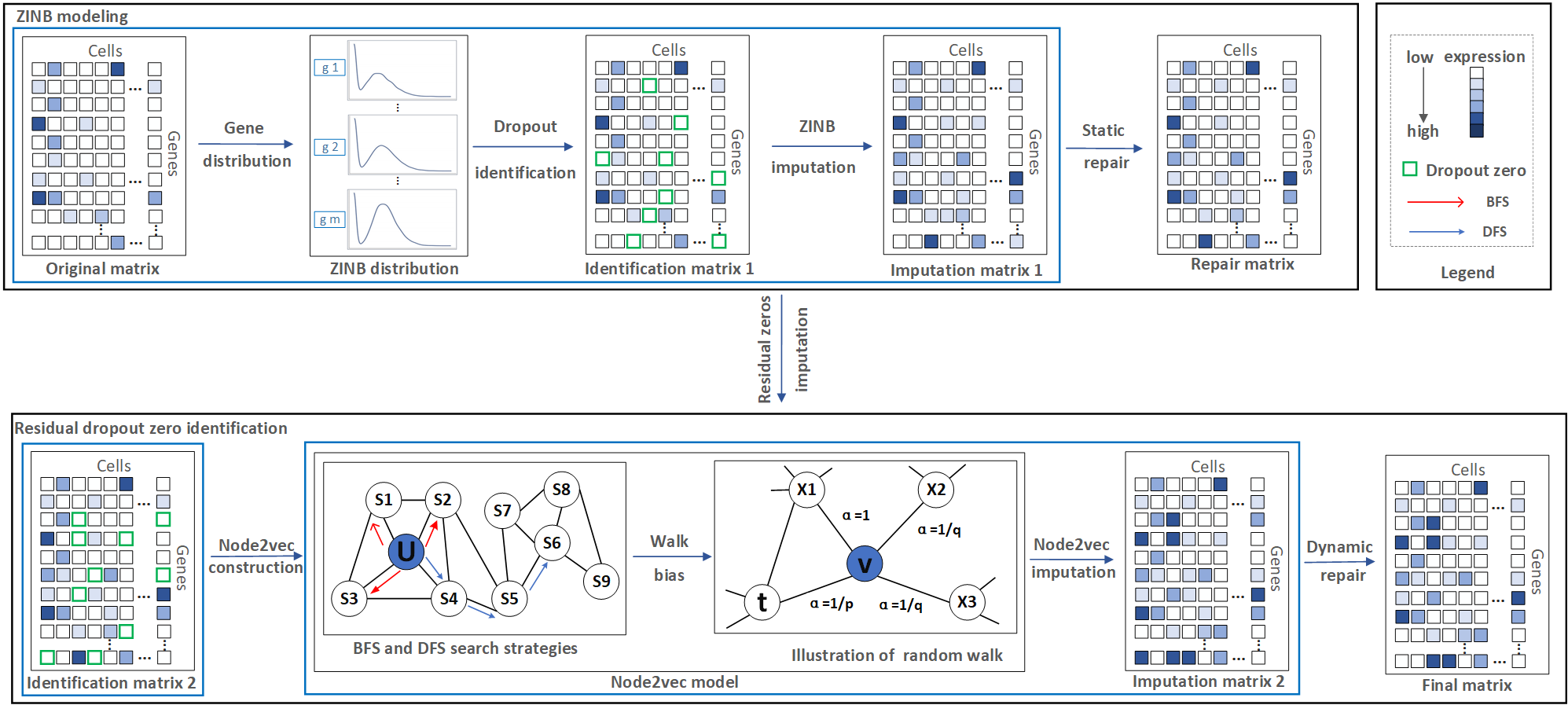
PbImpute employs a multistage process to address dropout imputation in scRNA-seq data. Initially, a ZINB model is fitted to the raw expression matrix to estimate π, r, and p parameters using an EM algorithm. These parameters guide initial imputation. Subsequently, a static repair step corrects over-imputation by adjusting outlying nonzero values. Residual dropout zeros are then identified within cell clusters based on gene expression frequency and partition-specific coefficients of variation. A cell similarity embedding, generated using Node2vec with breadth-first search (BFS) and depth-first search (DFS), constrains imputation of these residual dropouts, preserving true biological zeros. Finally, a dynamic repair step adjusts nonzero values exhibiting substantial local variation, yielding the final refined expression matrix.
Superior Performance in Real and Simulated Data
In benchmark tests using both simulated and real scRNA-seq datasets, PbImpute outperformed existing methods. The tool demonstrated an F1 Score of 0.88 at an 83% dropout rate and improved clustering resolution, differential expression analysis, and cell-cell correlation accuracy. The method also enhanced trajectory inference, making it particularly useful for studying cell development and disease progression.
Advancing Single-Cell Analysis and Disease Research
The ability to more accurately recover missing gene expression values means that PbImpute can help researchers identify rare cell types, detect disease-associated gene expression changes, and better understand cellular heterogeneity. This has profound implications for fields such as cancer research, immunology, and regenerative medicine. By refining scRNA-seq data quality, this tool represents a significant step toward more precise and reliable single-cell transcriptomic analyses.
Availability – The PbImpute software is freely available on GitHub https://github.com/WyBioTeam/PbImpute
Zhang Y, Wang Y, Liu X, Feng X. (2025) PbImpute: Precise Zero Discrimination and Balanced Imputation in Single-Cell RNA Sequencing Data. J Chem Inf Model [Epub ahead of print] [article]
Related Posts












Single-cell RNA sequencing (scRNA-seq) has revolutionized our understanding of cellular diversity by allowing scientists to examine gene expression at an individual cell level. However, a major challenge in scRNA-seq data analysis is the presence of “dropout zeros”—instances where genes appear to have no expression, not because they are truly inactive, but due to technical limitations like low mRNA capture efficiency. These dropouts can distort downstream analyses, making it difficult to accurately characterize cell populations and gene expression patterns.
Researchers from the Guilin University of Technology have developed a novel computational method called PbImpute to address this issue. PbImpute takes a unique approach by carefully distinguishing between technical dropouts and true biological zeros while ensuring that imputed values accurately reflect real gene expression levels.
How PbImpute Works
PbImpute employs a five-stage process to correct dropout zeros:
- Zero Discrimination: It first distinguishes between technical and biological zeros using a statistical model called a zero-inflated negative binomial (ZINB) distribution.
- Initial Imputation: Dropout zeros are then adjusted through an initial repair process.
- Secondary Dropout Identification: The algorithm re-evaluates the data using gene expression frequency and variation to ensure accuracy.
- Neural Network-Based Imputation: A graph-embedding neural network enhances data accuracy by preserving relationships between genes and cells.
- Dynamic Repair Mechanism: The final step fine-tunes imputed values to prevent excessive alterations.
By integrating statistical modeling with machine learning techniques, PbImpute achieves an optimal balance between correcting missing data and preserving biological accuracy.
PbImpute workflow
PbImpute employs a multistage process to address dropout imputation in scRNA-seq data. Initially, a ZINB model is fitted to the raw expression matrix to estimate π, r, and p parameters using an EM algorithm. These parameters guide initial imputation. Subsequently, a static repair step corrects over-imputation by adjusting outlying nonzero values. Residual dropout zeros are then identified within cell clusters based on gene expression frequency and partition-specific coefficients of variation. A cell similarity embedding, generated using Node2vec with breadth-first search (BFS) and depth-first search (DFS), constrains imputation of these residual dropouts, preserving true biological zeros. Finally, a dynamic repair step adjusts nonzero values exhibiting substantial local variation, yielding the final refined expression matrix.
Superior Performance in Real and Simulated Data
In benchmark tests using both simulated and real scRNA-seq datasets, PbImpute outperformed existing methods. The tool demonstrated an F1 Score of 0.88 at an 83% dropout rate and improved clustering resolution, differential expression analysis, and cell-cell correlation accuracy. The method also enhanced trajectory inference, making it particularly useful for studying cell development and disease progression.
Advancing Single-Cell Analysis and Disease Research
The ability to more accurately recover missing gene expression values means that PbImpute can help researchers identify rare cell types, detect disease-associated gene expression changes, and better understand cellular heterogeneity. This has profound implications for fields such as cancer research, immunology, and regenerative medicine. By refining scRNA-seq data quality, this tool represents a significant step toward more precise and reliable single-cell transcriptomic analyses.
Availability – The PbImpute software is freely available on GitHub https://github.com/WyBioTeam/PbImpute
Zhang Y, Wang Y, Liu X, Feng X. (2025) PbImpute: Precise Zero Discrimination and Balanced Imputation in Single-Cell RNA Sequencing Data. J Chem Inf Model [Epub ahead of print] [article]
Related Posts
Recent Posts
 RNAmel simplifies RNA sequencing data analysis with a reproducible, integrated platform
 Heart failure reshapes bone marrow to create inflammation-related immune memory
 Overlooked DNA regions surrounding ‘microexons’ hold missing pieces of autism’s genetic puzzle
 RiboBA improves detection of hidden protein-coding regions using ribosome profiling
 An anti-senescence gene may fight spinal disc deterioration
 Bulk RNA-seq Analysis: A Complete Beginner’s Guide
RNA-Seq Products & Services



Stay Connected