

Recent advances in genomics have made it possible to understand the diverse states of individual cells, leading to breakthroughs in fields like immunology and cancer research. Single-cell RNA sequencing (scRNA-seq) has been at the forefront of these efforts, offering a way to study gene expression in single cells and identify rare populations of cells with unique characteristics. However, there has always been a challenge in isolating these rare populations, particularly when we need to focus on specific RNA or protein markers that are not always easy to detect using traditional techniques.
A major hurdle has been the reliance on flow sorting, which is a technique that separates cells based on surface markers. This requires highly specific antibodies to detect those markers, but many cell populations don’t have easily identifiable surface markers. Additionally, some studies involve isolating nuclei from tissue samples, which leaves out important proteins located outside the nucleus, limiting the information we can gather from the cell.
To address these limitations, scientists at Stanford University and Memorial Sloan Kettering Cancer Center have developed a new method called Programmable Enrichment via RNA FlowFISH by sequencing (PERFF-seq). This scalable assay combines the power of RNA-based sorting with single-cell genomics, enabling researchers to profile cell subpopulations based on the abundance of specific RNA transcripts. This means that, instead of focusing solely on surface markers, scientists can now identify rare populations by their RNA expression patterns, allowing for a deeper understanding of cell diversity.
Rationale and development of PERFF-seq
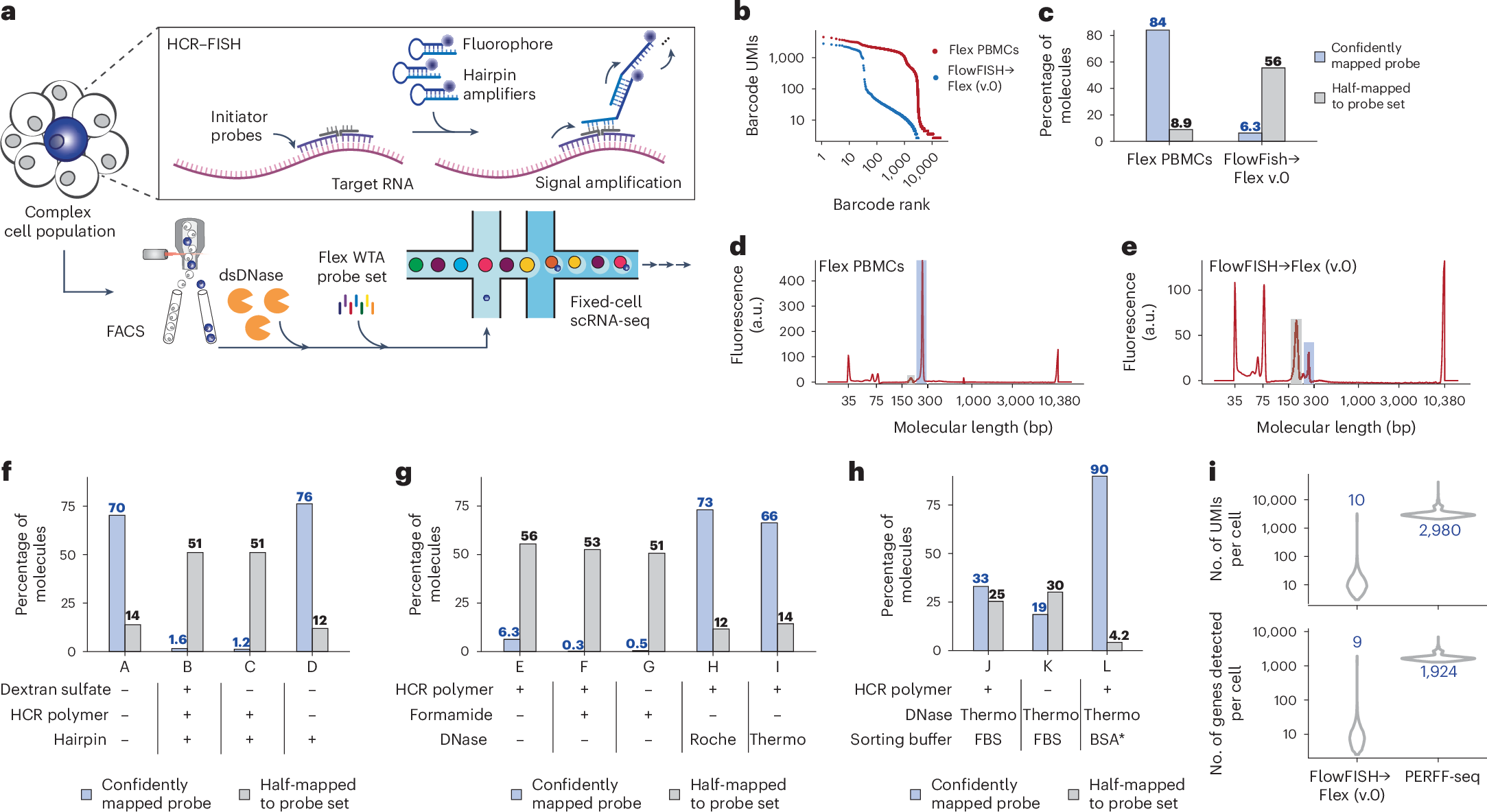
a, Schematic of the PERFF-seq assay. Target RNA(s) is(are) bound by pairs of adjacent initiator probes that ensure specificity. Hairpin amplifiers unzip and hybridize iteratively to generate fluorescent signal and enable FACS before single-cell profiling with the droplet-based scRNA-seq Flex kit. b, Knee plot of cells profiled with standard Flex versus HCR–FlowFISH-sorted cells. c, Fraction of reads fully mapping (blue) or half-mapping (gray) to the reference probe set. d, Bioanalyzer traces highlighting the expected product size of the full probe (~260 bp; blue) and half-probe (~190 bp; gray) for a high-quality Flex library. e, Same as d but for the FlowFISH → Flex v.0 experiment. f, Experiments identifying the HCR polymer as the corrupting agent for data quality. g, Conditions screened for polymer stripping, including DNase and formamide treatments. h, Sorting buffer components analyzed to improve data quality. i, UMIs (top) and genes (bottom) detected per cell comparing the initial FlowFISH → Flex v.0 experiment, from b to the final PERFF-seq library from h. Median values are shown in blue. Values plotted in c and f–i represent overall library values for a single replicate. a.u., arbitrary units; Thermo, Thermo Fisher Scientific.
How PERFF-seq Works
PERFF-seq leverages a technique called RNA-based cytometry, which uses RNA probes to label specific RNA sequences inside the cells. This process allows researchers to sort cells based on the expression levels of specific genes, even in cases where surface markers are not available. By using this method, scientists can isolate rare cell populations that would otherwise be overlooked using traditional flow sorting methods.
One of the major advantages of PERFF-seq is its versatility. In their study, the researchers applied this technique to various cell types and tissue samples, including immune populations (with a total of 184,126 cells) and brain tissue from both fresh-frozen and formalin-fixed, paraffin-embedded samples (33,145 nuclei). In each case, PERFF-seq allowed them to isolate subpopulations of cells with unique RNA expression profiles and uncover previously hidden phenotypic diversity.
Why this is Important
This new approach is significant because it opens up new possibilities for understanding cell-state heterogeneity, especially in complex tissues like the immune system and the brain. By sorting cells based on RNA expression, researchers can discover rare cell types that might play critical roles in disease or development. Additionally, PERFF-seq can be applied to a variety of tissue types, giving scientists the ability to probe cellular diversity across many different biological contexts.
PERFF-seq also offers a scalable solution that can be used in high-throughput genomic analyses. This means that researchers can now study large numbers of cells or tissue samples more efficiently, helping to speed up discoveries in areas like immunology, cancer research, and neuroscience.
Conclusion
The development of PERFF-seq represents an important step forward in single-cell genomics. By enabling programmable sorting based on RNA expression, this new assay allows researchers to isolate rare cell populations and explore cellular diversity in ways that were previously not possible. As this technology continues to evolve, it could have profound implications for understanding how cells work together to form tissues, how they respond to disease, and how they can be targeted in therapies.
Abay T, Stickels RR, Takizawa MT, Nalbant BN, Hsieh YH, Hwang S, Snopkowski C, Yu KKH, Abou-Mrad Z, Tabar V, Ludwig LS, Chaligné R, Satpathy AT, Lareau CA. (2025) Transcript-specific enrichment enables profiling rare cell states via scRNA-seq. Nat Genet [Epub ahead of print]. [article]
Related Posts






Recent advances in genomics have made it possible to understand the diverse states of individual cells, leading to breakthroughs in fields like immunology and cancer research. Single-cell RNA sequencing (scRNA-seq) has been at the forefront of these efforts, offering a way to study gene expression in single cells and identify rare populations of cells with unique characteristics. However, there has always been a challenge in isolating these rare populations, particularly when we need to focus on specific RNA or protein markers that are not always easy to detect using traditional techniques.
A major hurdle has been the reliance on flow sorting, which is a technique that separates cells based on surface markers. This requires highly specific antibodies to detect those markers, but many cell populations don’t have easily identifiable surface markers. Additionally, some studies involve isolating nuclei from tissue samples, which leaves out important proteins located outside the nucleus, limiting the information we can gather from the cell.
To address these limitations, scientists at Stanford University and Memorial Sloan Kettering Cancer Center have developed a new method called Programmable Enrichment via RNA FlowFISH by sequencing (PERFF-seq). This scalable assay combines the power of RNA-based sorting with single-cell genomics, enabling researchers to profile cell subpopulations based on the abundance of specific RNA transcripts. This means that, instead of focusing solely on surface markers, scientists can now identify rare populations by their RNA expression patterns, allowing for a deeper understanding of cell diversity.
Rationale and development of PERFF-seq
a, Schematic of the PERFF-seq assay. Target RNA(s) is(are) bound by pairs of adjacent initiator probes that ensure specificity. Hairpin amplifiers unzip and hybridize iteratively to generate fluorescent signal and enable FACS before single-cell profiling with the droplet-based scRNA-seq Flex kit. b, Knee plot of cells profiled with standard Flex versus HCR–FlowFISH-sorted cells. c, Fraction of reads fully mapping (blue) or half-mapping (gray) to the reference probe set. d, Bioanalyzer traces highlighting the expected product size of the full probe (~260 bp; blue) and half-probe (~190 bp; gray) for a high-quality Flex library. e, Same as d but for the FlowFISH → Flex v.0 experiment. f, Experiments identifying the HCR polymer as the corrupting agent for data quality. g, Conditions screened for polymer stripping, including DNase and formamide treatments. h, Sorting buffer components analyzed to improve data quality. i, UMIs (top) and genes (bottom) detected per cell comparing the initial FlowFISH → Flex v.0 experiment, from b to the final PERFF-seq library from h. Median values are shown in blue. Values plotted in c and f–i represent overall library values for a single replicate. a.u., arbitrary units; Thermo, Thermo Fisher Scientific.
How PERFF-seq Works
PERFF-seq leverages a technique called RNA-based cytometry, which uses RNA probes to label specific RNA sequences inside the cells. This process allows researchers to sort cells based on the expression levels of specific genes, even in cases where surface markers are not available. By using this method, scientists can isolate rare cell populations that would otherwise be overlooked using traditional flow sorting methods.
One of the major advantages of PERFF-seq is its versatility. In their study, the researchers applied this technique to various cell types and tissue samples, including immune populations (with a total of 184,126 cells) and brain tissue from both fresh-frozen and formalin-fixed, paraffin-embedded samples (33,145 nuclei). In each case, PERFF-seq allowed them to isolate subpopulations of cells with unique RNA expression profiles and uncover previously hidden phenotypic diversity.
Why this is Important
This new approach is significant because it opens up new possibilities for understanding cell-state heterogeneity, especially in complex tissues like the immune system and the brain. By sorting cells based on RNA expression, researchers can discover rare cell types that might play critical roles in disease or development. Additionally, PERFF-seq can be applied to a variety of tissue types, giving scientists the ability to probe cellular diversity across many different biological contexts.
PERFF-seq also offers a scalable solution that can be used in high-throughput genomic analyses. This means that researchers can now study large numbers of cells or tissue samples more efficiently, helping to speed up discoveries in areas like immunology, cancer research, and neuroscience.
Conclusion
The development of PERFF-seq represents an important step forward in single-cell genomics. By enabling programmable sorting based on RNA expression, this new assay allows researchers to isolate rare cell populations and explore cellular diversity in ways that were previously not possible. As this technology continues to evolve, it could have profound implications for understanding how cells work together to form tissues, how they respond to disease, and how they can be targeted in therapies.
Abay T, Stickels RR, Takizawa MT, Nalbant BN, Hsieh YH, Hwang S, Snopkowski C, Yu KKH, Abou-Mrad Z, Tabar V, Ludwig LS, Chaligné R, Satpathy AT, Lareau CA. (2025) Transcript-specific enrichment enables profiling rare cell states via scRNA-seq. Nat Genet [Epub ahead of print]. [article]
Related Posts
Recent Posts
 RNAmel simplifies RNA sequencing data analysis with a reproducible, integrated platform
 Heart failure reshapes bone marrow to create inflammation-related immune memory
 Overlooked DNA regions surrounding ‘microexons’ hold missing pieces of autism’s genetic puzzle
 RiboBA improves detection of hidden protein-coding regions using ribosome profiling
 An anti-senescence gene may fight spinal disc deterioration
 Bulk RNA-seq Analysis: A Complete Beginner’s Guide
RNA-Seq Products & Services


Stay Connected