

Cells contain many types of RNA that perform different jobs. Some RNAs carry instructions for making proteins, while others help regulate when and how genes are used. Researchers are increasingly finding that small pieces produced when larger RNA molecules are cut can also have important biological functions.
Two examples are fragments derived from transfer RNA, called tRNA-derived small RNAs or tsRNAs, and fragments derived from ribosomal RNA, called rRNA-derived small RNAs or rsRNAs. These molecules were once sometimes viewed simply as products of RNA degradation. Evidence now suggests that many are created through controlled cleavage of larger RNA molecules and may participate in biological regulation.
Researchers at the University of Nevada, Reno School of Medicine developed a computational tool called qMAP to examine these RNA fragmentation patterns in greater detail.
Overview of qMAP
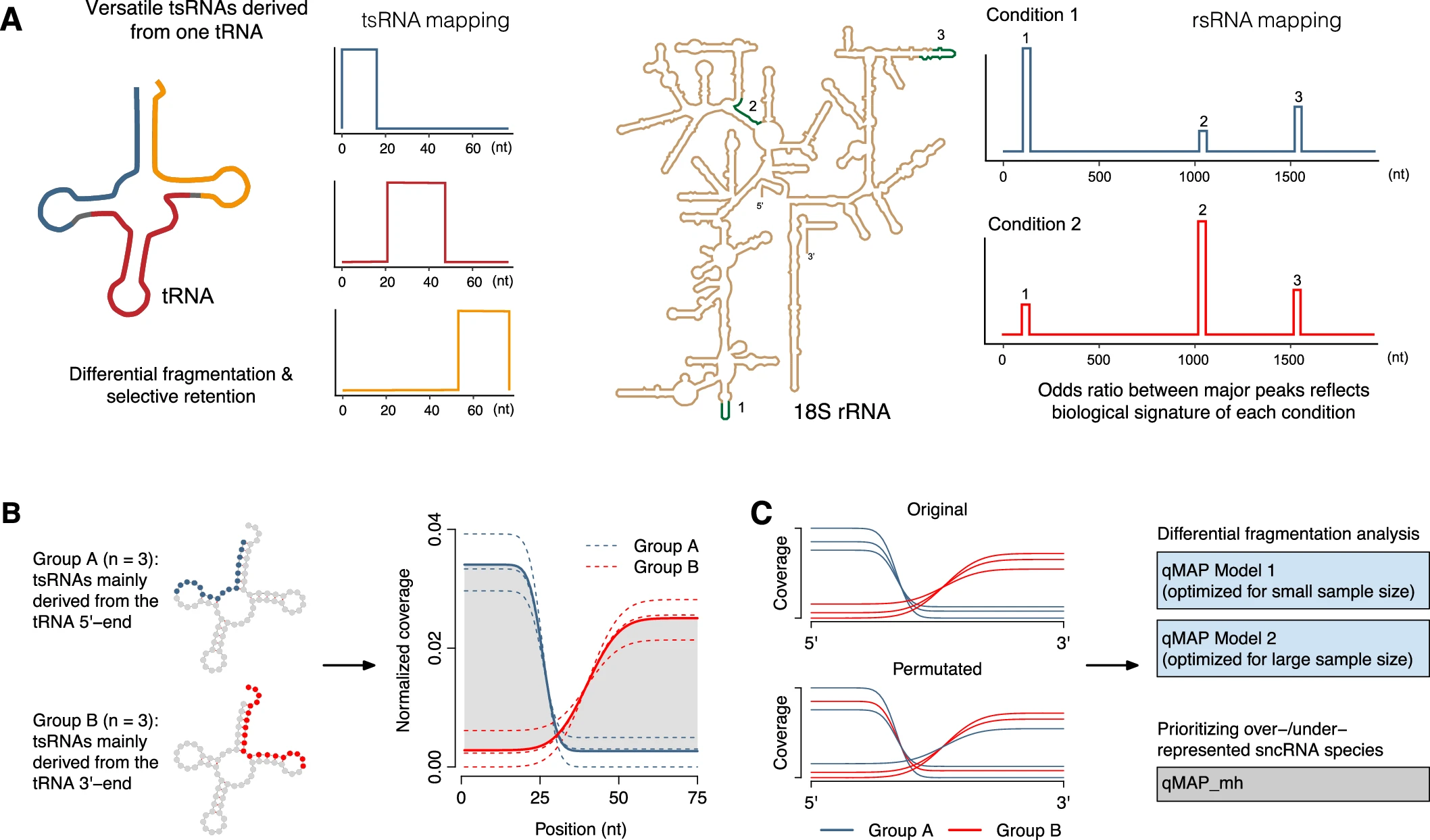
(A) Schematic diagram showing RNA differential fragmentation of tRNA (left panel) and rRNA (right panel). A single parental RNA can undergo differential fragmentation to generate distinct sncRNA species, and the differential cleavage ratios (e.g., of rsRNAs derived from 18S rRNA) reflect distinct biological conditions. The secondary structure template of 18S rRNA was obtained from RNAcentral (https://rnacentral.org). (B) Normalized coverage and coverage difference. We assume the fragmentation pattern of a given tRNA (75 nt long) is compared between Group A and Group B. The tsRNAs of Group A and Group B are mainly derived from the 5’-end and 3’-end of the parental tRNA, respectively. The normalized coverage of the tsRNAs is subsequently plotted along the parental tRNA for the individual samples within the two groups, illustrated as the blue/red dash curves. The solid blue and red curves indicate the mean coverage pattern for Group A and Group B, respectively. The gray area surrounded by the two solid curves represents the coverage difference between the two groups. (C) Computational strategy of qMAP. qMAP Model 1 and Model 2 rely on permutating samples between the groups to infer the statistical significance of the observed differential fragmentation, and qMAP_mh applies the Mantel–Haenszel procedure to identify the sncRNA species contributing to the observed differential fragmentation.
Traditional small RNA sequencing analysis often focuses on abundance, meaning how much of a particular RNA fragment is present in a sample. However, abundance alone may not reveal important changes in where a larger RNA molecule is being cut.
qMAP approaches the problem differently. Instead of looking only at the amount of each small RNA, the framework examines fragmentation patterns across the larger parental RNA molecule. This allows researchers to determine whether RNA molecules are being cleaved differently between biological conditions.
The researchers applied qMAP to several datasets involving development, disease, reproduction, and aging.
In one analysis, qMAP detected changing patterns of tRNA and rRNA fragmentation while mouse cells were being reprogrammed. Cellular reprogramming involves changing one type of cell into a more flexible state that can potentially develop into other cell types. The changing fragmentation patterns suggest that RNA cleavage may be another layer of regulation involved in this process.
The researchers also examined human ulcerative colitis, a chronic inflammatory disease of the colon. RNA fragmentation patterns were able to help distinguish samples associated with different disease conditions, suggesting that the way RNAs are cut may contain biological information that conventional measurements of RNA abundance do not capture.
Another application involved recurrent implantation failure, a condition in which embryos repeatedly fail to implant successfully during fertility treatment. Using blood samples, the researchers developed and validated an RNA fragmentation signature associated with recurrent implantation failure. These results raise the possibility that fragmentation patterns could eventually contribute to blood-based biomarkers for certain medical conditions.
qMAP also identified changes in RNA fragmentation associated with aging in sperm. These findings suggest that aging can affect not only the amount of particular small RNAs but also how larger RNA molecules are processed into smaller fragments.
Together, these examples support the idea of an “RNA fragmentome”, the complete collection of RNA fragments produced within a cell or biological sample. Just as researchers study the transcriptome to understand which genes are being expressed, examining the fragmentome could provide another view of how cells regulate RNA.
An important feature of qMAP is its ability to identify specific small RNA fragments responsible for differences between biological conditions. This can help researchers move from detecting a general change in fragmentation to identifying the individual RNA species that may be contributing to that change.
The approach could have applications in both basic biology and medicine. Researchers studying cellular development or aging may use RNA fragmentation patterns to uncover regulatory mechanisms that are not visible through conventional gene expression measurements. In disease research, the same patterns may provide new types of biomarkers capable of distinguishing biological conditions or patient groups.
Small RNA sequencing has already revealed that cells contain a much larger and more diverse population of regulatory RNA fragments than previously recognized. Tools such as qMAP expand what researchers can learn from those sequencing data by examining not only how much RNA is present, but also precisely how larger RNA molecules are being fragmented.
By making RNA cleavage patterns measurable across different biological conditions, qMAP provides researchers with a way to explore the RNA fragmentome as a distinct source of biological information. This additional layer may help reveal regulatory changes associated with development, disease, reproduction, and aging.
Availability – The source code of qMAP: GitHub (https://github.com/cozyrna/qMAP).
Rawal HC, Yu J, Zhang X, Cai C, Chen Q, Zhou T. (2026) qMAP decodes RNA fragmentation dynamics in development and disease. Molecular Systems Biology [Epub ahead of print]. [article]
Related Posts






Cells contain many types of RNA that perform different jobs. Some RNAs carry instructions for making proteins, while others help regulate when and how genes are used. Researchers are increasingly finding that small pieces produced when larger RNA molecules are cut can also have important biological functions.
Two examples are fragments derived from transfer RNA, called tRNA-derived small RNAs or tsRNAs, and fragments derived from ribosomal RNA, called rRNA-derived small RNAs or rsRNAs. These molecules were once sometimes viewed simply as products of RNA degradation. Evidence now suggests that many are created through controlled cleavage of larger RNA molecules and may participate in biological regulation.
Researchers at the University of Nevada, Reno School of Medicine developed a computational tool called qMAP to examine these RNA fragmentation patterns in greater detail.
Overview of qMAP
(A) Schematic diagram showing RNA differential fragmentation of tRNA (left panel) and rRNA (right panel). A single parental RNA can undergo differential fragmentation to generate distinct sncRNA species, and the differential cleavage ratios (e.g., of rsRNAs derived from 18S rRNA) reflect distinct biological conditions. The secondary structure template of 18S rRNA was obtained from RNAcentral (https://rnacentral.org). (B) Normalized coverage and coverage difference. We assume the fragmentation pattern of a given tRNA (75 nt long) is compared between Group A and Group B. The tsRNAs of Group A and Group B are mainly derived from the 5’-end and 3’-end of the parental tRNA, respectively. The normalized coverage of the tsRNAs is subsequently plotted along the parental tRNA for the individual samples within the two groups, illustrated as the blue/red dash curves. The solid blue and red curves indicate the mean coverage pattern for Group A and Group B, respectively. The gray area surrounded by the two solid curves represents the coverage difference between the two groups. (C) Computational strategy of qMAP. qMAP Model 1 and Model 2 rely on permutating samples between the groups to infer the statistical significance of the observed differential fragmentation, and qMAP_mh applies the Mantel–Haenszel procedure to identify the sncRNA species contributing to the observed differential fragmentation.
Traditional small RNA sequencing analysis often focuses on abundance, meaning how much of a particular RNA fragment is present in a sample. However, abundance alone may not reveal important changes in where a larger RNA molecule is being cut.
qMAP approaches the problem differently. Instead of looking only at the amount of each small RNA, the framework examines fragmentation patterns across the larger parental RNA molecule. This allows researchers to determine whether RNA molecules are being cleaved differently between biological conditions.
The researchers applied qMAP to several datasets involving development, disease, reproduction, and aging.
In one analysis, qMAP detected changing patterns of tRNA and rRNA fragmentation while mouse cells were being reprogrammed. Cellular reprogramming involves changing one type of cell into a more flexible state that can potentially develop into other cell types. The changing fragmentation patterns suggest that RNA cleavage may be another layer of regulation involved in this process.
The researchers also examined human ulcerative colitis, a chronic inflammatory disease of the colon. RNA fragmentation patterns were able to help distinguish samples associated with different disease conditions, suggesting that the way RNAs are cut may contain biological information that conventional measurements of RNA abundance do not capture.
Another application involved recurrent implantation failure, a condition in which embryos repeatedly fail to implant successfully during fertility treatment. Using blood samples, the researchers developed and validated an RNA fragmentation signature associated with recurrent implantation failure. These results raise the possibility that fragmentation patterns could eventually contribute to blood-based biomarkers for certain medical conditions.
qMAP also identified changes in RNA fragmentation associated with aging in sperm. These findings suggest that aging can affect not only the amount of particular small RNAs but also how larger RNA molecules are processed into smaller fragments.
Together, these examples support the idea of an “RNA fragmentome”, the complete collection of RNA fragments produced within a cell or biological sample. Just as researchers study the transcriptome to understand which genes are being expressed, examining the fragmentome could provide another view of how cells regulate RNA.
An important feature of qMAP is its ability to identify specific small RNA fragments responsible for differences between biological conditions. This can help researchers move from detecting a general change in fragmentation to identifying the individual RNA species that may be contributing to that change.
The approach could have applications in both basic biology and medicine. Researchers studying cellular development or aging may use RNA fragmentation patterns to uncover regulatory mechanisms that are not visible through conventional gene expression measurements. In disease research, the same patterns may provide new types of biomarkers capable of distinguishing biological conditions or patient groups.
Small RNA sequencing has already revealed that cells contain a much larger and more diverse population of regulatory RNA fragments than previously recognized. Tools such as qMAP expand what researchers can learn from those sequencing data by examining not only how much RNA is present, but also precisely how larger RNA molecules are being fragmented.
By making RNA cleavage patterns measurable across different biological conditions, qMAP provides researchers with a way to explore the RNA fragmentome as a distinct source of biological information. This additional layer may help reveal regulatory changes associated with development, disease, reproduction, and aging.
Availability – The source code of qMAP: GitHub (https://github.com/cozyrna/qMAP).
Rawal HC, Yu J, Zhang X, Cai C, Chen Q, Zhou T. (2026) qMAP decodes RNA fragmentation dynamics in development and disease. Molecular Systems Biology [Epub ahead of print]. [article]
Related Posts
Recent Posts
 Scientists identify the neuroblastoma cells that signal poor outcomes
 GARAGE improves rare cell detection in single-cell RNA sequencing analysis using AI
 Machine learning reveals how RNA splicing is regulated in individual cell types
 Illumina releases SpliceAI2 to help advance rare disease research
 Postdoctoral Fellow – Long-Read RNA Methods Development for Neurodegeneration
 Novel biosensor uses DNA ‘barcodes’ to uncover disease signals in cells
RNA-Seq Products & Services


Stay Connected