In a study that could have implications for more effective cancer therapies and preventing cancer recurrence, University of Colorado Anschutz Cancer Center member Sabrina Spencer, PhD, working with graduate student Brianna Fernandez, used single-cell RNA sequencing to investigate the cell-cycle state of cells following chemotherapy.
Specifically, the researchers were looking to characterize cells in one of two arrested states: quiescence, a reversible state of cell-cycle arrest, and senescence, an irreversible state of cell-cycle arrest. Their research was published in January 2026 in the journal Nature Communications.
“People always talk about quiescence and senescence as binary, distinct states, but there wasn’t good data to support that model, or any other model,” says Spencer, associate professor of biochemistry at CU Boulder. “People don’t understand senescence very well, and since we’ve become pretty good at understanding quiescence in my lab, I thought we could make an important contribution to understanding the relationship between quiescence and senescence: What makes senescence irreversible, meaning the cells will never divide again, and what allows quiescence to be reversible?”
Model of therapy-induced senescence
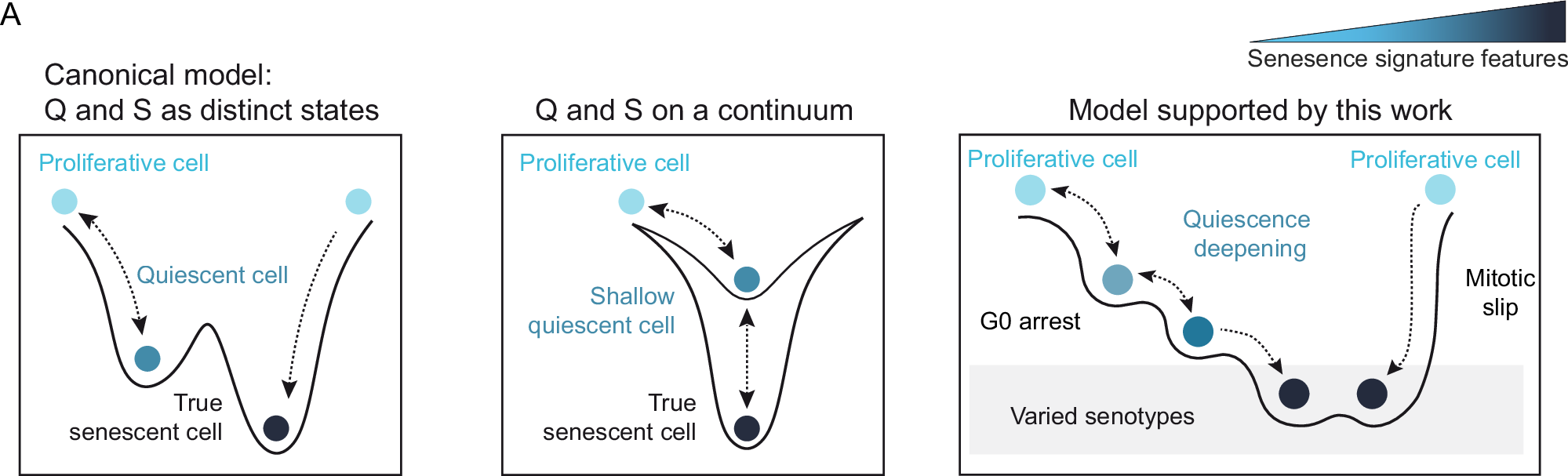
A Left: Canonical model of a switch-like transition between quiescence and senescence. We did not include an arrow from quiescence to senescence because it has not been clear in the field whether senescent cells can arise from existing quiescent cells or only from proliferating cells. Middle: Simple continuum model of cell-cycle withdrawal where quiescence and senescence represent different levels on the same continuum of withdrawal. Right: Model of cell-cycle arrest supported by this work. In the G0/G1 path, cells complete mitosis and first enter a shallow quiescence (G0). In this path, quiescent cells represent a reversible intermediate between proliferation and senescence and show a graded expression of senescence genes. In an alternative path, cells skip mitosis and arrest with 4 N DNA content. These cells transit directly to a senescent state, bypassing the quiescence deepening observed along the G0/G1 path.
On the continuum
The ultimate goal of chemotherapy is to kill cancer cells completely, but when that doesn’t happen, a senescent state is preferable, Fernandez explains, although it can cause chronic inflammation if the senescent cells aren’t destroyed by the immune system.
“There was originally some interest in senescence as a therapeutic outcome, because it induces an inflammatory response that recruits the immune system to clear the cells,” she says. “There’s also the fact that senescent cells will be arrested from the cell cycle, which will block tumor growth.”
Quiescent cells, on the other hand, are “dormant” cancer cells that have the ability to start dividing again at some point. The researchers were hoping to find biomarkers that could distinguish between the two distinct states, but the RNA sequencing revealed instead that chemotherapy-treated cancer cells are spread along on a continuum between quiescence and senescence.
“We confirmed that there’s a gradient between quiescence and senescence,” Fernandez explains. “All of the phenotypes that go along with senescence start to manifest as soon as cells exit the cell cycle after chemotherapy, just at a weak level. We couldn’t find a binary molecular distinction between quiescent and senescent cells in our data. Senescent cells have similar phenotypes as chemotherapy-induced quiescent cells; the senescent cells are just more extreme.”
To reoccur or not to reoccur
Though quiescence and senescence aren’t as cut and dry as the field believes or as the researchers hoped, the findings can help identify which cancer cells need further treatment after chemotherapy, Spencer says.
“One of the things I’m excited about is that this continuum of gene expression will allow us to create a marker panel to identify a cell’s depth of withdrawal,” she says. “If we could characterize where on the continuum a dormant cancer cell is, we may be able to say, ‘This cell has a very low likelihood of waking back up, so no further treatment is needed.’ But in another case, the cells may be in a shallow quiescence, and further treatment would be beneficial to avoid tumor recurrence.”
The research is also applicable to aging, where there’s an increase in senescent cells that are no longer able to divide.
“There’s a lot of interest in developing waypoints to characterize cell-cycle withdrawal, identifying where cells are on the continuum, then trying to push cells to be either more senescent or more proliferative,” Fernandez says.
Adds Spencer: “In the case of aging, you may want to rejuvenate the cells and push them away from senescence back towards proliferation for tissue and wound healing. But in cancer, you want to push them the other way.”
Source – University of Colorado Anschutz Cancer Center


In a study that could have implications for more effective cancer therapies and preventing cancer recurrence, University of Colorado Anschutz Cancer Center member Sabrina Spencer, PhD, working with graduate student Brianna Fernandez, used single-cell RNA sequencing to investigate the cell-cycle state of cells following chemotherapy.
Specifically, the researchers were looking to characterize cells in one of two arrested states: quiescence, a reversible state of cell-cycle arrest, and senescence, an irreversible state of cell-cycle arrest. Their research was published in January 2026 in the journal Nature Communications.
Model of therapy-induced senescence
A Left: Canonical model of a switch-like transition between quiescence and senescence. We did not include an arrow from quiescence to senescence because it has not been clear in the field whether senescent cells can arise from existing quiescent cells or only from proliferating cells. Middle: Simple continuum model of cell-cycle withdrawal where quiescence and senescence represent different levels on the same continuum of withdrawal. Right: Model of cell-cycle arrest supported by this work. In the G0/G1 path, cells complete mitosis and first enter a shallow quiescence (G0). In this path, quiescent cells represent a reversible intermediate between proliferation and senescence and show a graded expression of senescence genes. In an alternative path, cells skip mitosis and arrest with 4 N DNA content. These cells transit directly to a senescent state, bypassing the quiescence deepening observed along the G0/G1 path.
On the continuum
The ultimate goal of chemotherapy is to kill cancer cells completely, but when that doesn’t happen, a senescent state is preferable, Fernandez explains, although it can cause chronic inflammation if the senescent cells aren’t destroyed by the immune system.
Quiescent cells, on the other hand, are “dormant” cancer cells that have the ability to start dividing again at some point. The researchers were hoping to find biomarkers that could distinguish between the two distinct states, but the RNA sequencing revealed instead that chemotherapy-treated cancer cells are spread along on a continuum between quiescence and senescence.
To reoccur or not to reoccur
Though quiescence and senescence aren’t as cut and dry as the field believes or as the researchers hoped, the findings can help identify which cancer cells need further treatment after chemotherapy, Spencer says.
The research is also applicable to aging, where there’s an increase in senescent cells that are no longer able to divide.
Source – University of Colorado Anschutz Cancer Center
Fernandez B, Passanisi VJ, Ashraf HM, Spencer SL. (2025) Single-cell RNA sequencing reveals a quiescence-senescence continuum and distinct senotypes following chemotherapy. Nature Communications 17(1):169. [article]
Related Posts
Novel biosensor uses DNA ‘barcodes’ to uncover disease signals in cells
CellART extracts single-cell information from high-resolution spatial transcriptomics
Cell2space restores spatial context to single-cell RNA sequencing data
Urine test may improve bladder cancer diagnosis and guide treatment decisions
DeCoRE – a computational method to resolve RNA structural heterogeneity from RNA structure probing data by direct RNA sequencing
Tracing 700 million years of cell evolution
How should biological replicates be handled in long-read RNA sequencing?
RNA-Seq reveals a new way the developing heart controls its growth
The Human RNome Project Consortium seeks to publish first-ever complete sequence of the body’s RNA
scFlowReport brings multiple single-cell RNA sequencing analyses into one workflow
Long-read RNA sequencing reveals how neurons choose alternative RNA endings
DeOPUS improves cell-type estimates from bulk RNA sequencing
ResolVI improves accuracy in spatial transcriptomics analysis
RNA sequencing reveals transcriptional allele differences in prostate cancer stem cells
Unmasking “zombie cells” in aging tissue with an AI-powered barcode
RNA variant imaging for cancer diagnosis
Autism-risk mutations reveal two opposing patterns of brain gene activity
A real-data approach to evaluating RNA transcript analysis methods
Detection and sequencing of Ap2N-capped RNAs in human cells
Single-cell RNA sequencing provides a closer look at the Aedes aegypti midgut
Stay Connected
Submit a Post to the Blog
Recent Posts
Subscribe to the RNA-Seq Blog
RNA-Seq Products & Services