

Researchers from Stanford University have developed a powerful new method called RARE-seq to detect extremely small amounts of cell-free RNA (cfRNA) in the blood. cfRNA are tiny fragments of RNA released by cells into the bloodstream, including cancer cells, and can provide valuable clues about a person’s health without the need for invasive procedures.
Traditional RNA sequencing techniques have struggled to detect these fragments at low levels, especially in early-stage cancers. RARE-seq changes that. It’s approximately 50 times more sensitive than conventional methods, detecting tumor-derived cfRNA at levels as low as 0.05%. The team also solved a common issue in cfRNA testing—contamination from platelets, which can interfere with accurate results.
In a large-scale test involving over 400 plasma samples from individuals with various cancers and non-cancerous conditions, RARE-seq was able to detect gene expression signatures associated with non-small-cell lung cancer. Impressively, its sensitivity increased with cancer stage and even outperformed standard ctDNA (circulating tumor DNA) testing in some cases. It also picked up resistance mechanisms in patients who had developed resistance to certain cancer drugs and showed promise in identifying where the cancer originated and in monitoring responses to mRNA vaccines.
Summary of cancer and non-cancer cfRNA cohorts
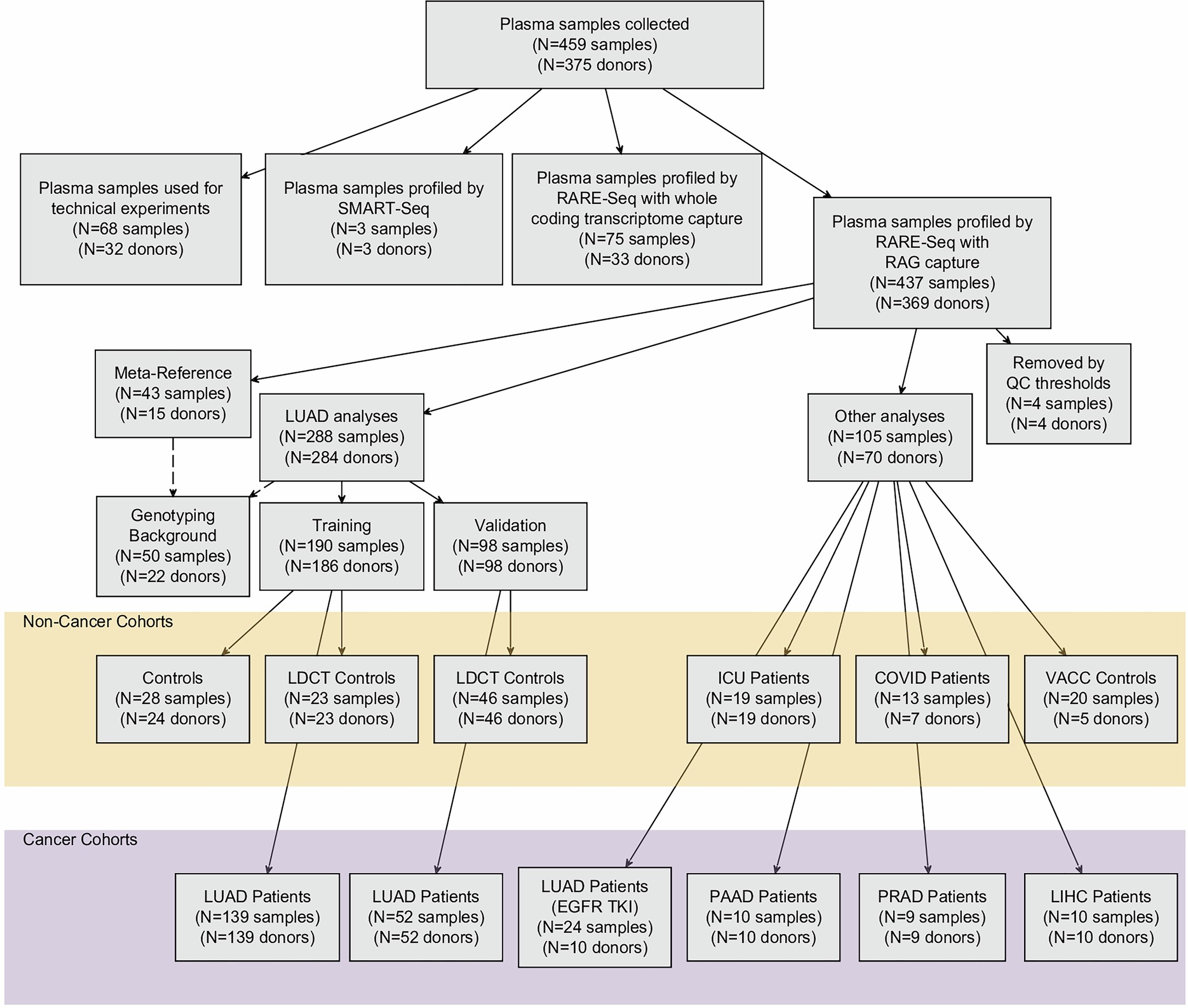
LDCT, low-dose computed tomography. ICU, intensive care unit. COVID, COVID-19 infection. VACC, post-COVID-19 mRNA vaccination. LUAD, lung adenocarcinoma. EGFR TKI, treated with epidermal growth factor receptor tyrosine kinase inhibitor. PAAD, pancreatic adenocarcinoma. PRAD, prostate adenocarcinoma. LIHC, liver hepatocellular carcinoma.
This innovative approach may soon enable earlier cancer detection, better tracking of disease progression, and broader use of cfRNA for diagnosing and understanding a wide range of health conditions.
Nesselbush M, Luca B, Jeon Y, Jabara I, Meador C, Garofalo A, Binkley M, Hui A, van ‘t Erve I, Xu N, Shi W, Liu K, Sugio T, Kastelowitz N, Hamilton E, Liu C, Olsen M, Bonilla R, Wang Y, Jiang A, Lau B, Eichholz J, Banwait M, Schroers-Martin J, Boegeholz J, King D, Luikart H, Esfahani M, Mehrmohamadi M, Stehr H, Raclin T, Tibshirani R, Khush K, Srinivas S, Yu H, Rogers A, Nair V, Isbell J, Li B, Piotrowska Z, Sequist L, Hata A, Neal J, Wakelee H, Gentles A, Alizadeh A, Diehn M. (2025) An ultrasensitive method for detection of cell-free RNA. Nature [Epub ahead of print]. [article]
Related Posts


Researchers from Stanford University have developed a powerful new method called RARE-seq to detect extremely small amounts of cell-free RNA (cfRNA) in the blood. cfRNA are tiny fragments of RNA released by cells into the bloodstream, including cancer cells, and can provide valuable clues about a person’s health without the need for invasive procedures.
Traditional RNA sequencing techniques have struggled to detect these fragments at low levels, especially in early-stage cancers. RARE-seq changes that. It’s approximately 50 times more sensitive than conventional methods, detecting tumor-derived cfRNA at levels as low as 0.05%. The team also solved a common issue in cfRNA testing—contamination from platelets, which can interfere with accurate results.
In a large-scale test involving over 400 plasma samples from individuals with various cancers and non-cancerous conditions, RARE-seq was able to detect gene expression signatures associated with non-small-cell lung cancer. Impressively, its sensitivity increased with cancer stage and even outperformed standard ctDNA (circulating tumor DNA) testing in some cases. It also picked up resistance mechanisms in patients who had developed resistance to certain cancer drugs and showed promise in identifying where the cancer originated and in monitoring responses to mRNA vaccines.
Summary of cancer and non-cancer cfRNA cohorts
LDCT, low-dose computed tomography. ICU, intensive care unit. COVID, COVID-19 infection. VACC, post-COVID-19 mRNA vaccination. LUAD, lung adenocarcinoma. EGFR TKI, treated with epidermal growth factor receptor tyrosine kinase inhibitor. PAAD, pancreatic adenocarcinoma. PRAD, prostate adenocarcinoma. LIHC, liver hepatocellular carcinoma.
This innovative approach may soon enable earlier cancer detection, better tracking of disease progression, and broader use of cfRNA for diagnosing and understanding a wide range of health conditions.
Nesselbush M, Luca B, Jeon Y, Jabara I, Meador C, Garofalo A, Binkley M, Hui A, van ‘t Erve I, Xu N, Shi W, Liu K, Sugio T, Kastelowitz N, Hamilton E, Liu C, Olsen M, Bonilla R, Wang Y, Jiang A, Lau B, Eichholz J, Banwait M, Schroers-Martin J, Boegeholz J, King D, Luikart H, Esfahani M, Mehrmohamadi M, Stehr H, Raclin T, Tibshirani R, Khush K, Srinivas S, Yu H, Rogers A, Nair V, Isbell J, Li B, Piotrowska Z, Sequist L, Hata A, Neal J, Wakelee H, Gentles A, Alizadeh A, Diehn M. (2025) An ultrasensitive method for detection of cell-free RNA. Nature [Epub ahead of print]. [article]
Related Posts
Recent Posts
 RNAmel simplifies RNA sequencing data analysis with a reproducible, integrated platform
 Heart failure reshapes bone marrow to create inflammation-related immune memory
 Overlooked DNA regions surrounding ‘microexons’ hold missing pieces of autism’s genetic puzzle
 RiboBA improves detection of hidden protein-coding regions using ribosome profiling
 An anti-senescence gene may fight spinal disc deterioration
 Bulk RNA-seq Analysis: A Complete Beginner’s Guide
RNA-Seq Products & Services



Stay Connected