


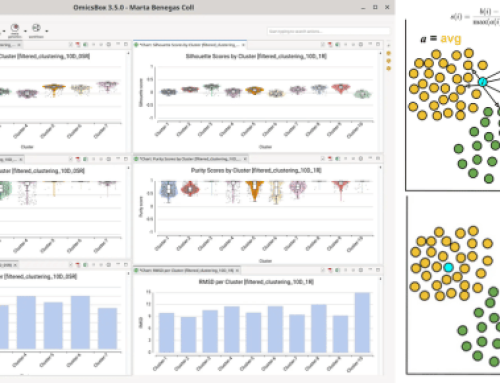
rCASC is a modular workflow providing an integrated analysis environment (from count generation to cell subpopulation identification) exploiting Docker containerization to achieve both functional and computational reproducibility in data analysis. Hence, rCASC provides preprocessing tools to remove low-quality cells and/or specific bias, e.g., cell cycle. Subpopulation discovery can instead be achieved using different clustering techniques based on different distance metrics. Cluster quality is then estimated through the new metric “cell stability score” (CSS), which describes the stability of a cell in a cluster as a consequence of a perturbation induced by removing a random set of cells from the cell population. CSS provides better cluster robustness information than the silhouette metric. Moreover, rCASC’s tools can identify cluster-specific gene signatures.
Alessandrì et al GigaScience, Volume 8, Issue 9, September 2019
Related Posts











rCASC is a modular workflow providing an integrated analysis environment (from count generation to cell subpopulation identification) exploiting Docker containerization to achieve both functional and computational reproducibility in data analysis. Hence, rCASC provides preprocessing tools to remove low-quality cells and/or specific bias, e.g., cell cycle. Subpopulation discovery can instead be achieved using different clustering techniques based on different distance metrics. Cluster quality is then estimated through the new metric “cell stability score” (CSS), which describes the stability of a cell in a cluster as a consequence of a perturbation induced by removing a random set of cells from the cell population. CSS provides better cluster robustness information than the silhouette metric. Moreover, rCASC’s tools can identify cluster-specific gene signatures.
Alessandrì et al GigaScience, Volume 8, Issue 9, September 2019
Related Posts
Recent Posts
 Researchers create first whole-body single-cell atlas of an adult vertebrate
 RNA sequencing reveals functional gene similarities across species
 UAlbany Joins $10 Million Effort to Map RNA Modifications in the Human Body
 Tempus Receives IVDR Certification for xR RNA Sequencing for Solid Tumor Profiling
 SpliceCOV improves RNA sequencing analysis by filtering transcriptional noise
 Nanopore RNA sequencing reveals new patterns associated with RNA modifications
RNA-Seq Products & Services



Stay Connected