

RNA sequencing allows researchers to measure which genes are active in a cell, providing valuable insights into cellular development, disease and responses to environmental changes. However, conventional RNA sequencing generally captures gene activity at a single moment in time, making it difficult to understand how gene expression changes over several hours or days.
This limitation is particularly important when studying temporary cellular responses. For example, a cell may activate hundreds of genes in response to an infection, but those changes can disappear before researchers collect a sample.
Researchers at the Department of Biosystems Science and Engineering at ETH Zurich in Basel, Switzerland, developed a synthetic cellular structure called a recordanelle that can preserve RNA molecules over time. Their findings, published in Nature Biotechnology, introduce a method for recording a cell’s gene expression history and recovering that information using RNA sequencing.
Overcoming the limitations of traditional RNA sequencing
Messenger RNA (mRNA) carries genetic instructions from DNA to the cellular machinery that produces proteins. By measuring the abundance of different mRNA molecules, RNA sequencing provides a detailed picture of gene expression.
However, mRNA molecules are constantly produced and degraded as cells respond to changing conditions. This means that a conventional RNA sequencing experiment may miss important biological events that occurred before the cells were analyzed.
Existing approaches for recording gene activity over time often monitor only a limited number of genes. The researchers sought to develop a system capable of preserving information from thousands of genes without substantially interfering with normal cellular functions.
How recordanelles capture RNA over time
The recordanelle is an engineered structure designed to collect and protect RNA molecules inside living cells.
It consists of three main components: a mitochondrial membrane anchor that attaches the structure to mitochondria, a protein segment that assembles a protective compartment, and an RNA-binding protein that captures RNA molecules.
Together, these components create a storage system for RNA transcripts that would otherwise be broken down by the cell.
Recording transient gene expression events
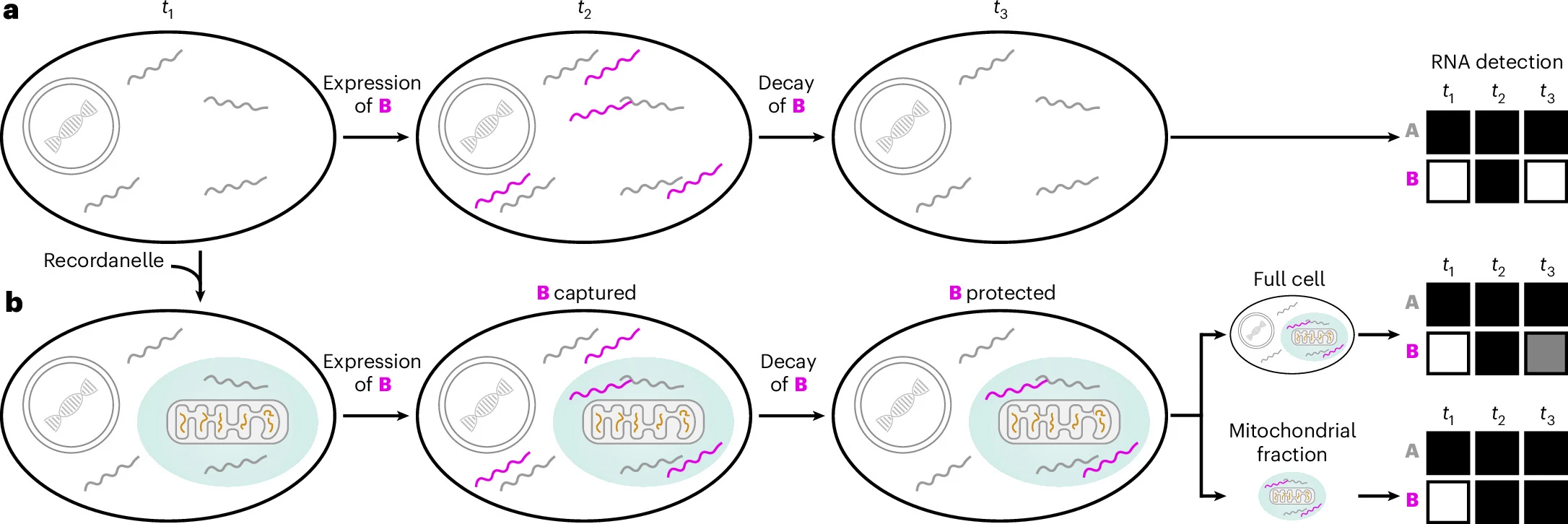
a, In a cell continuously expressing a set of genes A (gray), a stimulus triggers a transient expression of a set of genes B (magenta). Once the stimulus has passed, genes B progressively decay. When these cells are sampled and their RNA content is analyzed at different time points, the set of genes A can always be detected but expression of genes B can only be detected at t2, after the stimulation and before they decay to baseline. b, In cells expressing an RNA recording organelle (recordanelle) mounted onto the mitochondria, once genes B are expressed upon stimulation, they are captured within the organelle, where they are protected from decay. The RNA content of the entire cell can then be analyzed at a later time point t3, at which the recorded transcripts remain detectable. To improve the signal-to-noise ratio, recordanelles can be purified by mitochondrial extraction, enriching for the captured and recorded transcripts.
The researchers initially demonstrated that recordanelles could capture specially engineered RNA molecules. They then modified the system to recognize poly(A) tails, sequences commonly found at the ends of messenger RNAs, allowing it to collect a much broader range of naturally occurring transcripts.
Their optimized recordanelle contained RNA molecules representing up to 90% of the genes expressed in the tested human cells. Importantly, this represents coverage of the transcriptome, rather than capture of 90% of every RNA molecule present.
By protecting these transcripts from degradation, recordanelles preserve a molecular record of previous gene expression activity.
Recording temporary changes in gene expression
To test whether recordanelles could preserve information over time, the researchers used human cells engineered to activate specific genes in response to an experimental stimulus.
Normally, the resulting RNA molecules disappear as gene expression returns to its original state. However, recordanelles retained these transcripts, allowing researchers to detect the earlier activity even after the cellular response had ended.
The team also examined interferon signaling, an important part of the immune response to viral infections.
Using single-cell RNA sequencing, they demonstrated that recordanelles could preserve information about interferon-induced gene expression for several days, even after the original response was no longer detectable in ordinary cells.
This ability to capture temporary biological events could provide a more complete understanding of how individual cells respond to infections, inflammatory signals and other changing conditions.
Preserving cellular function
An important consideration for any molecular recording technology is whether it alters the biology being measured.
The researchers evaluated recordanelle-expressing cells for changes in gene expression, cell viability, energy production and mitochondrial function.
Under the experimental conditions tested, recordanelles did not substantially alter these processes. This suggests that the technology can preserve RNA information without causing major disruptions to normal cellular activity.
However, the researchers acknowledge that introducing artificial structures into cells may have effects that require further investigation, particularly during longer experiments or in different cell types.
New possibilities for single-cell RNA sequencing
Recordanelles offer a new approach to studying gene expression by preserving information about previous cellular activity rather than relying exclusively on measurements collected at one time point.
Combining this recording system with single-cell RNA sequencing could help researchers investigate how individual cells respond to immune signals, undergo differentiation or change during disease development.
Future applications may include studying developmental biology, immune responses and other processes in which temporary gene expression changes influence long-term cellular behavior.
By providing a way to recover a cell’s transcriptional history, recordanelles could expand the information available from RNA sequencing and improve our understanding of how biological processes unfold over time.
Reinkemeier CD, Manero-Carranza M, Farouni R, Filice F, Klotz A, Schneider-Heieck K, Andermann TL, Platt RJ. (2026) Recordanelles for transcriptome-wide single-cell RNA recording in human cells. Nature Biotechnology [Epub ahead of print]. [article]
Related Posts




RNA sequencing allows researchers to measure which genes are active in a cell, providing valuable insights into cellular development, disease and responses to environmental changes. However, conventional RNA sequencing generally captures gene activity at a single moment in time, making it difficult to understand how gene expression changes over several hours or days.
This limitation is particularly important when studying temporary cellular responses. For example, a cell may activate hundreds of genes in response to an infection, but those changes can disappear before researchers collect a sample.
Researchers at the Department of Biosystems Science and Engineering at ETH Zurich in Basel, Switzerland, developed a synthetic cellular structure called a recordanelle that can preserve RNA molecules over time. Their findings, published in Nature Biotechnology, introduce a method for recording a cell’s gene expression history and recovering that information using RNA sequencing.
Overcoming the limitations of traditional RNA sequencing
Messenger RNA (mRNA) carries genetic instructions from DNA to the cellular machinery that produces proteins. By measuring the abundance of different mRNA molecules, RNA sequencing provides a detailed picture of gene expression.
However, mRNA molecules are constantly produced and degraded as cells respond to changing conditions. This means that a conventional RNA sequencing experiment may miss important biological events that occurred before the cells were analyzed.
Existing approaches for recording gene activity over time often monitor only a limited number of genes. The researchers sought to develop a system capable of preserving information from thousands of genes without substantially interfering with normal cellular functions.
How recordanelles capture RNA over time
The recordanelle is an engineered structure designed to collect and protect RNA molecules inside living cells.
It consists of three main components: a mitochondrial membrane anchor that attaches the structure to mitochondria, a protein segment that assembles a protective compartment, and an RNA-binding protein that captures RNA molecules.
Together, these components create a storage system for RNA transcripts that would otherwise be broken down by the cell.
Recording transient gene expression events
a, In a cell continuously expressing a set of genes A (gray), a stimulus triggers a transient expression of a set of genes B (magenta). Once the stimulus has passed, genes B progressively decay. When these cells are sampled and their RNA content is analyzed at different time points, the set of genes A can always be detected but expression of genes B can only be detected at t2, after the stimulation and before they decay to baseline. b, In cells expressing an RNA recording organelle (recordanelle) mounted onto the mitochondria, once genes B are expressed upon stimulation, they are captured within the organelle, where they are protected from decay. The RNA content of the entire cell can then be analyzed at a later time point t3, at which the recorded transcripts remain detectable. To improve the signal-to-noise ratio, recordanelles can be purified by mitochondrial extraction, enriching for the captured and recorded transcripts.
The researchers initially demonstrated that recordanelles could capture specially engineered RNA molecules. They then modified the system to recognize poly(A) tails, sequences commonly found at the ends of messenger RNAs, allowing it to collect a much broader range of naturally occurring transcripts.
Their optimized recordanelle contained RNA molecules representing up to 90% of the genes expressed in the tested human cells. Importantly, this represents coverage of the transcriptome, rather than capture of 90% of every RNA molecule present.
By protecting these transcripts from degradation, recordanelles preserve a molecular record of previous gene expression activity.
Recording temporary changes in gene expression
To test whether recordanelles could preserve information over time, the researchers used human cells engineered to activate specific genes in response to an experimental stimulus.
Normally, the resulting RNA molecules disappear as gene expression returns to its original state. However, recordanelles retained these transcripts, allowing researchers to detect the earlier activity even after the cellular response had ended.
The team also examined interferon signaling, an important part of the immune response to viral infections.
Using single-cell RNA sequencing, they demonstrated that recordanelles could preserve information about interferon-induced gene expression for several days, even after the original response was no longer detectable in ordinary cells.
This ability to capture temporary biological events could provide a more complete understanding of how individual cells respond to infections, inflammatory signals and other changing conditions.
Preserving cellular function
An important consideration for any molecular recording technology is whether it alters the biology being measured.
The researchers evaluated recordanelle-expressing cells for changes in gene expression, cell viability, energy production and mitochondrial function.
Under the experimental conditions tested, recordanelles did not substantially alter these processes. This suggests that the technology can preserve RNA information without causing major disruptions to normal cellular activity.
However, the researchers acknowledge that introducing artificial structures into cells may have effects that require further investigation, particularly during longer experiments or in different cell types.
New possibilities for single-cell RNA sequencing
Recordanelles offer a new approach to studying gene expression by preserving information about previous cellular activity rather than relying exclusively on measurements collected at one time point.
Combining this recording system with single-cell RNA sequencing could help researchers investigate how individual cells respond to immune signals, undergo differentiation or change during disease development.
Future applications may include studying developmental biology, immune responses and other processes in which temporary gene expression changes influence long-term cellular behavior.
By providing a way to recover a cell’s transcriptional history, recordanelles could expand the information available from RNA sequencing and improve our understanding of how biological processes unfold over time.
Reinkemeier CD, Manero-Carranza M, Farouni R, Filice F, Klotz A, Schneider-Heieck K, Andermann TL, Platt RJ. (2026) Recordanelles for transcriptome-wide single-cell RNA recording in human cells. Nature Biotechnology [Epub ahead of print]. [article]
Related Posts
Recent Posts
 PANGEA – an integrated cell atlas across diverse biological contexts enables systematic profiling of multicellular responses in human diseases
 UMIche – a UMI-centric analysis platform for enhancing molecular quantification accuracy in bulk and single-cell sequencing
 New AI tool uses RNA sequencing to uncover gene interactions in Alzheimer’s disease
 New RNA sequencing tool reveals how stem cells develop into heart cells
 Estimating the completeness of large-scale single-cell sequencing projects
 New RNA sequencing tool improves transcriptome reconstruction using machine learning
RNA-Seq Products & Services



Stay Connected