
The Barcelona Institute for Global Health (ISGlobal), a centre supported by the ”la Caixa” Foundation, has launched HTGAnalyzer, a new, easy-to-use, fast and reproducible bioinformatics tool for advanced transcriptomic data analysis. Designed within the R statistical environment, this package simplifies complex analytical processes, making them accessible to professionals without specific expertise in bioinformatics.
Transcriptomic analysis: key to personalised medicine
This type of analysis examines all messenger RNA molecules present in a cell at a given time, revealing which genes are expressed and in what quantity. This information is crucial in precision medicine, an approach that seeks to tailor treatments to each patient’s genetic and molecular profile.
Despite its clinical potential, the implementation of transcriptomic techniques has been limited not by data generation, but by the complexity of the required bioinformatics analysis.
A user-friendly tool for clinicians and researchers
To address this challenge, the ISGlobal team has developed HTGAnalyzer: an automated, free and user-friendly tool for clinicians of various specialities. Laia Díez-Ahijado was the lead author of the tool, which was jointly conceptualised by Natalia Rakislova and Robert Albero.
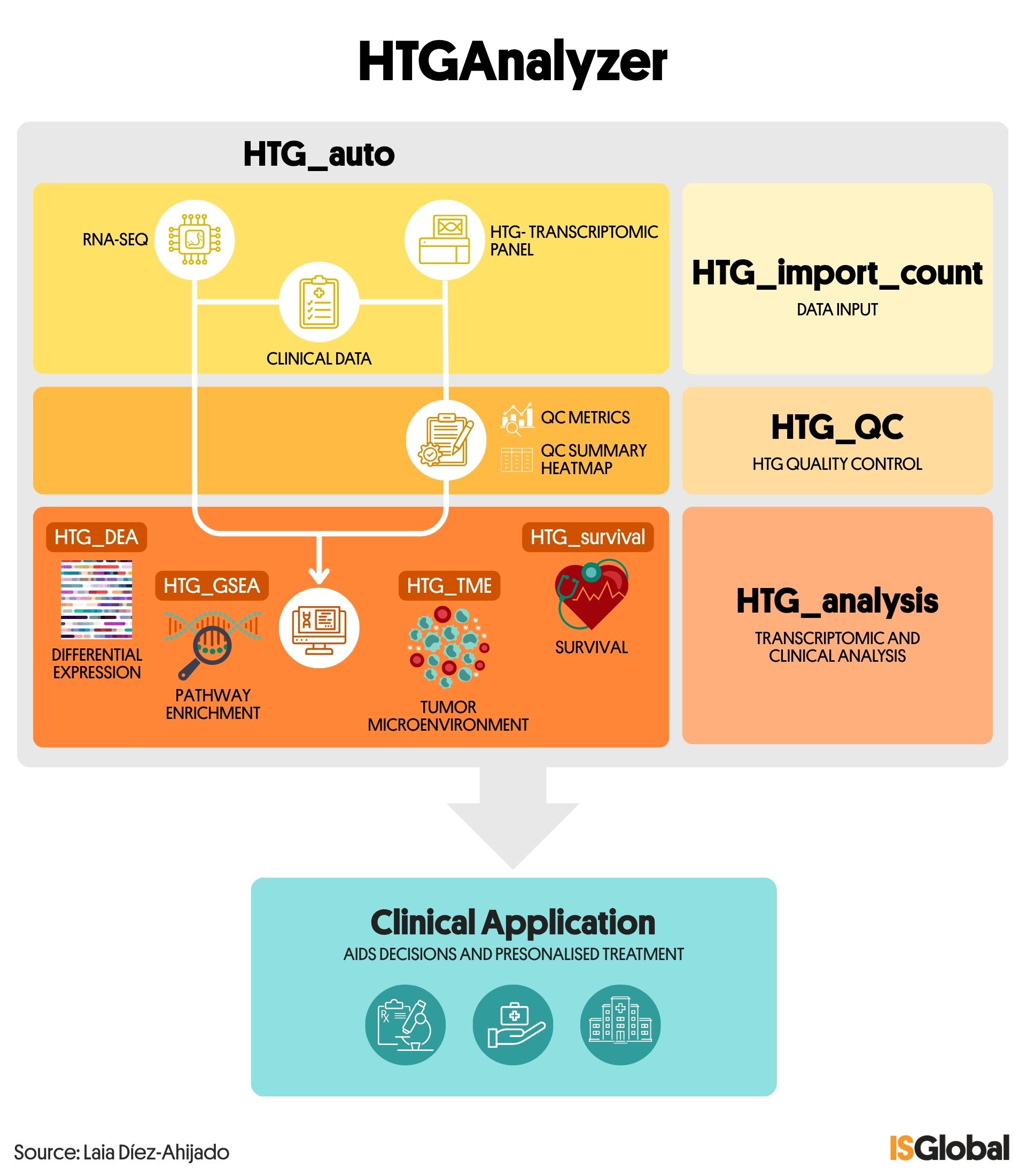
The study, published in Computers in Biology and Medicine, demonstrates how HTGAnalyzer simplifies complex transcriptomic workflows, including data import and normalisation, sample quality control, differential gene expression analysis, functional enrichment, tumour microenvironment profiling and survival analysis. The tool uses patients’ molecular data to identify biological and clinical differences, thereby supporting the clinical interpretation of results.
Validation using real-world oncology data
HTGAnalyzer was validated using multiple datasets, including RNA-seq data from The Cancer Genome Atlas (TCGA) and a cohort of patients with vulvar cancer — a rare and sometimes aggressive malignancy.
In the latter case, the tool identified differentially expressed genes, described their immunological profiles, and revealed genes and cellular pathways linked to this cancer and to patient survival. These findings highlight the clinical potential of HTGAnalyzer for generating knowledge applicable to cancer diagnosis, treatment, and prognosis.
Supporting precision medicine and health equity
With this development, the research team has achieved its goal of bridging the gap between complex bioinformatic analysis and the practical needs of clinical and research environments. HTGAnalyzer enables professionals without advanced bioinformatics expertise to perform essential transcriptomic analyses that are increasingly being used in personalised medicine to inform diagnosis, prognosis, and personalised treatments based on the patient’s molecular biology.
Source – ISGlobal
Availability – The HTGAnalyzer pipeline is available at https://github.com/ISGLOBAL-Rakislova-Lab/HTGAnalyzer/


The Barcelona Institute for Global Health (ISGlobal), a centre supported by the ”la Caixa” Foundation, has launched HTGAnalyzer, a new, easy-to-use, fast and reproducible bioinformatics tool for advanced transcriptomic data analysis. Designed within the R statistical environment, this package simplifies complex analytical processes, making them accessible to professionals without specific expertise in bioinformatics.
Transcriptomic analysis: key to personalised medicine
This type of analysis examines all messenger RNA molecules present in a cell at a given time, revealing which genes are expressed and in what quantity. This information is crucial in precision medicine, an approach that seeks to tailor treatments to each patient’s genetic and molecular profile.
Despite its clinical potential, the implementation of transcriptomic techniques has been limited not by data generation, but by the complexity of the required bioinformatics analysis.
A user-friendly tool for clinicians and researchers
To address this challenge, the ISGlobal team has developed HTGAnalyzer: an automated, free and user-friendly tool for clinicians of various specialities. Laia Díez-Ahijado was the lead author of the tool, which was jointly conceptualised by Natalia Rakislova and Robert Albero.
The study, published in Computers in Biology and Medicine, demonstrates how HTGAnalyzer simplifies complex transcriptomic workflows, including data import and normalisation, sample quality control, differential gene expression analysis, functional enrichment, tumour microenvironment profiling and survival analysis. The tool uses patients’ molecular data to identify biological and clinical differences, thereby supporting the clinical interpretation of results.
Validation using real-world oncology data
HTGAnalyzer was validated using multiple datasets, including RNA-seq data from The Cancer Genome Atlas (TCGA) and a cohort of patients with vulvar cancer — a rare and sometimes aggressive malignancy.
In the latter case, the tool identified differentially expressed genes, described their immunological profiles, and revealed genes and cellular pathways linked to this cancer and to patient survival. These findings highlight the clinical potential of HTGAnalyzer for generating knowledge applicable to cancer diagnosis, treatment, and prognosis.
Supporting precision medicine and health equity
With this development, the research team has achieved its goal of bridging the gap between complex bioinformatic analysis and the practical needs of clinical and research environments. HTGAnalyzer enables professionals without advanced bioinformatics expertise to perform essential transcriptomic analyses that are increasingly being used in personalised medicine to inform diagnosis, prognosis, and personalised treatments based on the patient’s molecular biology.
Source – ISGlobal
Availability – The HTGAnalyzer pipeline is available at https://github.com/ISGLOBAL-Rakislova-Lab/HTGAnalyzer/
Díez-Ahijado L, Del Rincón AM, Marimón L, Saco A, Del Pino M, Torné A, Darecka K, Sisuashvili L, Peñuelas N, Pascual-Mas P, Carreras-Dieguez N, Ordi O, Rakislova N, Albero R. (2025) HTGAnalyzer: An accessible R package with a web interface for enhanced transcriptomic analysis in precision medicine. Computers in Biology and Medicine 196(Pt B):110772. [article]
Related Posts
RNAmel simplifies RNA sequencing data analysis with a reproducible, integrated platform
Heart failure reshapes bone marrow to create inflammation-related immune memory
Overlooked DNA regions surrounding ‘microexons’ hold missing pieces of autism’s genetic puzzle
RiboBA improves detection of hidden protein-coding regions using ribosome profiling
An anti-senescence gene may fight spinal disc deterioration
Scientists identify the neuroblastoma cells that signal poor outcomes
Novel biosensor uses DNA ‘barcodes’ to uncover disease signals in cells
CellART extracts single-cell information from high-resolution spatial transcriptomics
Cell2space restores spatial context to single-cell RNA sequencing data
Urine test may improve bladder cancer diagnosis and guide treatment decisions
DeCoRE – a computational method to resolve RNA structural heterogeneity from RNA structure probing data by direct RNA sequencing
Tracing 700 million years of cell evolution
How should biological replicates be handled in long-read RNA sequencing?
RNA-Seq reveals a new way the developing heart controls its growth
The Human RNome Project Consortium seeks to publish first-ever complete sequence of the body’s RNA
scFlowReport brings multiple single-cell RNA sequencing analyses into one workflow
Long-read RNA sequencing reveals how neurons choose alternative RNA endings
DeOPUS improves cell-type estimates from bulk RNA sequencing
ResolVI improves accuracy in spatial transcriptomics analysis
RNA sequencing reveals transcriptional allele differences in prostate cancer stem cells
Stay Connected
Submit a Post to the Blog
Recent Posts
Subscribe to the RNA-Seq Blog
RNA-Seq Products & Services