In most modern cells, DNA stores the genetic blueprint, and relies on proteins to replicate, repair and build from those blueprints. At the same time, proteins require instructions from DNA to be made in the first place.
So which one came first? Neither, hypothesize researchers like Saurja DasGupta, a biochemist at the University of Notre Dame.
DasGupta seeks to better understand the chemical origins of life by studying the structure, function and evolution of RNA, an intermediary molecule that can both store genetic information and catalyze biochemical reactions. In a study out today in Nature Communications, DasGupta and colleagues present a key mechanism for sustaining RNA-based life: an engineered enzyme that selectively recognizes and repairs broken RNA.
“Our results suggest that the molecular tools needed to preserve the RNA-based genetic code and pass it on to future generations could have been furnished by RNA alone — no proteins required,” said DasGupta, who is an assistant professor in the Department of Chemistry and Biochemistry with a concurrent appointment in the Department of Biological Sciences.
The RNA-based enzyme, or “ribozyme,” engineered by the researchers pastes together pieces of RNA and targets a distinguishing feature of broken RNA: a phosphate group — one phosphorous atom bonded to four oxygen atoms — at the end of the broken RNA chain. Intact strands of RNA, in contrast, terminate in a hydroxyl group — one oxygen atom and one hydrogen atom.
“The fact that this enzyme seeks out terminal phosphate groups in RNA — and, therefore, broken RNAs — while ignoring strands that end with standard hydroxyl groups suggests that it could have been important for primordial RNA repair,” said DasGupta, who collaborated with Jack W. Szostak of the University of Chicago on the study.
The dual storage and catalysis capabilities of RNA are the basis of the RNA World hypothesis, which posits that the earliest forms of life on Earth that lived almost four billion years ago were powered exclusively by RNA. The hypothesis suggests that RNA molecules preceded DNA and proteins for encoding genes and facilitating cellular processes, respectively.
“Modern organisms have repair mechanisms to mend broken DNAs; if early life forms carried their genes in RNA, then a similar repair process must have existed,” DasGupta said. “Otherwise, when heat, high pH or other stressors inevitably damaged the RNA genome, the genetic information would have been permanently lost, effectively stopping life in its tracks.”
A major hurdle to the study of primordial RNA systems is that they do not exist anymore. In order to show that these RNA-based organisms and their components could have sustained life, researchers need to first engineer new ribozymes through a process called in vitro evolution. The process entails selecting RNA catalysts with particular properties from trillions of RNA molecules inside test tubes. Researchers impose certain conditions on these artificial evolution experiments in hopes of engineering ribozymes with specific functions, but often encounter surprises along the way.
Selection protocol and substrate used to isolate RNA ligase ribozymes
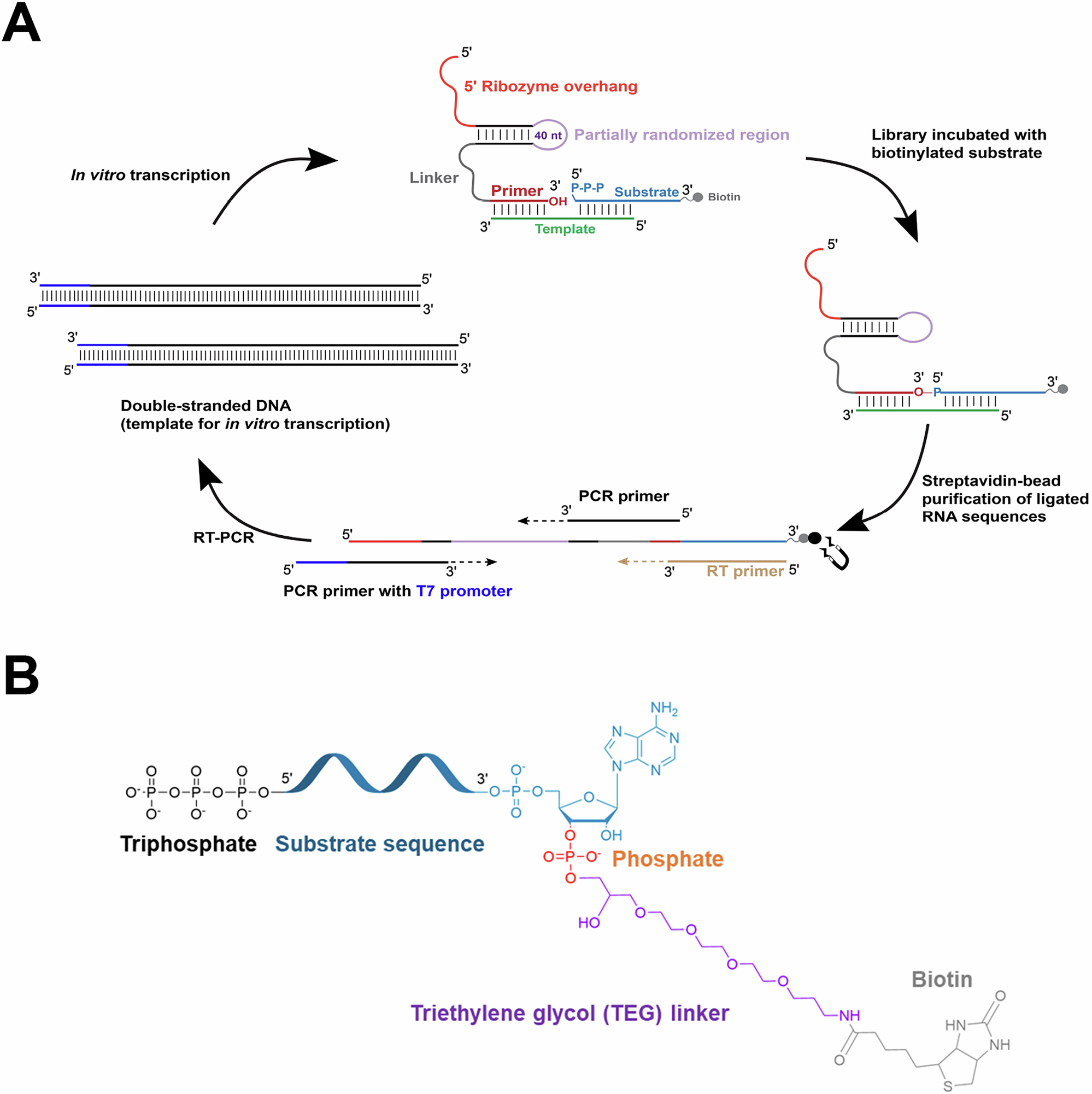
A An RNA library containing a partially randomized sequence having an estimated complexity of ~1014 sequences (depicted in light purple) derived from an AIP-Ligase (RS1) was challenged with an RNA substrate (depicted in light blue), containing a 5’-triphosphate group and a 3’-TEG-biotin group (depicted in gray) in the presence of an RNA template (depicted in green). Ligated sequences were purified by binding to streptavidin-coated magnetic beads and reverse transcribed using a primer (RT primer; depicted in gold) that is complementary to the entire substrate sequence. The RT primer also has the potential to bind directly to the library sequences by forming four base-pairs with the 3’ end of their ‘primer’ sequence (depicted in red). The cDNA was PCR-amplified, with the T7 promoter sequence (depicted in blue) added to the dsDNA sequence during PCR. This dsDNA was transcribed to generate the library for subsequent rounds of selection. All sequences are included in Supplementary Data Table 1. B The chemical features of the substrate used in the selection (PPP-Substrate-Biot). The substrate contains a triphosphate group (black) on its 5’ end and is connected to a biotin moiety (gray) via a triethylene glycol (TEG) linker (purple) attached to the 3’-phosphate (orange) on the terminal adenine of the substrate.
“The general consensus is that artificial evolution comes down to quite a bit of luck,” DasGupta said. “Sometimes you get what you’re aiming for, sometimes you don’t. And when you don’t, you start over and do it again.”
Initially, DasGupta’s research group set out to tweak the biochemistry of an existing class of ribozymes using the method. But when they saw unexpected results, the researchers followed those up instead of discarding them — and uncovered something brand new.
“The existence of this ribozyme has interesting implications for our understanding of the origins of life, and we came across it while looking for something else,” DasGupta said. “What I’m most surprised about, actually, is that it wasn’t found sooner.”
Beyond primordial biology, the significance of the newly-engineered ribozyme extends into the realm of biotechnology.
Broken RNA is common in viral infections and is a sign of abnormal cell function in certain cancers. The standard RNA sequencing techniques used to analyze the genetic markers of these diseases, however, misses out on broken RNA, since the chemical tags that mark RNA strands for analysis are not designed to attach to broken ends.
“Broken RNAs are essentially invisible in standard sequencing protocols, which is a barrier to understanding the relationship between RNA cleavage and disease,” said DasGupta, who is a faculty affiliate of the Berthiaume Institute for Precision Health and the Warren Center for Drug Discovery.
Since the RNA-repair ribozyme is selective for broken RNA, it could be used to render cleaved strands “visible” by isolating them for special preparation prior to RNA sequencing. As a first step, DasGupta’s research group is in the process of optimizing the ribozyme’s reaction efficiency while broadening the range of potential molecular targets.
“What began as a quest for insight into the origins of RNA-based life and ended in an unanticipated finding has also provided a potential solution to a major challenge in biotechnology,” DasGupta said. “We’re excited to continue pursuing these new frontiers in ancient RNA biology and modern diagnostics.”
Source – University of Notre Dame


In most modern cells, DNA stores the genetic blueprint, and relies on proteins to replicate, repair and build from those blueprints. At the same time, proteins require instructions from DNA to be made in the first place.
So which one came first? Neither, hypothesize researchers like Saurja DasGupta, a biochemist at the University of Notre Dame.
DasGupta seeks to better understand the chemical origins of life by studying the structure, function and evolution of RNA, an intermediary molecule that can both store genetic information and catalyze biochemical reactions. In a study out today in Nature Communications, DasGupta and colleagues present a key mechanism for sustaining RNA-based life: an engineered enzyme that selectively recognizes and repairs broken RNA.
The RNA-based enzyme, or “ribozyme,” engineered by the researchers pastes together pieces of RNA and targets a distinguishing feature of broken RNA: a phosphate group — one phosphorous atom bonded to four oxygen atoms — at the end of the broken RNA chain. Intact strands of RNA, in contrast, terminate in a hydroxyl group — one oxygen atom and one hydrogen atom.
The dual storage and catalysis capabilities of RNA are the basis of the RNA World hypothesis, which posits that the earliest forms of life on Earth that lived almost four billion years ago were powered exclusively by RNA. The hypothesis suggests that RNA molecules preceded DNA and proteins for encoding genes and facilitating cellular processes, respectively.
A major hurdle to the study of primordial RNA systems is that they do not exist anymore. In order to show that these RNA-based organisms and their components could have sustained life, researchers need to first engineer new ribozymes through a process called in vitro evolution. The process entails selecting RNA catalysts with particular properties from trillions of RNA molecules inside test tubes. Researchers impose certain conditions on these artificial evolution experiments in hopes of engineering ribozymes with specific functions, but often encounter surprises along the way.
Selection protocol and substrate used to isolate RNA ligase ribozymes
A An RNA library containing a partially randomized sequence having an estimated complexity of ~1014 sequences (depicted in light purple) derived from an AIP-Ligase (RS1) was challenged with an RNA substrate (depicted in light blue), containing a 5’-triphosphate group and a 3’-TEG-biotin group (depicted in gray) in the presence of an RNA template (depicted in green). Ligated sequences were purified by binding to streptavidin-coated magnetic beads and reverse transcribed using a primer (RT primer; depicted in gold) that is complementary to the entire substrate sequence. The RT primer also has the potential to bind directly to the library sequences by forming four base-pairs with the 3’ end of their ‘primer’ sequence (depicted in red). The cDNA was PCR-amplified, with the T7 promoter sequence (depicted in blue) added to the dsDNA sequence during PCR. This dsDNA was transcribed to generate the library for subsequent rounds of selection. All sequences are included in Supplementary Data Table 1. B The chemical features of the substrate used in the selection (PPP-Substrate-Biot). The substrate contains a triphosphate group (black) on its 5’ end and is connected to a biotin moiety (gray) via a triethylene glycol (TEG) linker (purple) attached to the 3’-phosphate (orange) on the terminal adenine of the substrate.
Initially, DasGupta’s research group set out to tweak the biochemistry of an existing class of ribozymes using the method. But when they saw unexpected results, the researchers followed those up instead of discarding them — and uncovered something brand new.
Beyond primordial biology, the significance of the newly-engineered ribozyme extends into the realm of biotechnology.
Broken RNA is common in viral infections and is a sign of abnormal cell function in certain cancers. The standard RNA sequencing techniques used to analyze the genetic markers of these diseases, however, misses out on broken RNA, since the chemical tags that mark RNA strands for analysis are not designed to attach to broken ends.
Since the RNA-repair ribozyme is selective for broken RNA, it could be used to render cleaved strands “visible” by isolating them for special preparation prior to RNA sequencing. As a first step, DasGupta’s research group is in the process of optimizing the ribozyme’s reaction efficiency while broadening the range of potential molecular targets.
Source – University of Notre Dame
Biswas A, Weiss Z, Szostak JW, DasGupta S. (2026) A ribozyme ligase that requires a 3′ terminal phosphate on its RNA substrate. Nature Communications 17: 5634. [article]
Related Posts
Researchers create first whole-body single-cell atlas of an adult vertebrate
UAlbany Joins $10 Million Effort to Map RNA Modifications in the Human Body
SpliceCOV improves RNA sequencing analysis by filtering transcriptional noise
Overlooked ‘off switch’ in lung tumors may explain why immunotherapy doesn’t work for everyone
Squids Edit RNA for Novel Protein Functions
New marker panel and web tool help define early human cell fates
RNA sequencing reveals molecular changes driving right ventricular heart failure
Researchers Develop AI Tool to Map MicroRNA Binding Sites on Circular RNAs
Single-cell RNA sequencing reveals the diversity of human neutrophils across health and disease
Yale researchers improve RNA extraction from precision-cut lung slices
RNA sequencing reveals how genes combine to regulate inflammation and immune responses
RNAffinityDB – a curated database of experimental RNA–protein binding affinities
“Raman Genome” for SARS-CoV-2: new Raman technology distinguishes viral variants by their molecular RNA architecture
Advanced paternal age has sex-specific effects on fetal brain gene expression
Exercise is good for us—but why?
Ribosome profiling reveals shared patterns in ribosome diversity and collisions
RNAmel simplifies RNA sequencing data analysis with a reproducible, integrated platform
Heart failure reshapes bone marrow to create inflammation-related immune memory
Overlooked DNA regions surrounding ‘microexons’ hold missing pieces of autism’s genetic puzzle
RiboBA improves detection of hidden protein-coding regions using ribosome profiling
Stay Connected
Submit a Post to the Blog
Recent Posts
Subscribe to the RNA-Seq Blog
RNA-Seq Products & Services