

Bacterial cells, unlike mammalian cells, do not have mRNA polyadenylated tails, which presents a challenge when trying to isolate mRNA for study, especially in single-cell RNA sequencing (scRNA-seq). This issue is made more difficult because of the high abundance of ribosomal RNA (rRNA) that can overwhelm the detection of mRNA. To address this problem, researchers at Wuhan University have developed a new technique called ribosomal RNA-derived cDNA depletion (RiboD), which was integrated into the existing PETRI-seq method to create RiboD-PETRI. This new approach provides a cost-effective, high-throughput solution for bacterial scRNA-seq without requiring expensive equipment.
Development of RiboD-PETRI and validation of its technical performance
in studying population heterogeneity
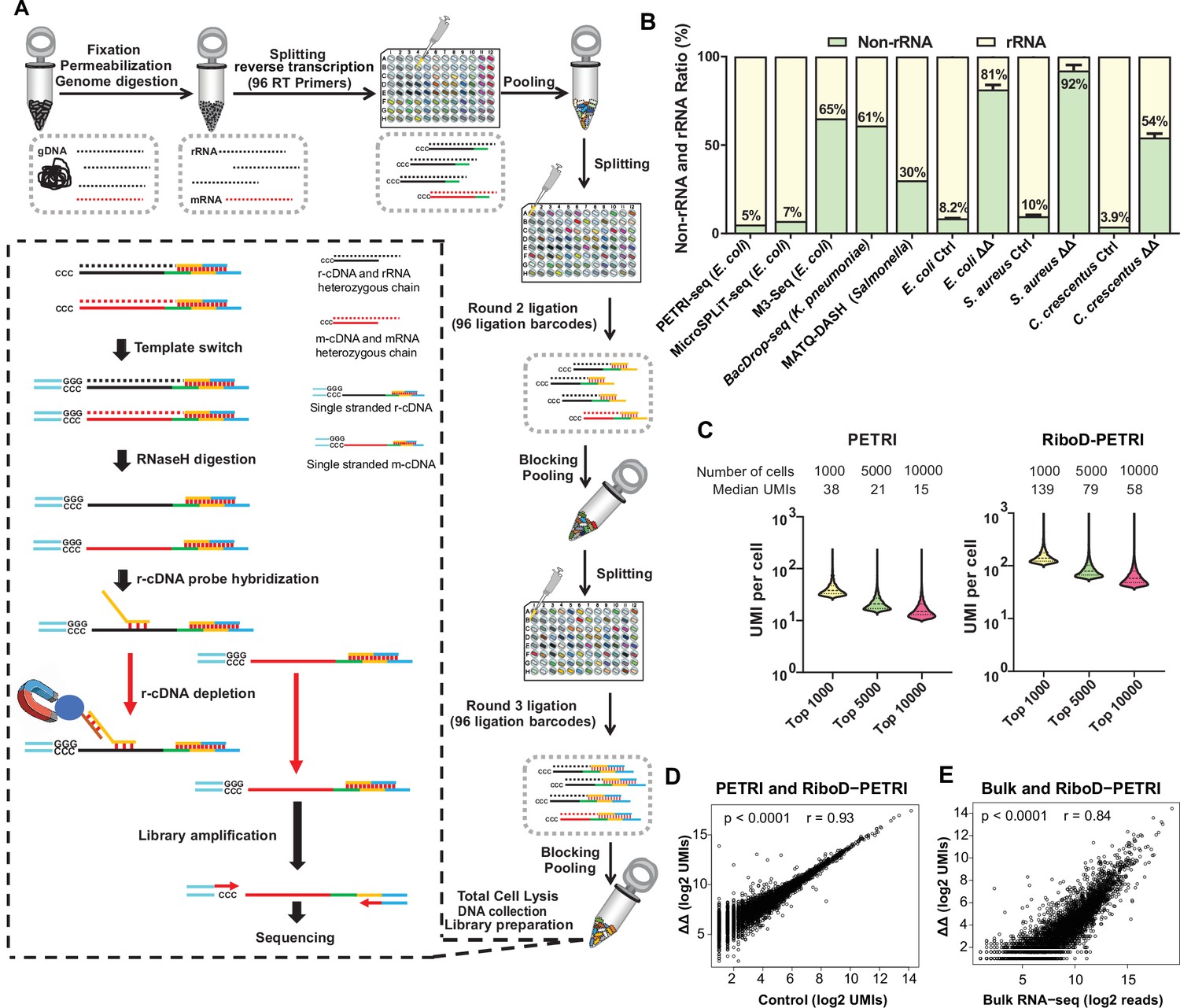
(A) Graphic summary of the RiboD-PETRI method illustrating the incorporation of RiboD after cell pooling and lysis in PETRI-seq. (B) Comparison of non-rRNA (tRNA, mRNA, and other non-rRNA) and rRNA unique molecular identifier (UMI) counts ratio among different bacterial scRNA-seq methods. (C) Comparison of UMI counts per cell between RiboD-PETRI and PETRI at the same unsaturated sequencing depth. (D) Assessment of the effect of rRNA depletion on transcriptional profiles. (E) Evaluation of the correlation between RiboD-PETRI data and bulk RNA-seq results.
RiboD-PETRI works by efficiently removing rRNA, which significantly increases the ability to detect mRNA—up to 92% more mRNA reads. This enhancement is especially useful for exploring bacterial population heterogeneity, meaning it helps scientists study the differences between individual bacteria in a population. For example, when applied to investigate bacterial biofilms (clusters of bacteria that stick to surfaces), the method successfully identified distinct subpopulations of bacteria with unique gene expression patterns.
One interesting discovery was the identification of a subpopulation of bacteria involved in biofilm attachment, marked by the gene PdeI. This subpopulation was found to increase levels of cyclic diguanylate (c-di-GMP), a molecule that plays a role in the formation of persister cells—bacteria that are highly resistant to antibiotics. By tackling the issue of rRNA interference in bacterial scRNA-seq, RiboD-PETRI provides a more accurate and detailed way to study bacterial populations, particularly in biofilms, at an unprecedented resolution.
This breakthrough will allow scientists to explore deeper into bacterial behavior and interactions, potentially opening new avenues for understanding antibiotic resistance and other bacterial phenomena.
Yan X, Liao H, Wang C, Huang C, Zhang W, Guo C, Pu Y. (2024) An improved bacterial single-cell RNA-seq reveals biofilm heterogeneity. Elife 13:RP97543. [article]
Related Posts






Bacterial cells, unlike mammalian cells, do not have mRNA polyadenylated tails, which presents a challenge when trying to isolate mRNA for study, especially in single-cell RNA sequencing (scRNA-seq). This issue is made more difficult because of the high abundance of ribosomal RNA (rRNA) that can overwhelm the detection of mRNA. To address this problem, researchers at Wuhan University have developed a new technique called ribosomal RNA-derived cDNA depletion (RiboD), which was integrated into the existing PETRI-seq method to create RiboD-PETRI. This new approach provides a cost-effective, high-throughput solution for bacterial scRNA-seq without requiring expensive equipment.
Development of RiboD-PETRI and validation of its technical performance
in studying population heterogeneity
(A) Graphic summary of the RiboD-PETRI method illustrating the incorporation of RiboD after cell pooling and lysis in PETRI-seq. (B) Comparison of non-rRNA (tRNA, mRNA, and other non-rRNA) and rRNA unique molecular identifier (UMI) counts ratio among different bacterial scRNA-seq methods. (C) Comparison of UMI counts per cell between RiboD-PETRI and PETRI at the same unsaturated sequencing depth. (D) Assessment of the effect of rRNA depletion on transcriptional profiles. (E) Evaluation of the correlation between RiboD-PETRI data and bulk RNA-seq results.
RiboD-PETRI works by efficiently removing rRNA, which significantly increases the ability to detect mRNA—up to 92% more mRNA reads. This enhancement is especially useful for exploring bacterial population heterogeneity, meaning it helps scientists study the differences between individual bacteria in a population. For example, when applied to investigate bacterial biofilms (clusters of bacteria that stick to surfaces), the method successfully identified distinct subpopulations of bacteria with unique gene expression patterns.
One interesting discovery was the identification of a subpopulation of bacteria involved in biofilm attachment, marked by the gene PdeI. This subpopulation was found to increase levels of cyclic diguanylate (c-di-GMP), a molecule that plays a role in the formation of persister cells—bacteria that are highly resistant to antibiotics. By tackling the issue of rRNA interference in bacterial scRNA-seq, RiboD-PETRI provides a more accurate and detailed way to study bacterial populations, particularly in biofilms, at an unprecedented resolution.
This breakthrough will allow scientists to explore deeper into bacterial behavior and interactions, potentially opening new avenues for understanding antibiotic resistance and other bacterial phenomena.
Yan X, Liao H, Wang C, Huang C, Zhang W, Guo C, Pu Y. (2024) An improved bacterial single-cell RNA-seq reveals biofilm heterogeneity. Elife 13:RP97543. [article]
Related Posts
Recent Posts
 RNAmel simplifies RNA sequencing data analysis with a reproducible, integrated platform
 Heart failure reshapes bone marrow to create inflammation-related immune memory
 Overlooked DNA regions surrounding ‘microexons’ hold missing pieces of autism’s genetic puzzle
 RiboBA improves detection of hidden protein-coding regions using ribosome profiling
 An anti-senescence gene may fight spinal disc deterioration
 Bulk RNA-seq Analysis: A Complete Beginner’s Guide
RNA-Seq Products & Services



Stay Connected