

RNA translation is one of the most essential processes in biology—it’s how our cells take the genetic instructions in RNA and use them to build proteins. This process is crucial for life and plays a major role in human health, including diseases like cancer. However, studying RNA translation in detail has been challenging due to its complexity and technical limitations.
To tackle this problem, researchers at the University of Michigan have developed RiboTIE, a new tool that uses artificial intelligence to improve the analysis of ribosome profiling data. Ribosome profiling, or Ribo-Seq, is a technique that allows scientists to see exactly which parts of RNA are being translated into proteins. However, existing methods can miss important details or produce errors when detecting open reading frames (ORFs)—the specific sections of RNA that the ribosome translates into proteins.
RiboTIE combines flexibility and performance for the detection of RNA translation in Ribo-Seq data
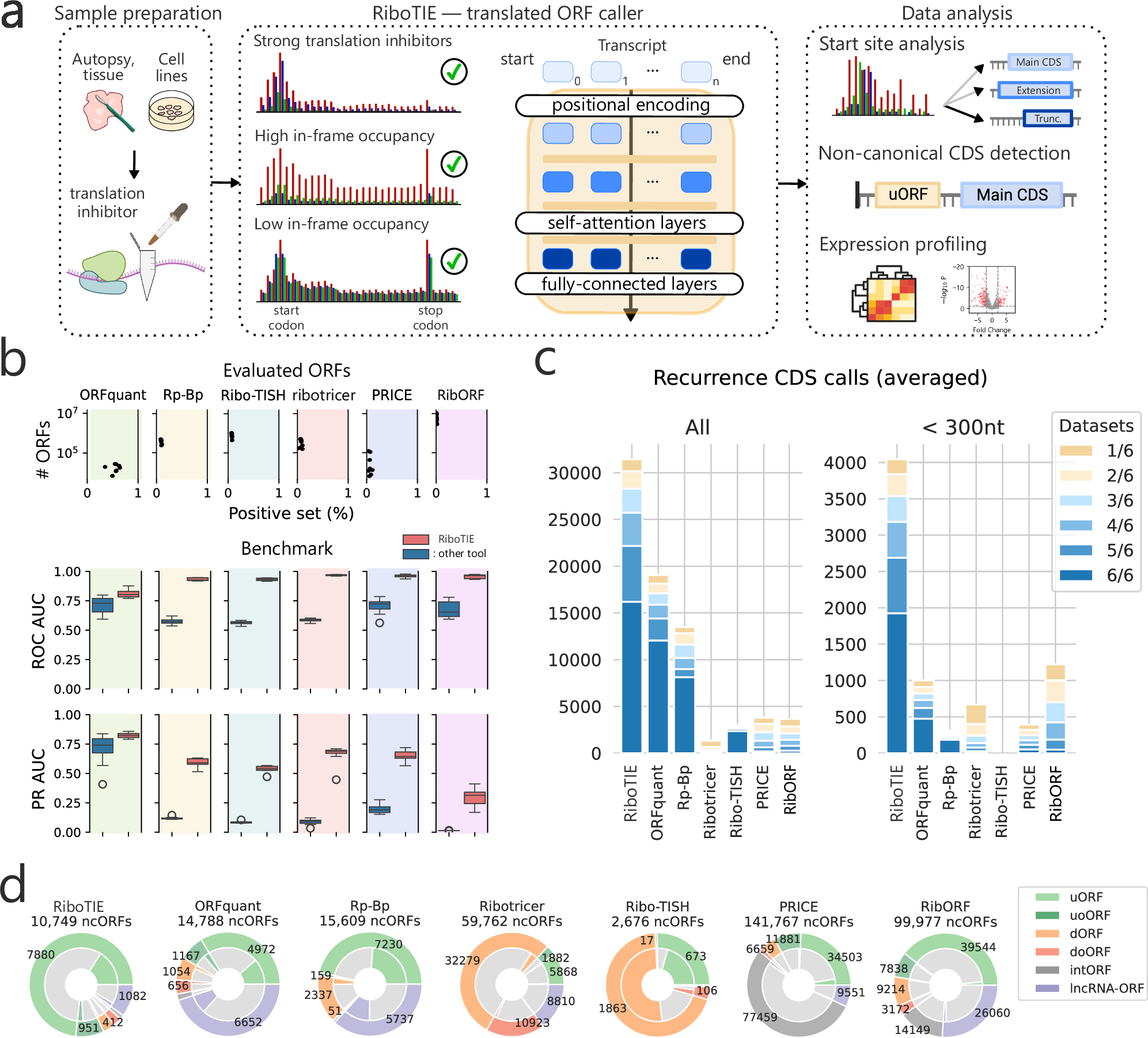
a Schematic outlining RiboTIE’s function for the analysis of translated products (CDS coding sequence, uORF upstream open reading frame). (left) RiboTIE has been tested on Ribo-Seq from various cell types and translation inhibitors, where (middle) transformer models processing read counts aligned to transcripts are capable of leveraging information from both data with low and high in-frame read occupancy. (right) RiboTIE can be applied for a variety of studies, including start site analysis, detection of ncORFs, and expression profiling. b Benchmarking analyses featuring eight datasets. RiboTIE is compared with six other tools for translated ORF delineation from ribosome profiling. Precision recall (PR) or Receiver Operator Characteristic (ROC) Area Under the Curve (AUC) scores are compared on ORF libraries that are generated by and unique to each tool. Data in box plots show the median (line), 25th to 75th percentiles (box), and 1.5 times interquartile range (whiskers). c A stacked barplot that reflects the number of called annotated CDSs (left, all; right, <300 nt) for each ORF caller tool for six replicate samples of pancreatic progenitor cells, the fraction of CDSs that are found in a certain number of replicates is represented as well. d The total number of non-canonical ORFs (ncORFs) and each type of ncORFs called by each tool combining all predictions on the six replicate samples of pancreatic progenitor cells. The inner fractions represent ncORFs present in >4 datasets.RiboTIE is different because it uses a transformer model, a type of machine learning technology, to analyze raw Ribo-Seq data more accurately. This advanced approach allows scientists to detect translated ORFs with higher precision and sensitivity than older methods. The researchers tested RiboTIE on multiple datasets, including samples from healthy brains and medulloblastoma, a type of brain cancer. The tool not only confirmed previously known findings but also uncovered new insights into how RNA translation is regulated in both normal and diseased cells.
By improving the accuracy of Ribo-Seq analysis, RiboTIE has the potential to deepen our understanding of protein synthesis and its role in diseases like cancer. This could help researchers identify new therapeutic targets or better understand how cells function under different conditions. As the study suggests, RiboTIE is a powerful and versatile tool that could advance RNA translation research in many exciting ways.
Availability – RiboTIE (https://doi.org/10.5281/zenodo.10689717) is implemented in Python and is available through GitHub (https://github.com/TRISTAN-ORF/RiboTIE) and PyPI (https://pypi.org/project/transcript-transformer/).
Clauwaert J, McVey Z, Gupta R, Yannuzzi I, Basrur V, Nesvizhskii AI, Menschaert G, Prensner JR. (2025) Deep learning to decode sites of RNA translation in normal and cancerous tissues. Nat Commun 16(1):1275. [article]
Related Posts






RNA translation is one of the most essential processes in biology—it’s how our cells take the genetic instructions in RNA and use them to build proteins. This process is crucial for life and plays a major role in human health, including diseases like cancer. However, studying RNA translation in detail has been challenging due to its complexity and technical limitations.
To tackle this problem, researchers at the University of Michigan have developed RiboTIE, a new tool that uses artificial intelligence to improve the analysis of ribosome profiling data. Ribosome profiling, or Ribo-Seq, is a technique that allows scientists to see exactly which parts of RNA are being translated into proteins. However, existing methods can miss important details or produce errors when detecting open reading frames (ORFs)—the specific sections of RNA that the ribosome translates into proteins.
RiboTIE combines flexibility and performance for the detection of RNA translation in Ribo-Seq data
a Schematic outlining RiboTIE’s function for the analysis of translated products (CDS coding sequence, uORF upstream open reading frame). (left) RiboTIE has been tested on Ribo-Seq from various cell types and translation inhibitors, where (middle) transformer models processing read counts aligned to transcripts are capable of leveraging information from both data with low and high in-frame read occupancy. (right) RiboTIE can be applied for a variety of studies, including start site analysis, detection of ncORFs, and expression profiling. b Benchmarking analyses featuring eight datasets. RiboTIE is compared with six other tools for translated ORF delineation from ribosome profiling. Precision recall (PR) or Receiver Operator Characteristic (ROC) Area Under the Curve (AUC) scores are compared on ORF libraries that are generated by and unique to each tool. Data in box plots show the median (line), 25th to 75th percentiles (box), and 1.5 times interquartile range (whiskers). c A stacked barplot that reflects the number of called annotated CDSs (left, all; right, <300 nt) for each ORF caller tool for six replicate samples of pancreatic progenitor cells, the fraction of CDSs that are found in a certain number of replicates is represented as well. d The total number of non-canonical ORFs (ncORFs) and each type of ncORFs called by each tool combining all predictions on the six replicate samples of pancreatic progenitor cells. The inner fractions represent ncORFs present in >4 datasets.RiboTIE is different because it uses a transformer model, a type of machine learning technology, to analyze raw Ribo-Seq data more accurately. This advanced approach allows scientists to detect translated ORFs with higher precision and sensitivity than older methods. The researchers tested RiboTIE on multiple datasets, including samples from healthy brains and medulloblastoma, a type of brain cancer. The tool not only confirmed previously known findings but also uncovered new insights into how RNA translation is regulated in both normal and diseased cells.
By improving the accuracy of Ribo-Seq analysis, RiboTIE has the potential to deepen our understanding of protein synthesis and its role in diseases like cancer. This could help researchers identify new therapeutic targets or better understand how cells function under different conditions. As the study suggests, RiboTIE is a powerful and versatile tool that could advance RNA translation research in many exciting ways.
Availability – RiboTIE (https://doi.org/10.5281/zenodo.10689717) is implemented in Python and is available through GitHub (https://github.com/TRISTAN-ORF/RiboTIE) and PyPI (https://pypi.org/project/transcript-transformer/).
Clauwaert J, McVey Z, Gupta R, Yannuzzi I, Basrur V, Nesvizhskii AI, Menschaert G, Prensner JR. (2025) Deep learning to decode sites of RNA translation in normal and cancerous tissues. Nat Commun 16(1):1275. [article]
Related Posts
Recent Posts
 Scientists identify the neuroblastoma cells that signal poor outcomes
 GARAGE improves rare cell detection in single-cell RNA sequencing analysis using AI
 Machine learning reveals how RNA splicing is regulated in individual cell types
 Illumina releases SpliceAI2 to help advance rare disease research
 Postdoctoral Fellow – Long-Read RNA Methods Development for Neurodegeneration
 Novel biosensor uses DNA ‘barcodes’ to uncover disease signals in cells
RNA-Seq Products & Services


Stay Connected