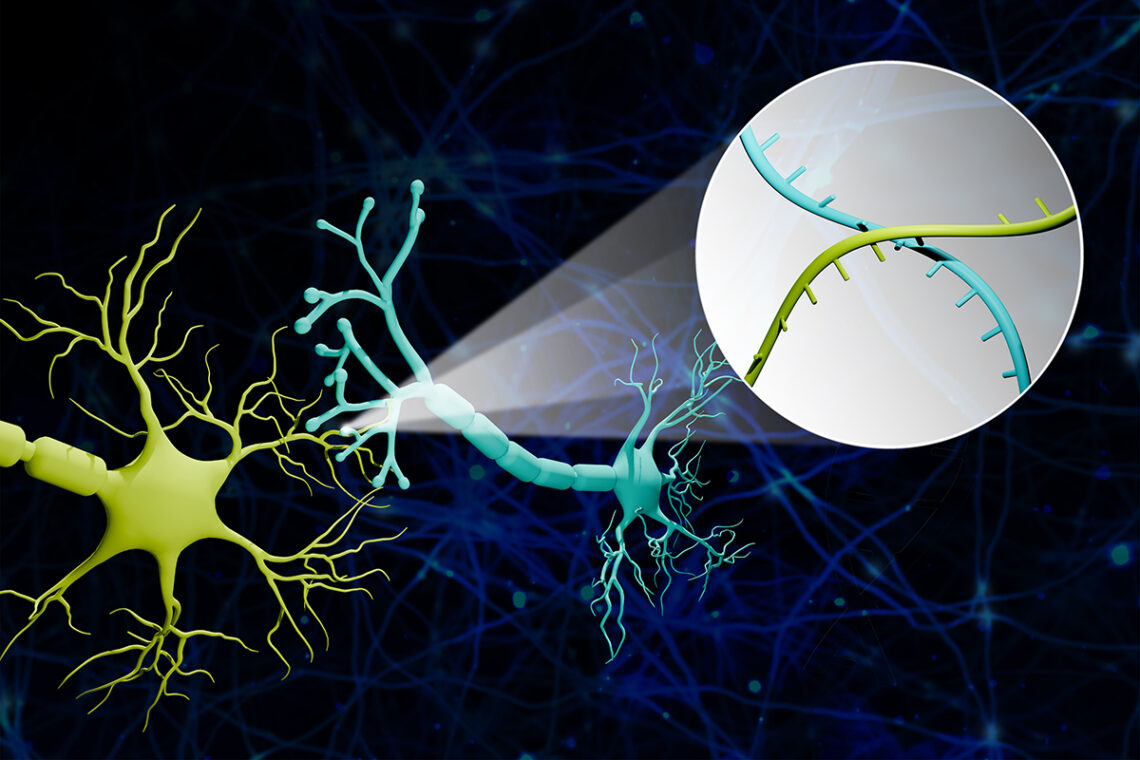
Comingling RNA barcodes, each correlating to a neuron, indicate where neurons connect in the brain, letting researchers map neural connection with speed, scale and resolution. Graphic by Michael Vincent.
By tagging neurons with molecular “barcodes,” researchers mapped connections among thousands of neurons in the mouse brain with unprecedented speed and resolution.
The approach could expand understanding not only of the layout of elaborate networks in the brain, but also how the brain functions, what happens when there is dysfunction and how neurodegenerative diseases progress.
“When engineering a computer, you need to know the circuitry of the central processing unit. If you don’t know how everything is wired together, you can’t understand its function, optimize it or fix it when something breaks. We are approaching the brain the same way,” said study leader Boxuan Zhao, a professor of cell and developmental biology at the University of Illinois Urbana-Champaign.
“Our technology enables simultaneous mapping of thousands of neural connections with single-synapse resolution — a capability that doesn’t exist in any current technology. It is directly applicable to understanding circuit dysfunction in neurodegenerative diseases and could provide a platform for developing circuit-guided therapeutic interventions,” he said.
Traditionally, brain mapping has been a long, laborious process involving cutting the brain into very thin slices, imaging with different types of microscopes and trying to reconstruct neural pathways. Newer sequencing-based techniques can label thousands of neurons at once, but most trace only where a neuron reaches to — not which specific partner it connects with at the synapse, Zhao said.
Zhao’s group developed a platform, Connectome-seq, that uses RNA “barcodes” to tag each neuron. Specialized proteins carry the RNA barcodes from the neuron’s cell body and anchor them at the synapse, the junction between two neurons. The researchers then isolate the synaptic junctions and use high-throughput sequencing to read out which pairs of RNA barcodes ended up together, revealing which neurons are connected at large scale.
“We translated the neural connectivity problem into a sequencing problem. Imagine a big bunch of balloons. The main body of each balloon has its unique barcode stickers all over it, and some move down to the end of the string. If two balloons are tied together at the end, the two barcodes meet at the junction,” Zhao said. “Then we snip out the knots and sequence the barcodes in each one. If the same knot has stickers from balloon A and balloon B, we know these two balloons are tied together. We are doing this in the brain, just on the level of thousands of neuron cells. With this information, we can reconstruct a sophisticated map that represents the connections among all these seemingly floaty groups.”
The researchers used Connectome-seq to map more than 1,000 neurons in a mouse brain circuit called the pontocerebellar circuit, which connects two different regions of the brain. They revealed previously unknown connectivity patterns, including connections between cell types that were not previously known to be directly wired together in the adult brain.
“With improvements already underway in our lab, we are confident that we can make it even better and eventually reach the goal of mapping the whole mouse brain,” Zhao said.
Due to its speed and ability to map large areas, Connectome-seq has potential to accelerate research into neurodegenerative conditions, psychiatric disorders and other neurological conditions, Zhao said, by enabling comparison between connections in healthy brains and brains at different stages of disease.
“With sequencing-based approaches, the time and cost are greatly reduced, which really makes it possible to see differences in different brains. We could see where connections change, where the most vulnerable parts of the brain are, perhaps before symptoms even appear,” Zhao said. “For example, if we can catch where exactly the weak link is that kick starts the whole catastrophic cascade in Alzheimer’s disease, can we specifically strengthen those connections to where the disease slows or does not progress?”
Source – University of Illinois Urbana-Champaign
Availability – Code supporting the current study is available via Github at https://www.github.com/BoxuanZhaoLab/connectome-seq-code and is released under the MIT license.


Comingling RNA barcodes, each correlating to a neuron, indicate where neurons connect in the brain, letting researchers map neural connection with speed, scale and resolution. Graphic by Michael Vincent.
By tagging neurons with molecular “barcodes,” researchers mapped connections among thousands of neurons in the mouse brain with unprecedented speed and resolution.
The approach could expand understanding not only of the layout of elaborate networks in the brain, but also how the brain functions, what happens when there is dysfunction and how neurodegenerative diseases progress.
Traditionally, brain mapping has been a long, laborious process involving cutting the brain into very thin slices, imaging with different types of microscopes and trying to reconstruct neural pathways. Newer sequencing-based techniques can label thousands of neurons at once, but most trace only where a neuron reaches to — not which specific partner it connects with at the synapse, Zhao said.
Zhao’s group developed a platform, Connectome-seq, that uses RNA “barcodes” to tag each neuron. Specialized proteins carry the RNA barcodes from the neuron’s cell body and anchor them at the synapse, the junction between two neurons. The researchers then isolate the synaptic junctions and use high-throughput sequencing to read out which pairs of RNA barcodes ended up together, revealing which neurons are connected at large scale.
The researchers used Connectome-seq to map more than 1,000 neurons in a mouse brain circuit called the pontocerebellar circuit, which connects two different regions of the brain. They revealed previously unknown connectivity patterns, including connections between cell types that were not previously known to be directly wired together in the adult brain.
Due to its speed and ability to map large areas, Connectome-seq has potential to accelerate research into neurodegenerative conditions, psychiatric disorders and other neurological conditions, Zhao said, by enabling comparison between connections in healthy brains and brains at different stages of disease.
Source – University of Illinois Urbana-Champaign
Availability – Code supporting the current study is available via Github at https://www.github.com/BoxuanZhaoLab/connectome-seq-code and is released under the MIT license.
Chen D, Isakova A, Wan Z J, Wagner M J, Wu Y, Zhao B S. (2025) Connectome-seq: High-throughput Mapping of Neuronal Connectivity at Single-Synapse Resolution via Barcode Sequencing. Nature Methods [Epub ahead of print]. [article]
Related Posts
Scientists identify the neuroblastoma cells that signal poor outcomes
Novel biosensor uses DNA ‘barcodes’ to uncover disease signals in cells
CellART extracts single-cell information from high-resolution spatial transcriptomics
Cell2space restores spatial context to single-cell RNA sequencing data
Urine test may improve bladder cancer diagnosis and guide treatment decisions
DeCoRE – a computational method to resolve RNA structural heterogeneity from RNA structure probing data by direct RNA sequencing
Tracing 700 million years of cell evolution
How should biological replicates be handled in long-read RNA sequencing?
RNA-Seq reveals a new way the developing heart controls its growth
The Human RNome Project Consortium seeks to publish first-ever complete sequence of the body’s RNA
scFlowReport brings multiple single-cell RNA sequencing analyses into one workflow
Long-read RNA sequencing reveals how neurons choose alternative RNA endings
DeOPUS improves cell-type estimates from bulk RNA sequencing
ResolVI improves accuracy in spatial transcriptomics analysis
RNA sequencing reveals transcriptional allele differences in prostate cancer stem cells
Unmasking “zombie cells” in aging tissue with an AI-powered barcode
Single-cell TimeLapse-seq reveals MTA is an essential retrotransposon
RNA variant imaging for cancer diagnosis
Autism-risk mutations reveal two opposing patterns of brain gene activity
A real-data approach to evaluating RNA transcript analysis methods
Stay Connected
Submit a Post to the Blog
Recent Posts
Subscribe to the RNA-Seq Blog
RNA-Seq Products & Services