

As genetic testing becomes more common in medical care, doctors are increasingly faced with interpreting results that are not always clear. Some genetic changes, called variants of uncertain significance, do not have obvious effects, making it difficult to know whether they cause disease or not.
One key way to better understand these variants is by looking at how they affect RNA splicing, a process that helps turn genes into the final instructions for making proteins. Disruptions in splicing can lead to faulty proteins and disease. However, RNA analysis is not yet routinely used in clinical diagnostics, despite its potential to provide crucial information.
To address this, a team led by experts at INSERM in France came together to provide updated guidelines for using RNA-based approaches in genetic testing. The group emphasized that analyzing RNA directly, using tools like RNA sequencing, can help determine how genetic variants affect splicing and gene function. This can improve diagnosis and guide treatment decisions.
Their guidance aims to help genetic labs adopt RNA-based diagnostics more widely, bringing more clarity to challenging cases and improving care for patients with rare or unclear genetic disorders.
Decision tree and classification options based on RNA analyses
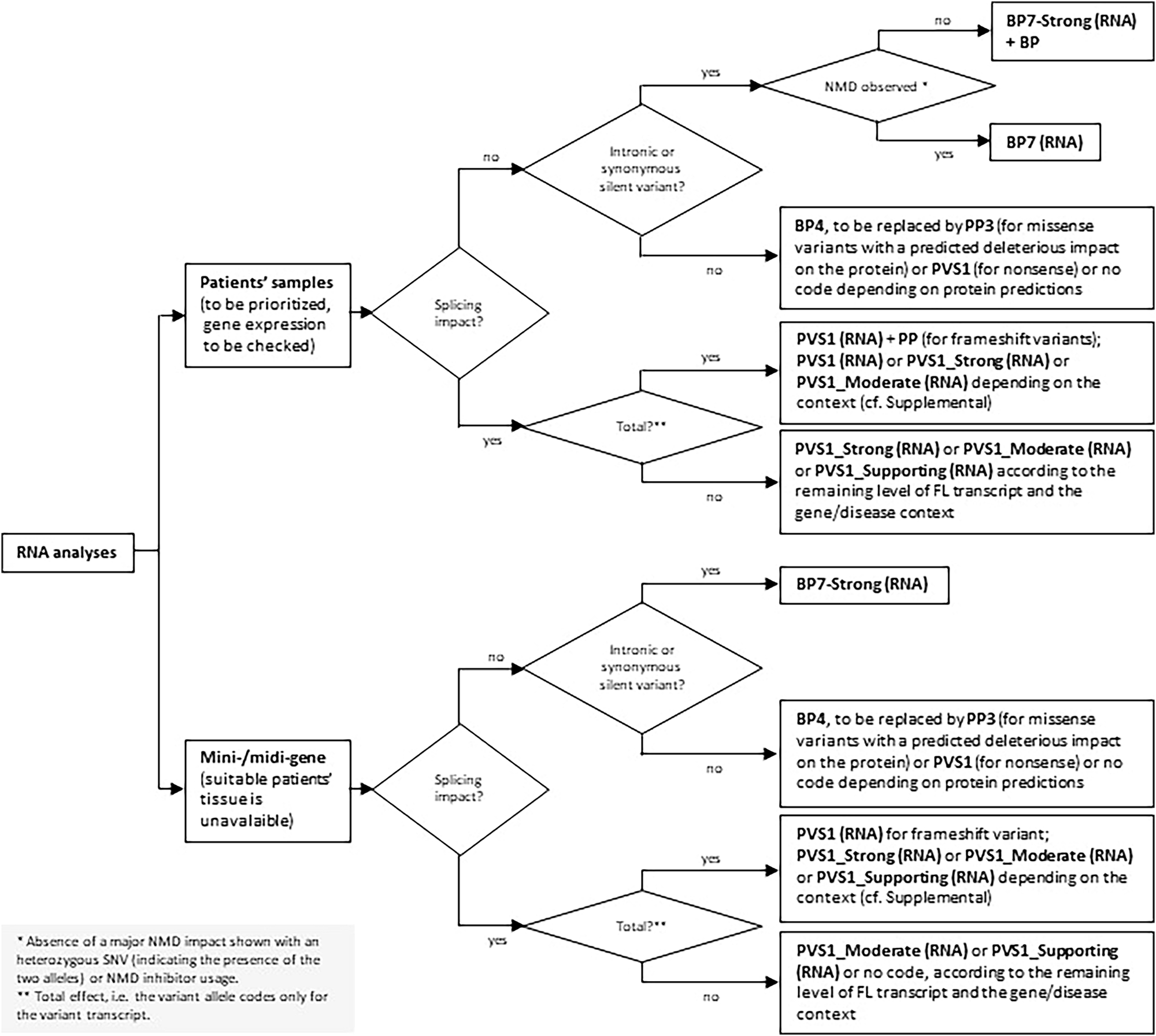
The PVS1 code is only valid for genes with a well-established “gene-disease” link, and for which loss of function is a known pathogenic mechanism. PVS1 should not be used in combination with PP3. The weight of the PVS1 code should be modulated according to context: altered region forming part of the physiological transcript and known to be critical for protein function or of unknown role; NMD predicted or not; possible use of a cryptic splice site, existence of alternative transcript(s) likely to exert rescue. PVS1 (RNA) for mini/midi genes studies should only be used for constructs validated for the exon of interest as some exons may be under or overexpressed depending on the construct used. Evidence weighting should be used when good practices are met.
Buisine M, Bellanne-Chantelot C, Calmels N, Vaché C, Besnard T, Cogne B, Vitobello A, Piton A, Martins A, Gaildrat P, Dhaenens C, Gorokhova S, Boutry-Kryza N, Caputo S, Leman R, Krieger S, Le Gac G, Houdayer C. (2025) RNA-based diagnostic studies in genetics: Review and guidance from a multidisciplinary French network. Eur J Hum Genet [Epub ahead of print]. [article]
Related Posts


As genetic testing becomes more common in medical care, doctors are increasingly faced with interpreting results that are not always clear. Some genetic changes, called variants of uncertain significance, do not have obvious effects, making it difficult to know whether they cause disease or not.
One key way to better understand these variants is by looking at how they affect RNA splicing, a process that helps turn genes into the final instructions for making proteins. Disruptions in splicing can lead to faulty proteins and disease. However, RNA analysis is not yet routinely used in clinical diagnostics, despite its potential to provide crucial information.
To address this, a team led by experts at INSERM in France came together to provide updated guidelines for using RNA-based approaches in genetic testing. The group emphasized that analyzing RNA directly, using tools like RNA sequencing, can help determine how genetic variants affect splicing and gene function. This can improve diagnosis and guide treatment decisions.
Their guidance aims to help genetic labs adopt RNA-based diagnostics more widely, bringing more clarity to challenging cases and improving care for patients with rare or unclear genetic disorders.
Decision tree and classification options based on RNA analyses
The PVS1 code is only valid for genes with a well-established “gene-disease” link, and for which loss of function is a known pathogenic mechanism. PVS1 should not be used in combination with PP3. The weight of the PVS1 code should be modulated according to context: altered region forming part of the physiological transcript and known to be critical for protein function or of unknown role; NMD predicted or not; possible use of a cryptic splice site, existence of alternative transcript(s) likely to exert rescue. PVS1 (RNA) for mini/midi genes studies should only be used for constructs validated for the exon of interest as some exons may be under or overexpressed depending on the construct used. Evidence weighting should be used when good practices are met.
Buisine M, Bellanne-Chantelot C, Calmels N, Vaché C, Besnard T, Cogne B, Vitobello A, Piton A, Martins A, Gaildrat P, Dhaenens C, Gorokhova S, Boutry-Kryza N, Caputo S, Leman R, Krieger S, Le Gac G, Houdayer C. (2025) RNA-based diagnostic studies in genetics: Review and guidance from a multidisciplinary French network. Eur J Hum Genet [Epub ahead of print]. [article]
Related Posts
Recent Posts
 Scientists identify the neuroblastoma cells that signal poor outcomes
 GARAGE improves rare cell detection in single-cell RNA sequencing analysis using AI
 Machine learning reveals how RNA splicing is regulated in individual cell types
 Illumina releases SpliceAI2 to help advance rare disease research
 Postdoctoral Fellow – Long-Read RNA Methods Development for Neurodegeneration
 Novel biosensor uses DNA ‘barcodes’ to uncover disease signals in cells
RNA-Seq Products & Services



Stay Connected