Led by first author Hyejin Mun from the University of Oklahoma, with corresponding authors Je-Hyun Yoon from the University of Oklahoma and Young-Kook Kim from Chonnam National University Medical School, the study profiles mitochondrial circular RNAs in Peripheral Blood Mononuclear Cells (PBMCs) from young and old human cohorts and probes how mitochondrial circRNAs and the mitochondrial RNA-binding protein GRSF1 relate to mitochondrial metabolism and cellular senescence.
“Here, we report profiles of circular RNAs annotated to mitochondrial chromosome, chrM, in young and old cohorts.”
Using total RNA sequencing of PBMCs from young and old donors and complementary cell-based experiments, the authors report that a large fraction of circular RNA junctions originates from the mitochondrial genome, with MT-RNR2 producing the most abundant circular junctions. They show that circMT-RNR2 levels are depleted in older cohorts and in replicative senescence of human fibroblasts, and that the mitochondria-localized RNA-binding protein GRSF1 interacts with both linear and circular MT-RNR2. Loss of GRSF1 reduced circMT-RNR2 levels, decreased mitochondrial TCA intermediates (fumarate and succinate), and accelerated cellular senescence and mitochondrial dysfunction — findings that link mitochondrial circRNAs to mitochondrial energetics and proliferative status in younger cells.
Mitochondria-localized RNA-binding protein GRSF1 binds transcripts
originated from mitochondrial genome
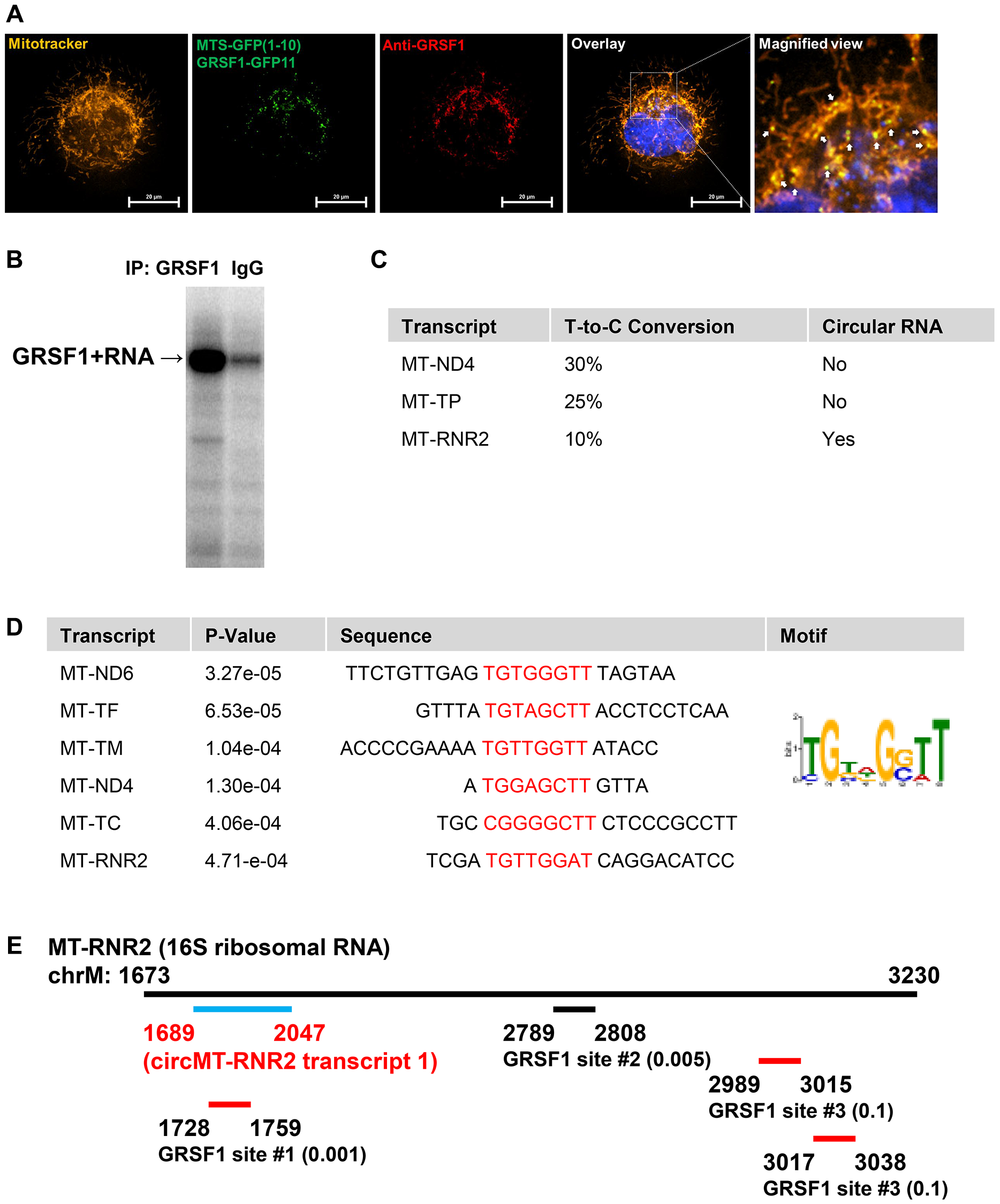
(A) GRSF1-GFP, expressed using the split GFP system (MTS-GFP1–10/GRSF1-GFP11), localizes to mitochondria, as confirmed by co-staining with anti-GRSF1 antibody and MitoTracker. DAPI was used to stain the nucleus. White arrows in the magnified view indicate regions of GRSF1 co-localization within mitochondria. The scale bar represents 20 μm. (B) Autoradiograph of 32P-labeled RNA fragments identified from GRSF1 or IgG immunoprecipitation. (C) Example of GRSF1-bound mitochondrial transcripts with T-to-C conversion ratio and existence of circular RNA. (D) Common RNA-sequences from GRSF1 PAR-CLIP located in mitochondrial transcripts. The sequence motif and p-values are presented from. (E) Location of RNA fragments from GRSF1 PAR-CLIP located in MT-RNR2. T-to-C conversion ratio is denoted next to the coordinates.
“Taken together, our findings demonstrate the existence and possible function of circular MT-RNR2 during human aging and senescence, implicating its role in promoting the TCA cycle.”
The authors note key limitations and outline next steps: clarifying the biogenesis mechanism of mitochondrial circular RNAs (including whether trans-splicing contributes), mapping direct interactions between mitochondrial transcripts and metabolic enzymes, and performing mechanistic studies (in vivo and in additional human cohorts) to test how circMT-RNR2 and GRSF1 influence mitochondrial energetics and organismal aging. These follow-ups will determine whether mitochondrial circular RNAs are actionable targets for modulating mitochondrial metabolism or delaying aspects of cellular aging.
Source – Eurekalert


Led by first author Hyejin Mun from the University of Oklahoma, with corresponding authors Je-Hyun Yoon from the University of Oklahoma and Young-Kook Kim from Chonnam National University Medical School, the study profiles mitochondrial circular RNAs in Peripheral Blood Mononuclear Cells (PBMCs) from young and old human cohorts and probes how mitochondrial circRNAs and the mitochondrial RNA-binding protein GRSF1 relate to mitochondrial metabolism and cellular senescence.
Using total RNA sequencing of PBMCs from young and old donors and complementary cell-based experiments, the authors report that a large fraction of circular RNA junctions originates from the mitochondrial genome, with MT-RNR2 producing the most abundant circular junctions. They show that circMT-RNR2 levels are depleted in older cohorts and in replicative senescence of human fibroblasts, and that the mitochondria-localized RNA-binding protein GRSF1 interacts with both linear and circular MT-RNR2. Loss of GRSF1 reduced circMT-RNR2 levels, decreased mitochondrial TCA intermediates (fumarate and succinate), and accelerated cellular senescence and mitochondrial dysfunction — findings that link mitochondrial circRNAs to mitochondrial energetics and proliferative status in younger cells.
Mitochondria-localized RNA-binding protein GRSF1 binds transcripts
originated from mitochondrial genome
(A) GRSF1-GFP, expressed using the split GFP system (MTS-GFP1–10/GRSF1-GFP11), localizes to mitochondria, as confirmed by co-staining with anti-GRSF1 antibody and MitoTracker. DAPI was used to stain the nucleus. White arrows in the magnified view indicate regions of GRSF1 co-localization within mitochondria. The scale bar represents 20 μm. (B) Autoradiograph of 32P-labeled RNA fragments identified from GRSF1 or IgG immunoprecipitation. (C) Example of GRSF1-bound mitochondrial transcripts with T-to-C conversion ratio and existence of circular RNA. (D) Common RNA-sequences from GRSF1 PAR-CLIP located in mitochondrial transcripts. The sequence motif and p-values are presented from. (E) Location of RNA fragments from GRSF1 PAR-CLIP located in MT-RNR2. T-to-C conversion ratio is denoted next to the coordinates.
The authors note key limitations and outline next steps: clarifying the biogenesis mechanism of mitochondrial circular RNAs (including whether trans-splicing contributes), mapping direct interactions between mitochondrial transcripts and metabolic enzymes, and performing mechanistic studies (in vivo and in additional human cohorts) to test how circMT-RNR2 and GRSF1 influence mitochondrial energetics and organismal aging. These follow-ups will determine whether mitochondrial circular RNAs are actionable targets for modulating mitochondrial metabolism or delaying aspects of cellular aging.
Source – Eurekalert
Mun H, Ham DW, Kim NC, Kwon BI, Kim YK, Yoon JH. (2026) Aging-associated mitochondrial circular RNAs. Aging (Albany NY) 18(1): 30–44. [article]
Related Posts
Scientists identify the neuroblastoma cells that signal poor outcomes
Novel biosensor uses DNA ‘barcodes’ to uncover disease signals in cells
CellART extracts single-cell information from high-resolution spatial transcriptomics
Cell2space restores spatial context to single-cell RNA sequencing data
Urine test may improve bladder cancer diagnosis and guide treatment decisions
DeCoRE – a computational method to resolve RNA structural heterogeneity from RNA structure probing data by direct RNA sequencing
Tracing 700 million years of cell evolution
How should biological replicates be handled in long-read RNA sequencing?
RNA-Seq reveals a new way the developing heart controls its growth
The Human RNome Project Consortium seeks to publish first-ever complete sequence of the body’s RNA
scFlowReport brings multiple single-cell RNA sequencing analyses into one workflow
Long-read RNA sequencing reveals how neurons choose alternative RNA endings
DeOPUS improves cell-type estimates from bulk RNA sequencing
ResolVI improves accuracy in spatial transcriptomics analysis
RNA sequencing reveals transcriptional allele differences in prostate cancer stem cells
Unmasking “zombie cells” in aging tissue with an AI-powered barcode
RNA variant imaging for cancer diagnosis
Autism-risk mutations reveal two opposing patterns of brain gene activity
A real-data approach to evaluating RNA transcript analysis methods
Detection and sequencing of Ap2N-capped RNAs in human cells
Stay Connected
Submit a Post to the Blog
Recent Posts
Subscribe to the RNA-Seq Blog
RNA-Seq Products & Services