Combining angiogenesis inhibitors with immune checkpoint inhibitors shows promise in treating aggressive liver tumors
Hepatocellular carcinoma (HCC), the most common liver cancer, includes aggressive subtypes resistant to treatment. Researchers from Institute of Science Tokyo (Science Tokyo), Japan, identified a key mechanism behind one such subtype and developed a mouse model replicating its characteristics. Their study found that combining angiogenesis inhibitors with immune checkpoint blockers effectively disrupted the tumor’s defenses, enabling immune cells to attack. These findings offer a promising strategy for improving treatments and outcomes for patients with aggressive HCC.
Among the many forms of liver cancer, hepatocellular carcinoma (HCC) is the most common and one of the leading causes of cancer-related deaths worldwide. It is a complex disease with multiple aggressive subtypes that are difficult to treat. One particularly aggressive variant is characterized by tumors that form large trabecular (layered) structures around blood vessels, effectively encapsulating them. This macrotubular (MT)/vascular encapsulation (VE) pattern creates a microenvironment that not only promotes tumor growth but is also immunosuppressive and resistant to standard treatments.
A recent study published online in Hepatology on February 26, 2025, brings new hope. A research team led by Professor Shinji Tanaka, along with Assistant Professor Shu Shimada from Institute of Science Tokyo (Science Tokyo), Japan, found that targeting angiogenesis alongside immune checkpoint blockade can disrupt the tumor’s protective structure, enabling immune cells to infiltrate and attack the cancer.
“Using integrated analysis of large-scale bulk and single-cell RNA-sequencing datasets, we refined the molecular and immunological classification of liver cancer. Utilizing these findings, we developed a syngeneic mouse model of aggressive HCC, which exhibited highly mitotic, tumorigenic, and metastatic abilities with the MT/VE structure contributing to immune evasion,” explains Tanaka.
Targeting Aggressive Hepatocellular Carcinoma: A Combined Anti-Angiogenesis and Immunotherapy Approach
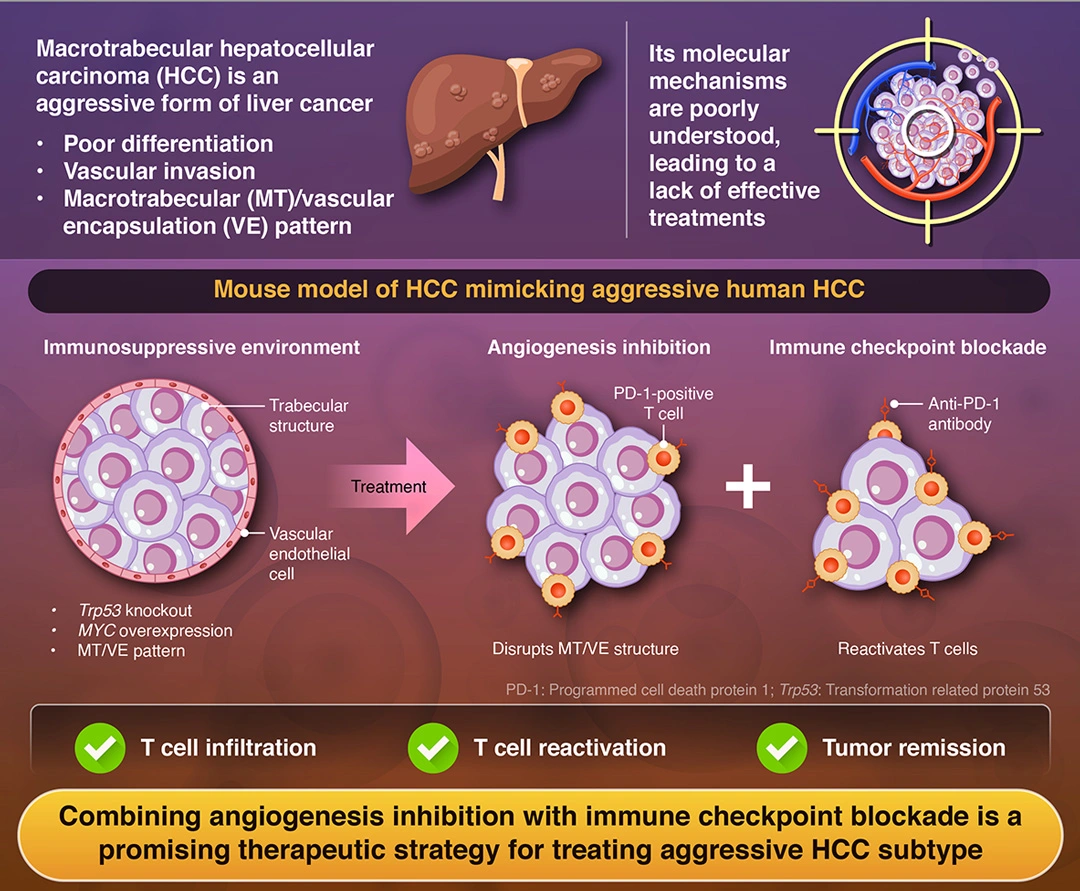
To develop the treatment, the researchers first had to determine why and how these tumors develop and form the MT/VE structure. Cancer cells often exhibit distinct gene expression profiles compared to normal cells, with certain genes being upregulated (overexpressed) or downregulated (underexpressed). Using RNA sequencing, researchers analyze these abnormal patterns to develop targeted therapies that block cancer-promoting processes.
The researchers analyzed over 228,000 individual cells using single-cell RNA sequencing and combined this with data from 691 HCC tumor samples. They found that the aggressive HCC subtype, classified as molecular subtype 1 (MS1), was characterized by a combination of rapidly dividing cells with high mitotic activity and metabolically active cells with elevated glucose metabolism or fat synthesis.
This subtype was characterized by TP53 mutations, overactive MYC signaling, and fewer T cells. TP53 is a gene that encodes the tumor-suppressor protein (p53), which prevents cancer, but mutations disable this function. MYC is an oncogene that drives cell growth and tumor progression, while the low number of T cells weakens the immune system’s ability to fight the tumor. Together, these factors make the cancer more aggressive and harder to treat.
To study potential treatments, the researchers developed a mouse model of HCC that mimicked these characteristics. They injected mice with liver cancer cells lacking the Trp53 gene and overexpressing MYC. These tumors exhibited cellular and histopathological characteristics similar to the MS1 subtype. The mouse model HCC was susceptible to a combination of an angiogenesis inhibitor and an anti-PD-1 antibody, an immune checkpoint inhibitor.
Treatment with angiogenesis inhibitors blocked the formation of new blood vessels, while the immune checkpoint inhibitors reactivated T cells, enabling them to attack the cancerous cells. “For MT/VETC-type liver cancer, combined therapy using potent anti-angiogenic agents and immune checkpoint inhibitors resulted in significant tumor shrinkage, suggesting that this novel therapeutic strategy may be effective,” says Tanaka.
The results of this study offer a promising path toward improving survival and quality of life for patients with this challenging disease.
Source – Institute of Science Tokyo


Combining angiogenesis inhibitors with immune checkpoint inhibitors shows promise in treating aggressive liver tumors
Hepatocellular carcinoma (HCC), the most common liver cancer, includes aggressive subtypes resistant to treatment. Researchers from Institute of Science Tokyo (Science Tokyo), Japan, identified a key mechanism behind one such subtype and developed a mouse model replicating its characteristics. Their study found that combining angiogenesis inhibitors with immune checkpoint blockers effectively disrupted the tumor’s defenses, enabling immune cells to attack. These findings offer a promising strategy for improving treatments and outcomes for patients with aggressive HCC.
Among the many forms of liver cancer, hepatocellular carcinoma (HCC) is the most common and one of the leading causes of cancer-related deaths worldwide. It is a complex disease with multiple aggressive subtypes that are difficult to treat. One particularly aggressive variant is characterized by tumors that form large trabecular (layered) structures around blood vessels, effectively encapsulating them. This macrotubular (MT)/vascular encapsulation (VE) pattern creates a microenvironment that not only promotes tumor growth but is also immunosuppressive and resistant to standard treatments.
A recent study published online in Hepatology on February 26, 2025, brings new hope. A research team led by Professor Shinji Tanaka, along with Assistant Professor Shu Shimada from Institute of Science Tokyo (Science Tokyo), Japan, found that targeting angiogenesis alongside immune checkpoint blockade can disrupt the tumor’s protective structure, enabling immune cells to infiltrate and attack the cancer.
Targeting Aggressive Hepatocellular Carcinoma: A Combined Anti-Angiogenesis and Immunotherapy Approach
To develop the treatment, the researchers first had to determine why and how these tumors develop and form the MT/VE structure. Cancer cells often exhibit distinct gene expression profiles compared to normal cells, with certain genes being upregulated (overexpressed) or downregulated (underexpressed). Using RNA sequencing, researchers analyze these abnormal patterns to develop targeted therapies that block cancer-promoting processes.
The researchers analyzed over 228,000 individual cells using single-cell RNA sequencing and combined this with data from 691 HCC tumor samples. They found that the aggressive HCC subtype, classified as molecular subtype 1 (MS1), was characterized by a combination of rapidly dividing cells with high mitotic activity and metabolically active cells with elevated glucose metabolism or fat synthesis.
This subtype was characterized by TP53 mutations, overactive MYC signaling, and fewer T cells. TP53 is a gene that encodes the tumor-suppressor protein (p53), which prevents cancer, but mutations disable this function. MYC is an oncogene that drives cell growth and tumor progression, while the low number of T cells weakens the immune system’s ability to fight the tumor. Together, these factors make the cancer more aggressive and harder to treat.
To study potential treatments, the researchers developed a mouse model of HCC that mimicked these characteristics. They injected mice with liver cancer cells lacking the Trp53 gene and overexpressing MYC. These tumors exhibited cellular and histopathological characteristics similar to the MS1 subtype. The mouse model HCC was susceptible to a combination of an angiogenesis inhibitor and an anti-PD-1 antibody, an immune checkpoint inhibitor.
Treatment with angiogenesis inhibitors blocked the formation of new blood vessels, while the immune checkpoint inhibitors reactivated T cells, enabling them to attack the cancerous cells. “For MT/VETC-type liver cancer, combined therapy using potent anti-angiogenic agents and immune checkpoint inhibitors resulted in significant tumor shrinkage, suggesting that this novel therapeutic strategy may be effective,” says Tanaka.
The results of this study offer a promising path toward improving survival and quality of life for patients with this challenging disease.
Source – Institute of Science Tokyo
Taniai T, Shimada S, Akiyama Y, Hatano M, Yasukawa K, Igarashi Y, Tsukihara S, Tanji Y, Kodera K, Okazaki K, Haruki K, Nara A, Yagi K, Akahoshi K, Ban D, Asahina Y, Ikegami T, Tanabe M, Tanaka S. (2025) Integrative transcriptome profiling elucidates molecular and immunovascular characteristics of macrotrabecular HCC. Hepatology 00(0): 1-12. [article]
Related Posts
Novel biosensor uses DNA ‘barcodes’ to uncover disease signals in cells
CellART extracts single-cell information from high-resolution spatial transcriptomics
Cell2space restores spatial context to single-cell RNA sequencing data
Urine test may improve bladder cancer diagnosis and guide treatment decisions
DeCoRE – a computational method to resolve RNA structural heterogeneity from RNA structure probing data by direct RNA sequencing
Tracing 700 million years of cell evolution
How should biological replicates be handled in long-read RNA sequencing?
RNA-Seq reveals a new way the developing heart controls its growth
The Human RNome Project Consortium seeks to publish first-ever complete sequence of the body’s RNA
scFlowReport brings multiple single-cell RNA sequencing analyses into one workflow
Long-read RNA sequencing reveals how neurons choose alternative RNA endings
DeOPUS improves cell-type estimates from bulk RNA sequencing
ResolVI improves accuracy in spatial transcriptomics analysis
RNA sequencing reveals transcriptional allele differences in prostate cancer stem cells
Unmasking “zombie cells” in aging tissue with an AI-powered barcode
RNA variant imaging for cancer diagnosis
Autism-risk mutations reveal two opposing patterns of brain gene activity
A real-data approach to evaluating RNA transcript analysis methods
Detection and sequencing of Ap2N-capped RNAs in human cells
Single-cell RNA sequencing provides a closer look at the Aedes aegypti midgut
Stay Connected
Submit a Post to the Blog
Recent Posts
Subscribe to the RNA-Seq Blog
RNA-Seq Products & Services